
Container Requirements and the 4 Bq/cm² Limit for NORM Waste
 October 15, 2026
 10 min read
 DITEC Experts, Radiation Protection Team, ALDuha Institute for Training and Environmental Consulting
One number decides whether the container is washed
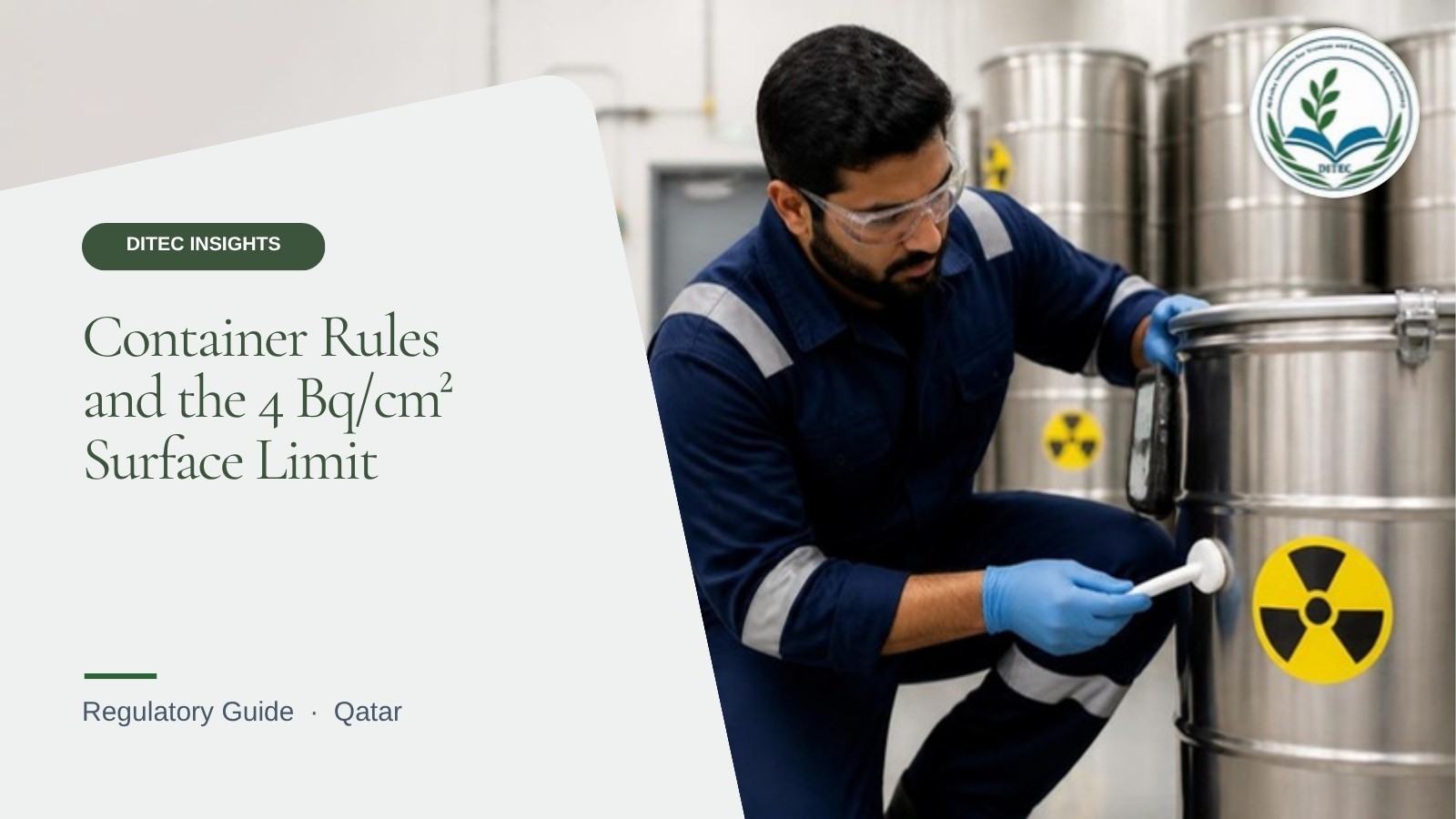
If the surface reading of beta particles and gamma rays on the outside of a NORM waste container is greater than four becquerel per square centimetre, the outside surface is washed with pressurised water until the reading becomes less than four. That is clause 4 of article 8 of the rules attached to Decision 45 of 2013, and the rest of the article is about the container itself. NORM is naturally occurring radioactive material: material in which the concentration of radionuclides has risen because of human activity.
A word first. The becquerel is the unit of radioactive activity, and one becquerel is one disintegration per second. Becquerel per square centimetre is therefore a measure of how much activity sits on each small patch of a surface, not of how much is inside the drum.
The container clauses come after collection in the order of the decision, and that order is the working order too: the material is collected, then it is put into a container, then the container is measured.
What the article is about, in one line
The opening of article 8 states its own subject: what is to be observed when the contaminated material that has been collected is placed in radioactive waste containers.
Three clauses on the container
Clauses 1 and 2 describe the container. Clause 4 describes the measurement on its surface and what follows from it.
Clause 1: condition and strength
The container is in good condition with no clear sign of damage inside or outside. Its material is a durable plastic of a kind that holds the waste adequately through the storage period and stands the work and safe loading and unloading.
The clause gives a purpose for the material and not only a name, and that purpose is the part that a buyer can actually test against a supplier.
Clause 2: the inner surface, and sunlight
The container is made of material whose inner surface does not react with the radioactive waste. It is also able to resist breakdown by ultraviolet light, so that the container does not lose its ability to retain what is inside it.
Ultraviolet light is the part of sunlight that breaks plastic down over time. The clause is therefore about open yards and long months, not about a single lift.
Clause 4: measure, then wash, then measure again
The surface contamination is measured on every container. If the surface activity emitted by beta particles and gamma rays is greater than four becquerel per square centimetre, the outside surface is washed with pressurised water until the surface activity becomes less than four. The clause adds a second route: the drum may be placed inside another drum to reduce the surface activity.
The threshold runs in two directions, and the two directions are two conditions inside one sentence.
The three clauses in rows
Clause | What it requires | What it does not fix
Clause 1 | good condition, no clear damage inside or outside, durable plastic that holds the waste through storage | no volume, no wall thickness, no standard and no inspection interval
Clause 2 | inner surface that does not react with the waste, and resistance to ultraviolet breakdown | no test method and no exposure period
Clause 4 | measurement on every container, washing with pressurised water above the threshold, or a drum inside another drum | no instrument, no interval of re-measurement, and no threshold stated for alpha emitters on the container surface
Two silences in clause 4, said plainly
The first silence is the emitter. The clause names beta particles and gamma rays and names no threshold for alpha emitters on the container surface. We read the clause as it is written and we do not import an alpha figure from another provision and attach it to this one.
The second silence is the value exactly equal to four. The clause triggers washing when the reading is greater than four, and stops the washing when it becomes less than four. A reading sitting exactly on four is in neither condition. We record that and we ask about it, and we do not resolve it by rounding.
A third thing the article does not do
The article does not say what happens if washing and the second drum both fail to bring the reading down. It names the two routes and stops. The practical answer in that case is a question for the Ministry, and we put it in writing.
Three numbers that look alike and govern three different things
A reader who meets four, and then zero point four, and then three point seven in the same decision will suspect a contradiction. There is none. The three belong to three separate subjects, and the honest record keeps the subject beside the number.
The four in article 8 clause 4 is a washing trigger on the outside of a container that is being filled and stored, and it is measured on the surface activity emitted by beta particles and gamma rays without distinguishing fixed from non-fixed contamination. The figures of 0.4 and 0.04 becquerel per square centimetre sit in article 9 clause 1 and are about the non-fixed surface contamination alone in transport, with a separate ceiling on the activity at the surface of the package. Non-fixed contamination is defined in article 1 as contamination that can be transferred spontaneously or removed easily from the contaminated surface during transport in ordinary conditions. The figures of 3.7 and 0.37 becquerel per square centimetre sit in annex 1 and are exemption levels for equipment. Three subjects, three provisions, and no single threshold that answers all of them.
The transport figures are mentioned here only to keep them apart from the container figure. The duties of transport are the subject of their own place in the decision and we build no rule about them here.
Why washing and exemption are not the same question
The clause requires the washing and gives it no purpose. Our reading is that washing changes the outside of a container and not its inside. Exemption is a judgement about the material itself against the levels in annex 1. A washed drum is a clean drum on the outside, and what is inside it is unchanged by the wash. Reading one as the other is the mistake we are guarding against here.
A measurement routine that can be audited
The clause asks for a measurement on every container. The following keeps that auditable, and then one worked case shows the arithmetic.
A caution of our own before the routine. Washing a contaminated surface with pressurised water produces spray that can be breathed in, and return water that is itself contaminated. So the washing is done where the return water is contained, on a lined floor, and with protection for whoever does it. The decision has its own article on decontaminating contaminated equipment, which requires that work to be done by specialists and gives priority to the pressurised water method in a closed circuit. A container falls within the definition of equipment in article 1. The decision does not refer the washing clause to that article, so we take guidance from it and we do not present it as a requirement of the washing clause.
Four items in the container record
One row per container, with its identifier, not one row per batch. The clause says every container.
The reading before washing and the reading after it, each with its date and the name of whoever took it.
Which route was used: pressurised water, or placing the drum inside another drum. The clause offers both and the record should say which one happened.
A note of the emitter measured. The clause is written about beta particles and gamma rays, so a record that says only a number without the emitter is incomplete against its own clause.
A worked case, with our two readings
A drum reads 6.2 becquerel per square centimetre for beta and gamma on its outside surface. Six point two is greater than 4, so the clause requires the outside to be washed with pressurised water. After washing the reading is 4.1. 4.1 is still not less than 4, so the condition for stopping has not been met, and either the washing continues or the drum goes inside another drum.
The drop is 2.1 becquerel per square centimetre, and that subtraction is ours and not a figure in the decision. The clause governs by the two readings and not by the size of the drop.
Frequently asked questions
What exactly triggers washing the drum?
A surface reading of beta particles and gamma rays greater than four becquerel per square centimetre on the outside of the container. The washing is with pressurised water and continues until the reading becomes less than four.
Is there an alpha limit on the container surface?
Clause 4 names beta particles and gamma rays only. We do not supply an alpha figure for the container surface from elsewhere in the decision, and we flag the absence instead.
Can a drum be put inside another drum instead of washing?
The clause names placing the drum in another drum as a way of reducing the surface activity, alongside washing. It does not rank the two, and we do not rank them for it.
Does the four becquerel figure mean the waste is exempt?
No. It is a washing threshold for the outside of a container. The exemption levels are the subject of article 5 and annex 1, and they are measured on the material and not on the outside of a drum.
Who measures the surface activity?
A measurement with a suitable instrument, taken and recorded by a competent person with the date and the emitter. The clause does not name the instrument, and an operator should be able to show how the reading was obtained.
Technical note
Put the subject beside every number you write down. Four on a container surface, zero point four in transport and three point seven in the exemption levels are three different questions, and a bare number in a record invites the wrong one.
Washing is an outside operation. It does not change the activity of the material inside the container, and no record should let a reader think that it did.
Where DITEC stands, and what this text is
ALDuha Institute for Training and Environmental Consulting (DITEC) works in training and consulting only. Building a container register, and training the people who write the readings into it, is training and consulting work. Taking the reading is a measurement. The Institute does not run a laboratory analysis service, does not calibrate instruments and does not test equipment, and field surveys are carried out through specialist partners. Licensed training is what the Institute offers, and nothing in a training programme or in this explanation is an undertaking that a licence will be issued or that it will be issued within any period.
A note on the authority: the text names the Ministry of Environment. Today that competence sits with the Ministry of Environment and Climate Change, Radiation Protection Department. The two questions about the exact value of four and about alpha on the container surface are put to that department. The successor reading is ours and not the wording of the decision, and the original wording is kept inside the quotations in the Arabic text of this article.
This article is an introductory explanation of a published regulatory text and is not a legal opinion.
Quick Actions
Radiation protection programmes for NORM in oil and gasRequest a radiation protection consultationIn this article
Related Blog
Explore more articles in NORM & Oil & Gas

October 15, 2026
NORM Container Labels and the Gamma Spectrometry Sample
Article 8 of Decision 45 of 2013 lists what a NORM container label must state, and sends a sample from every container to gamma spectrometry before it is routed.
Read more
October 15, 2026
Protecting the Worker During NORM Waste Collection
Article 7 of Decision 45 of 2013 asks for bags at the exit, wetting dry material, sealing equipment openings, and a closing sequence after NORM collection work.
Read more
October 15, 2026
Controlling the NORM Waste Collection Site in Qatar
Article 7 of Decision 45 of 2013 asks three things of a NORM collection site in Qatar: a barrier with warning signs, trained workers only, and a plastic floor cover.
Read more