
NORM Container Labels and the Gamma Spectrometry Sample
 October 15, 2026
 10 min read
 DITEC Experts, Radiation Protection Team, ALDuha Institute for Training and Environmental Consulting

What goes on the label, and what decides where the drum goes
Two clauses of article 8 of the rules attached to Decision 45 of 2013 answer two different questions. Clause 3 says what is stuck on the container: the radiation warning signs, and a label carrying clear information about the material. Clause 5 says what decides where the container goes: a sample from every container, measured by a gamma spectrometry analyser, read against the levels in annex 1.
A term first. Gamma spectrometry is a measurement that separates the gamma rays coming out of a sample by their energy, and the energies name the radionuclides present. So the instrument in clause 5 is not a dose meter. It tells you which nuclides are there and at what activity, which is what the annex 1 rows built on named isotopes are read against. The instrument has its limits: alpha emitters are not determined by gamma spectrometry, and some nuclides show only a weak line that needs a particular geometry and calibration. So the instrument alone is not an answer for every row of the annex.
The two clauses together are the paper trail of a drum. One is what a person reads from outside it. The other is what a laboratory reads from inside it. NORM is naturally occurring radioactive material: material in which the concentration of radionuclides has risen because of human activity. Hard scale is a solid crust depositing on the inner surfaces of pipes and equipment, and sludge is a sticky mixture gathering in tanks and separator vessels; both are defined in article 1. Scrap is metal and equipment taken out of service, which article 1 does not define, so that description is ours.
Where the routing decision comes from
Clause 5 names two destinations and attaches them to one test. If the sample is within the levels specified in annex 1, the material may be discharged as industrial waste. If it is not, it is moved to the stores. The test is the annex and not the label.
The label, item by item
Clause 3 asks for two things to be stuck on the container: the radiation warning signs, and labels carrying clear information about the radioactive material. We counted the items of information named in the clause on the text we transcribed. They are seven.
The seven items the clause names
First, what the material is: whether it is sludge, or hard scale, or scrap and the like.
Second and third, the volume of the waste and its weight.
Fourth, the level of radioactive activity per unit of weight.
Fifth and sixth, the party and the location where the radioactive waste was generated.
Seventh, any other information related to its originator. And the wording of the clause is one sentence that carries all seven.
The sample clause
Samples of the naturally occurring radioactive material are taken from every container and measured by a gamma spectrometry analyser. The clause says every container, and it says samples in the plural, and it fixes no number and no weight for them.
Our reading, which we attribute to ourselves, is that the fourth item on the label and the measurement in this clause are the same quantity. The label states the activity per unit of weight, and the analyser produces a figure of that kind. The decision does not join the two clauses in words, and it does not make one follow the other.
The label and the sample in rows
What | Where it comes from | Who produces it
The radiation warning signs and the label | clause 3, stuck on the container | the generator of the waste
The identity of the material, its volume, its weight, the party and the location | clause 3, items one to three and five to six | the yard records and the collection record
The activity per unit of weight | clause 3 item four, and clause 5 is a measurement of the same kind, and the decision does not join them | a gamma spectrometry analyser, operated by a specialist
The destination of the container | clause 5, read against annex 1 | the comparison of the measured level with the annex
What the two clauses leave open
Clause 3 does not fix the language of the label, its size, its material or its place on the container. It asks for clear information and names the items, and it stops there. An operator who prints a label in one language only has made a choice, and we do not call that choice a requirement.
Clause 5 does not name who performs the analysis, nor how often the sampling is repeated, nor the number or the weight of the samples. It names the instrument by its kind and the reference by its place in the decision. We record the silences and we ask about them.
A reference that is not the licence
Clause 5 refers the test to annex 1. The definition of radioactive waste in article 1 refers the concentration to what the competent authority determined in the licence. These are two references and not one, and the decision does not join them. So a drum can be inside the annex levels while the licence figure is a separate document question, and we do not merge the two.
Two provisions, one annex, two words for the outcome
Annex 1 is referred to from two places in this decision. Article 5 refers to it to say when waste is exempt from the application of the provisions of the regulations in force, and when it is not. Clause 5 of article 8 refers to it to decide where a drum goes. The reference is the same and the words of the outcome are different, and that difference is worth keeping in a record.
Article 5 says that where the level is higher than the annex levels the waste is considered radioactive contaminants, and that it must then be collected, transported, stored and disposed of under these rules. Clause 5 of article 8 says that where the sample is not within the annex levels the container is moved to the stores. One is a legal characterisation and the other is a movement instruction, and we report each in its own words.
The annex row this explanation does not use
Annex 1 has a row on contaminated gases that reads against the direction of the other rows of the same annex. That row is reserved until the page image is matched against it, so no figure from it appears here. The reservation is stated to the reader rather than hidden.
Filling a label so that it survives an audit
The label is where an inspector starts, so the four habits below matter more than the printing. Then one worked case shows a calculation that is often made and that the clause does not ask for.
Four habits on the label
Use the words of the decision for what the material is: sludge, hard scale, scrap. A local nickname on a label makes the drum unreadable to anyone outside the yard.
Write the volume and the weight as two separate fields, since the clause names them separately.
Write the activity per unit of weight with its unit and with the date of the analysis, so that the figure on the label can be traced to a measurement.
Write the party and the location of generation, not only the yard where the drum is standing now.
A multiplication often made, and not asked for
A drum holds 200 kilograms net of hard scale from oil equipment, and the analysis returns 0.9 becquerel per gram for Ra-226. Annex 1 puts the level for deposits in oil equipment at not exceeding 1.1 becquerel per gram, and 0.9 is below that.
Now the arithmetic that is often done and that the clause does not ask for. 200 kilograms is 200,000 grams, and at 0.9 becquerel per gram the total in the drum is 180,000 becquerel, which is 180 kilobecquerel. That total is our multiplication and it appears nowhere in the decision.
The clause governs by the level per unit of weight and not by the total in the drum. So a bigger drum of the same material does not change the answer, and a record that files the total beside the annex level invites a reader to compare two different quantities.
Frequently asked questions
What has to be written on the container label?
Clear information about the radioactive material: what it is, the volume and weight of the waste, the level of activity per unit of weight, the party and the location where it was generated, and any other information related to its originator. The radiation warning signs are stuck on as well.
Is a sample taken from every drum or from the batch?
The clause says samples are taken from every container. A single sample standing for a batch is not what the clause describes.
What instrument does the clause name?
A gamma spectrometry analyser. The clause names the kind of instrument and does not name a model, a calibration interval or a laboratory.
Where does the drum go after the analysis?
If the sample is within the levels specified in annex 1 it may be discharged as industrial waste, and otherwise it is moved to the stores. Those are the two routes the clause names.
Can we use the total activity in the drum instead of the level per kilogram?
The label item and the annex levels are both expressed per unit of weight. A total for the drum is a different quantity, and comparing a total with a level per unit of weight is a mistake a record should make impossible.
Technical note
A label is a claim and an analysis is its evidence. The fourth item on the label is a figure of the kind the analyser produces, and the decision does not make one follow the other. We recommend, as our own advice, that a label be filled after the analysis, since a label filled before it is a claim with no evidence behind it.
Keep a level and a total in two different fields, with their units written out. The annex speaks in levels per unit of weight, and a total in a drum answers a different question.
Where DITEC stands, and what this text is
ALDuha Institute for Training and Environmental Consulting (DITEC) works in training and consulting only. Designing a label and a container register, and training the people who fill them, is training and consulting work. Gamma spectrometry on a sample is laboratory work. The Institute does not run a laboratory analysis service, does not calibrate instruments and does not test equipment, and field surveys are carried out through specialist partners. Licensed training is what the Institute offers, and nothing in a training programme or in this explanation is an undertaking that a licence will be issued or that it will be issued within any period.
A note on the authority: the text names the Ministry of Environment. Today that competence sits with the Ministry of Environment and Climate Change, Radiation Protection Department. The questions about who performs the analysis and how often a container is re-sampled are put to that department. The successor reading is ours and not the wording of the decision, and the original wording is kept inside the quotations in the Arabic text of this article.
This article is an introductory explanation of a published regulatory text and is not a legal opinion.
Quick Actions
Radiation protection programmes for NORM in oil and gasRequest a radiation protection consultationIn this article
Related Blog
Explore more articles in NORM & Oil & Gas

October 15, 2026
Protecting the Worker During NORM Waste Collection
Article 7 of Decision 45 of 2013 asks for bags at the exit, wetting dry material, sealing equipment openings, and a closing sequence after NORM collection work.
Read more
October 15, 2026
Container Requirements and the 4 Bq/cm² Limit for NORM Waste
Article 8 of Decision 45 of 2013 sets the condition and material of a NORM waste container. A beta and gamma reading above 4 Bq/cm² on its surface means washing.
Read more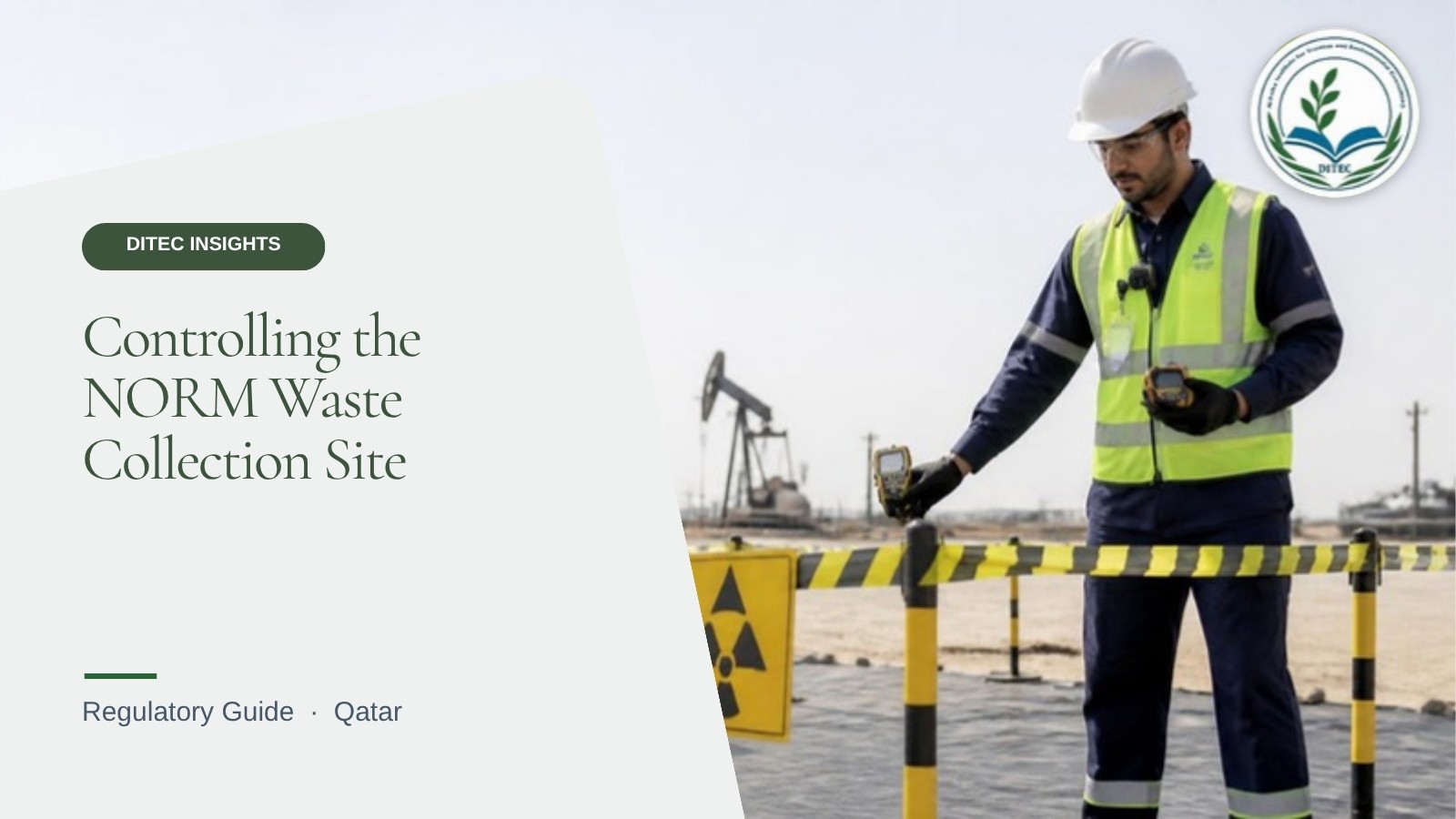
October 15, 2026
Controlling the NORM Waste Collection Site in Qatar
Article 7 of Decision 45 of 2013 asks three things of a NORM collection site in Qatar: a barrier with warning signs, trained workers only, and a plastic floor cover.
Read more