
Protecting the Worker During NORM Waste Collection
 October 15, 2026
 10 min read
 DITEC Experts, Radiation Protection Team, ALDuha Institute for Training and Environmental Consulting
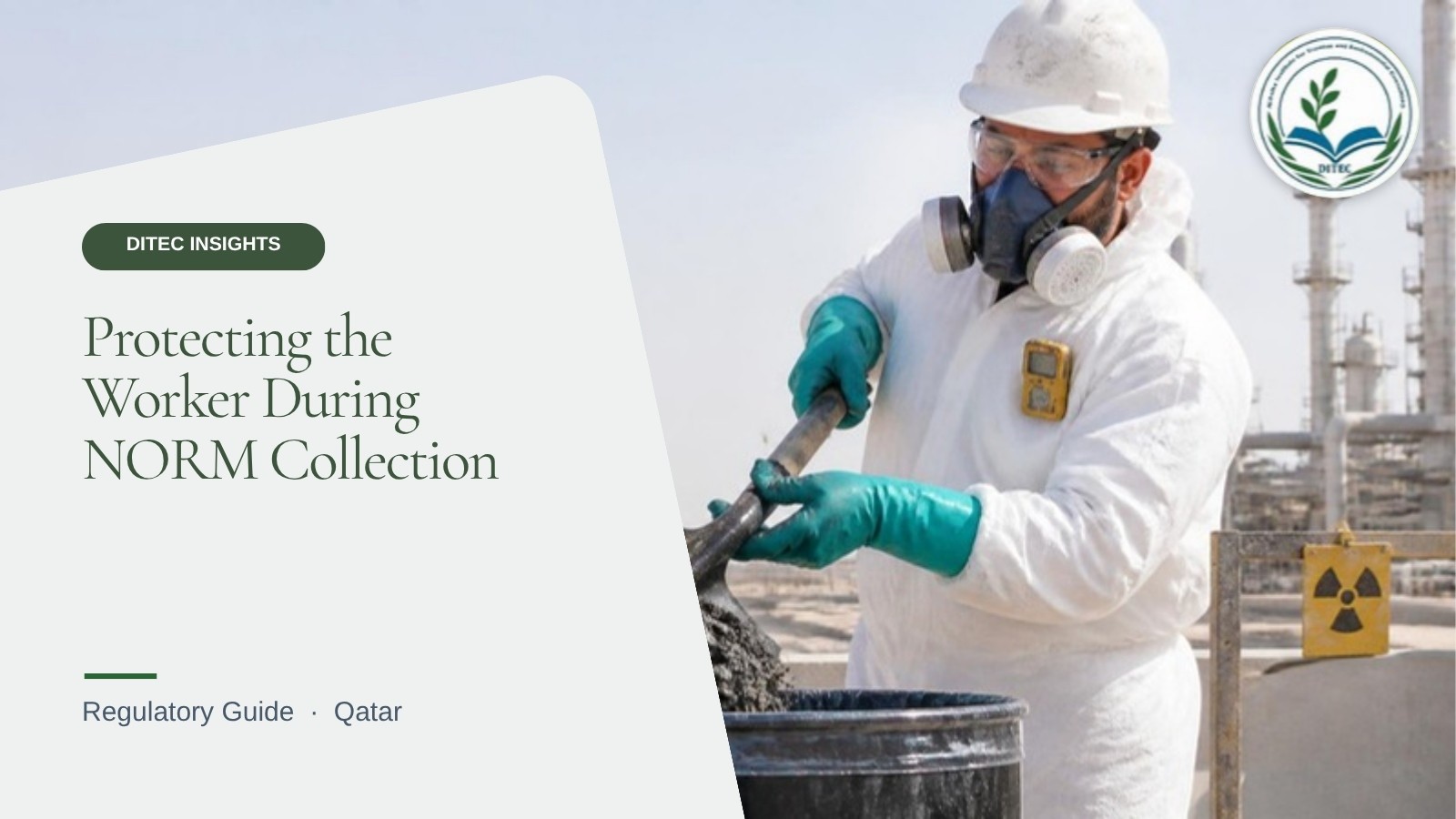
Four clauses about the person, not the place
Four of the seven clauses of article 7 are about the worker and the material in his hands: bags or containers at the exit for protective clothing and contaminated waste, wetting dry contaminated material so that it does not become airborne, sealing the openings of internally contaminated equipment with plastic, and a closing sequence at the end of the work. They are clauses 2, 5, 6 and 7 of the rules attached to Decision 45 of 2013.
One term first. Airborne radioactive material is material that has become dust or droplets in the air, where it can be breathed in. The clause gives a reason for the wetting and gives no reason for choosing water over anything else. Our reading, which we attribute to ourselves, is that wetting is a control on the material before it rises rather than on the worker after it has. NORM is naturally occurring radioactive material: material in which the concentration of radionuclides has risen because of human activity. And wetting reduces airborne material rather than removing it. The clause states that the wetting is repeated periodically and gives no reason for that, and our reading is that the repetition answers the drying. It is not a substitute for the personal protection that a risk assessment calls for.
The decision states a purpose of its own for all of this. Article 2 puts the protection of workers first among its aims.
What the article does not reach
Article 7 names no dose limit for the worker and no personal monitoring. It is written as a set of acts, not as a set of numbers. We say this of article 7 because that is the article we transcribed, and we do not read the silence as an absence of duties elsewhere in Qatari regulation.
The four clauses, clause by clause
Each clause in plain words, in the order of the article, with the operative words of each one.
Clause 2: bags and containers, at the exit
Containers or plastic bags are provided to gather the protective clothing and the contaminated waste on leaving the place of work. The place named is the exit, so the provision is about where the clothing stops rather than about what it is made of.
Clause 5: wetting, once and then periodically
Dry contaminated material is wetted with water to prevent airborne radioactive material from being generated. The clause then adds that the wetting is repeated periodically during the collection work, so it is not a single act at the start.
The word periodically carries no figure in the clause. No interval in minutes or hours is stated, and an operator who fixes one is making a choice that should be written as a choice.
Clause 6: sealing the openings
The openings of equipment that is internally contaminated with naturally occurring radioactive material are closed with a suitable plastic material. The clause states the act and the material, and states neither a time nor a purpose.
Clause 7: a closing sequence in four acts
The clause lists four acts in one sentence and in this order: the contaminated protective clothing is removed after the collection work is finished and before leaving the place of work, the plastic floor is surveyed for radiation, the contamination is removed by ordinary cleaning, and the barrier and the radiation warning signs are taken down.
The order matters in practice. The signs come down last in the sentence, after the survey and the cleaning, and a site that takes the signs down first has not followed the sequence as it is written.
The four clauses in rows
Clause | The act | When | What the text does not fix
Clause 2 | bags or containers for protective clothing and contaminated waste | on leaving the place of work | no size, no colour, no labelling of the bag
Clause 5 | wetting dry contaminated material with water | at the start and periodically during the work | no interval and no quantity of water
Clause 6 | sealing the openings of internally contaminated equipment with suitable plastic | not fixed in the clause | no thickness and no method of sealing
Clause 7 | remove clothing, survey the plastic floor, remove contamination by ordinary cleaning, take down the barrier and signs | after the collection work and before leaving | no instrument for the survey and no acceptance level for the floor
The silences, bounded by what we transcribed
Article 7 contains no figure at all. We counted that on the seven clauses we transcribed letter by letter. So there is no wetting interval, no survey acceptance level for the plastic floor, and no specification for the protective clothing in this article.
The clause on the closing sequence asks for the plastic floor to be surveyed for radiation and the contamination to be removed by ordinary cleaning. It does not say what reading makes the floor acceptable, and it does not say what happens if ordinary cleaning does not remove the contamination. Both are questions we put to the Ministry rather than answer ourselves.
One figure that is not here, and where it is
Dose figures do exist in the decision, in the provision on the temporary store, one for inside the store and one for the ring around it, and they are about that place rather than about the worker at a collection site. The store is treated as a controlled area and the ring as the supervision area, which is the ring around it. Neither term is defined in article 1, so the explanation is ours, and carrying either of them across to the collection work is the error we avoid.
Ordinary cleaning here, and the decontamination methods there
Clause 7 of article 7 uses the words removing the contamination by ordinary cleaning, about the plastic floor at the collection site. The decision has a separate annex of decontamination methods, and the first method in it is named ordinary manual cleaning. The two expressions are close and they are not the same words, and the annex is referred to from the article on decontaminating equipment, not from article 7.
So we do not say that the ordinary cleaning of a plastic sheet at the end of a shift is the annex method. The annex method is described as washing equipment with water and used for removing sand or sludge from devices. The subject there is equipment and the subject here is a floor cover, and we report the difference of wording and we do not call it an error in the text.
Who does the work, in each place
Article 7 requires that no one other than the trained workers works in the collection area. The article on decontaminating contaminated equipment requires that work to be done by specialists. Two different words in two different provisions, and neither of them names a course or a certificate.
A shift that ends the way the clause ends
The closing sequence is the part most often done out of order, so it is worth writing on the wall. Then one worked case with the arithmetic shown.
The closing sequence, in the order of the clause
First, the contaminated protective clothing comes off, after the collection work has finished and before anyone leaves the place of work.
Second, the plastic floor is surveyed for radiation.
Third, the contamination is removed by ordinary cleaning.
Fourth, in the order of the sentence, the barrier and the radiation warning signs are taken down. We recommend, as our own advice, that this be last.
Fifth, a caution of our own. The removal in the clause is for whoever has finished and is leaving. Whoever surveys the plastic floor and cleans it stays in protective clothing, or puts on a clean set, and takes it off at the exit.
A count we make before the shift
A crew of three works two shifts on one piece of equipment, and each worker uses one set of protective clothing per shift. Three workers times two shifts is six contaminated sets, and all six have to be gathered at the exit under clause 2. If the yard has put one bag at the exit for the day, it is holding six sets and the operator should have decided in advance that one bag takes six.
The number six is our arithmetic and not a figure in the decision. The clause requires the bags or containers to be provided and says nothing about how many sets one holds. What the count does is turn a word into a quantity that can be checked before the shift rather than after it.
Frequently asked questions
How often must dry contaminated material be wetted?
The clause says the wetting is also done periodically during the collection work, and it gives no interval. An operator who fixes an interval is making a choice and should record it as one.
Why wet the material at all?
The clause gives its own reason: to prevent airborne radioactive material from being generated. Wet material rises as dust less readily. The wetting reduces the airborne material rather than removing it, and the clause makes it periodic.
Where do the protective clothes go at the end of the shift?
Into the containers or plastic bags provided for gathering protective clothing and contaminated waste on leaving the place of work, and the clothing comes off before anyone leaves.
Can the warning signs come down as soon as the work stops?
In the wording of the clause the barrier and the signs come down after the clothing has been removed, the plastic floor has been surveyed and the contamination has been removed by ordinary cleaning. They are last in the sentence.
Does article 7 set a dose limit for the worker?
No. There is no figure of any kind in the seven clauses we transcribed. A dose figure in this decision belongs to the provision on the temporary store, and it is about that place and not about the person.
Technical note
Water is a control, not housekeeping. Clause 5 ties the wetting to preventing airborne material, so a dry pile that was never wetted is a missed control and not an untidy yard.
Read the sequence as a sequence. The clause puts four acts in one order. We recommend, as our own advice, that the order be followed as the sentence has it.
Where DITEC stands, and what this text is
ALDuha Institute for Training and Environmental Consulting (DITEC) works in training and consulting only. Writing a method statement for a collection shift, and training the crew that will follow it, is training and consulting work. The Institute does not run a laboratory analysis service, does not calibrate instruments and does not test equipment, and field surveys are carried out through specialist partners. Licensed training is what the Institute offers, and nothing in a training programme or in this explanation is an undertaking that a licence will be issued or that it will be issued within any period.
A note on the authority: the text names the Ministry of Environment. Today that competence sits with the Ministry of Environment and Climate Change, Radiation Protection Department. The two questions about the acceptance level for the floor and about ordinary cleaning are put to that department. The successor reading is ours and not the wording of the decision, and the original wording is kept inside the quotations in the Arabic text of this article.
This article is an introductory explanation of a published regulatory text and is not a legal opinion.
Quick Actions
Radiation protection programmes for NORM in oil and gasRequest a radiation protection consultationIn this article
Related Blog
Explore more articles in NORM & Oil & Gas

October 15, 2026
NORM Container Labels and the Gamma Spectrometry Sample
Article 8 of Decision 45 of 2013 lists what a NORM container label must state, and sends a sample from every container to gamma spectrometry before it is routed.
Read more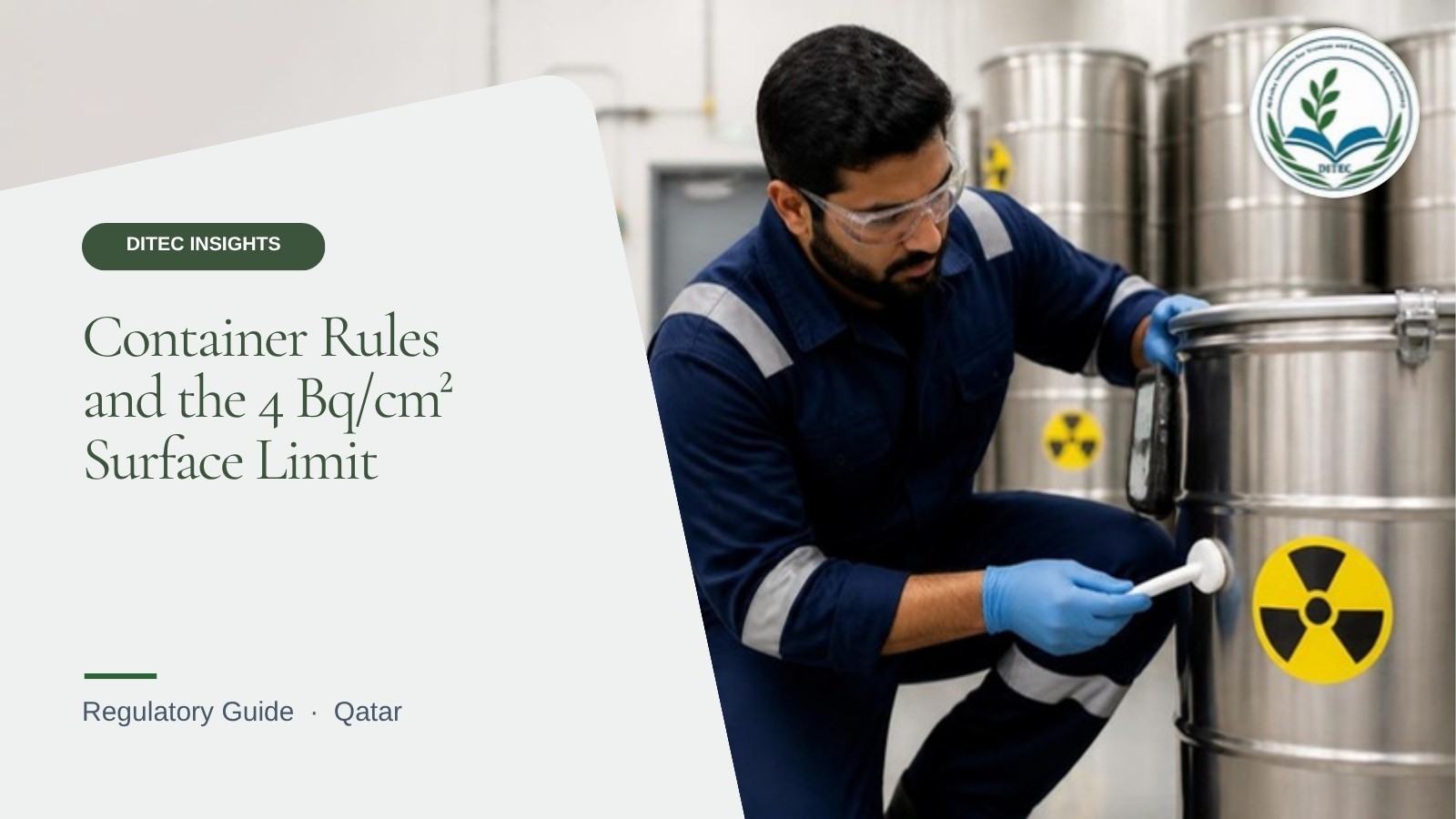
October 15, 2026
Container Requirements and the 4 Bq/cm² Limit for NORM Waste
Article 8 of Decision 45 of 2013 sets the condition and material of a NORM waste container. A beta and gamma reading above 4 Bq/cm² on its surface means washing.
Read more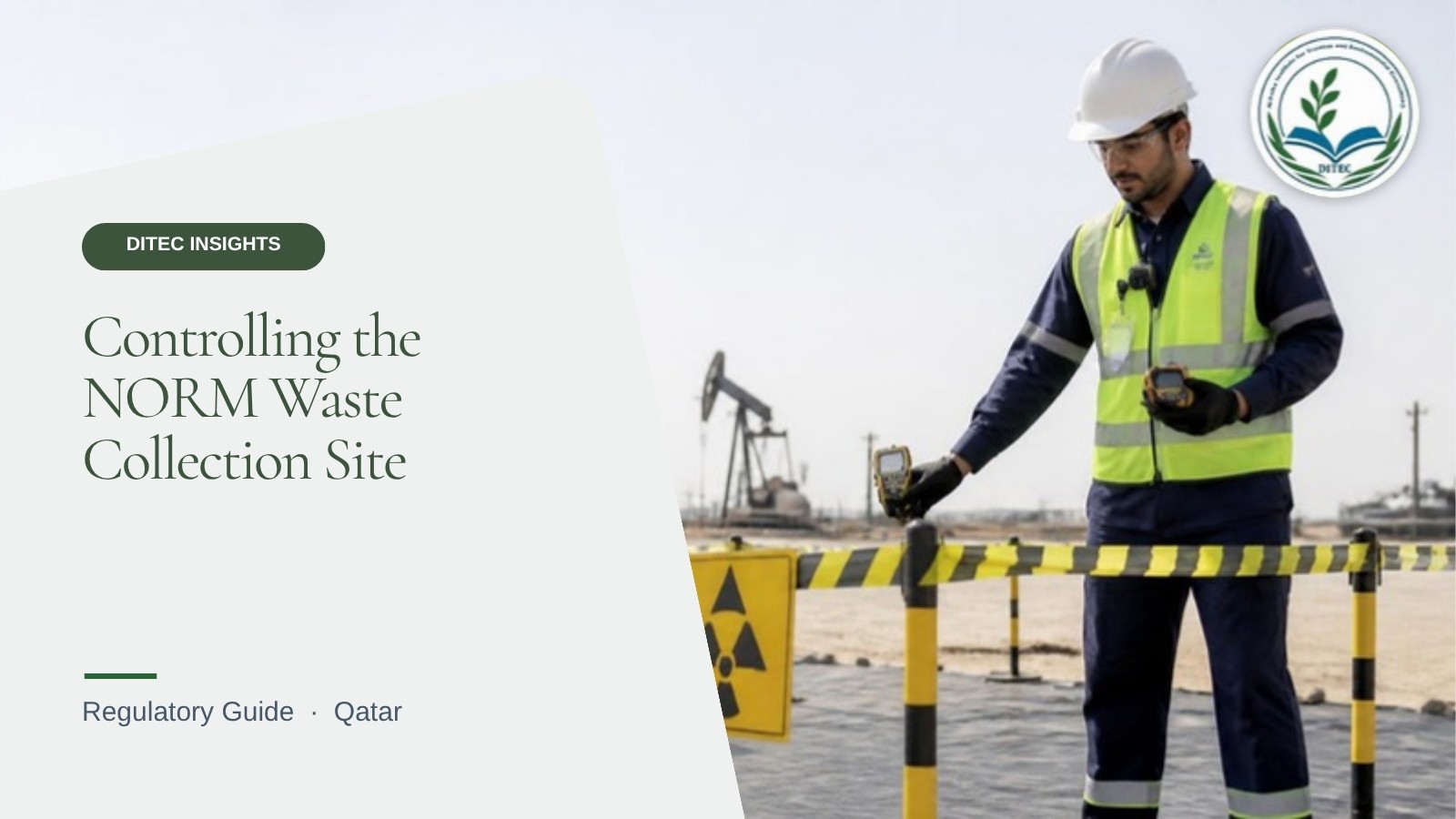
October 15, 2026
Controlling the NORM Waste Collection Site in Qatar
Article 7 of Decision 45 of 2013 asks three things of a NORM collection site in Qatar: a barrier with warning signs, trained workers only, and a plastic floor cover.
Read more