
When Contaminated Equipment Is Exempt Under Qatar NORM Rules
 October 14, 2026
 11 min read
 DITEC Experts, Radiation Protection Team, ALDuha Institute for Training and Environmental Consulting
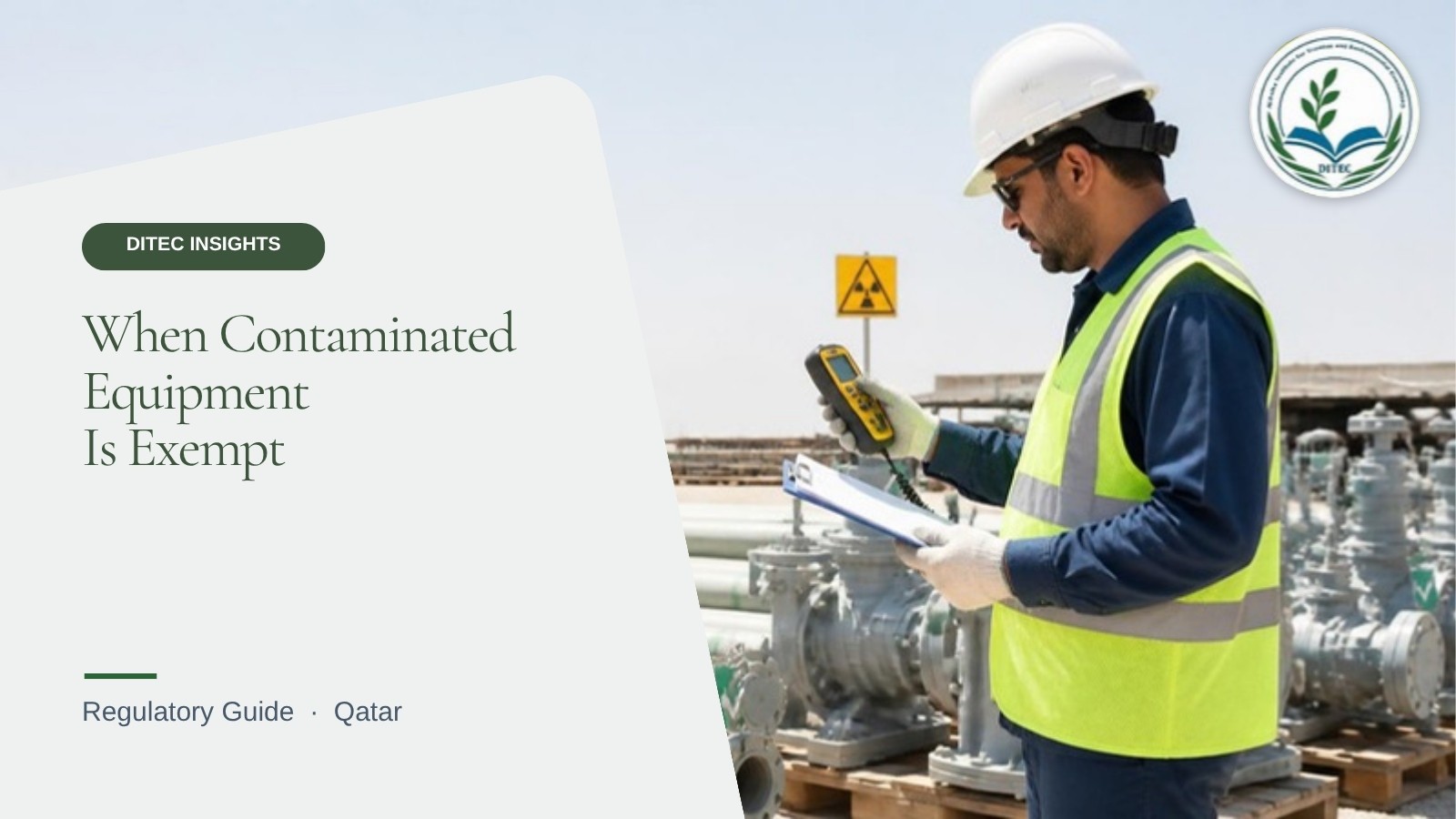
The question an operator asks first
A tube is pulled from a well and a reading appears on its surface. The first question is not what to do with it. It is whether the rules reach it at all. Article 5 of the attached rules answers that with one test: the level of radioactive activity of the radionuclides in the material, measured against the levels in Annex 1.
Three words are worth defining before the figures. A radionuclide is an unstable form of an element that emits radiation as it decays. A becquerel is one decay per second, and the surface figures below are becquerels per square centimetre. A microsievert per hour is a dose rate, that is how much radiation reaches a body in an hour.
Equipment is a defined term in these rules, and the definition is wide: the materials and devices used in the oil and gas industry or in the activities referred to in article 3 of these rules, such as containers, pipes, tanks and the like. So a container, a pipe and a tank are all equipment by the text, and the definition carries the scope article inside it.
One point before the detail. This page explains a published text and what it asks to be measured. What the Ministry decides about a particular facility is for the Ministry, and nothing here is an undertaking about it.
What article 5 says, in two sentences
The first sentence is the exemption: radioactive waste arising from practices subject to licensing and registration is exempt from applying the regulations in force if the level of radioactive activity of the radionuclides in it is lower than the levels specified in Annex 1 attached to these rules. Read it as it is written. The exemption is from applying the regulations in force, and it is not called an exemption from these rules and not an exemption from the licence.
The exemption also carries a condition of application at the head of the sentence: the waste is arising from practices subject to licensing and registration That is a condition and not filler, so it travels with the figure wherever the figure is quoted.
The second sentence is the other side: if the level of radioactive activity of the radionuclides in it is higher than that, it is considered radioactive contaminants, and collecting, transporting, storing and disposing of it in accordance with these rules becomes required. The wording there is contaminants, and we keep that word. We do not write that the material becomes radioactive waste, because radioactive waste is defined in article 1 by the concentration fixed by the competent authority in the licence and that is a different reference from Annex 1. Two thresholds, two references, and joining them in one sentence would be a claim of ours.
The equipment row of Annex 1, and what it does not say
The annex is titled exemption levels for materials and equipment contaminated with naturally occurring radioactive material. and its equipment row reads: radioactive contamination from alpha particle emitters not exceeding 0.37 becquerel per square centimetre for alpha sources and 3.7 becquerel per square centimetre for beta sources, or the radiation dose not exceeding 0.5 microsievert per hour including the radiation background at any accessible point.
One feature of that sentence we record and do not tidy. It opens by naming alpha particle emitters, and then gives two limits, one for alpha and one for beta. So the opening is narrower than what follows it. We transcribe it as it stands and do not reorder a sentence inside a quotation, and where we need the two limits in our own prose we say them in our own words and attribute them to ourselves.
Our reading of the row, attributed to us, is that it offers two independent ways to fall under the level: a surface contamination route with two figures, or a dose rate route with one figure which includes the radiation background and is taken at any accessible point. The word or in the middle of the row is what makes them two routes.
Annex 1 is referred to in two places in the transcribed text, not one: article 5, and item 5 of article 8, which says that a sample is taken from each container and measured by a gamma spectrum analyser, and if it is within the levels specified in Annex 1 attached to these rules it may be discharged as industrial waste, and otherwise it is moved to the stores So anyone who says the annex is cited only in article 5 is wrong, and the second place attaches the same levels to a laboratory result rather than to a surface reading.
The three figures in the equipment row, as we read them
| What is measured | The figure in the text | What is not said |
|---|---|---|
| Alpha sources, surface contamination | 0.37 becquerel per square centimetre | That the same pair of figures elsewhere in the decision carries the same meaning |
| Beta sources, surface contamination | 3.7 becquerel per square centimetre | That a beta probe reading settles an alpha question |
| Dose rate at any accessible point | 0.5 microsievert per hour, including the background | That the background value to subtract is in this decision |
| The type of limit | An exemption level in Annex 1 | That it is the same thing as a transport limit elsewhere |
An exemption level beside a detection threshold
Two provisions in this batch both speak about equipment and they do different work. Article 6 is a detection threshold: it says when equipment counts as contaminated at all. Article 5 with Annex 1 is an exemption level: it says when a material falls below the levels. A reader who mixes them either treats a clean tube as waste or treats a contaminated one as exempt.
The dose figure makes the difference visible. The exemption row names 0.5 microsievert per hour and says expressly that the background is included in it. Article 6 names no figure at all: it names twice the radiation background in the State, and the value of that background is not in this decision. So one of the two can be read from an instrument today, and the other needs a value the Ministry adopts.
What a facility can do with this row
Nothing below creates an exemption and nothing below shortens a procedure. It is the file a facility is asked about.
A worked case, read against the row
A production tube is pulled and surveyed. The surface reading for alpha emitters is 0.2 becquerel per square centimetre. The dose rate at the most accessible point is 0.4 microsievert per hour, with the background included in the reading rather than subtracted from it.
Reading against the row: 0.2 is below the 0.37 named for alpha sources, and 0.4 is below the 0.5 named for the dose rate, and the row says the background is included in that figure, which is how this reading was taken. On either of the two routes the tube falls below the level of the row.
What is still not settled by that. The exemption in article 5 is an exemption from applying the regulations in force, so we do not write exempt from the rules or exempt from the licence. And the condition of application travels with it: the waste has to be arising from practices subject to licensing and registration.
And what the file needs: who took the reading and on what authority, the instrument and its calibration date, that its response was checked for alpha rather than for gamma only, the points surveyed on the tube, and the date. A single number with no instrument behind it is not a measurement.
Four habits that hold whatever the reading is
Write the reading, the instrument, its calibration date and the surveyed point in one record, and keep the record with the licence.
Keep the two routes of the row apart in the record: a surface figure and a dose figure are not the same evidence.
Do not subtract a background value of your own from a dose reading, because the row says the background is included in its figure.
Put the questions the text does not answer to the Ministry in writing, quoting the row in full, instead of settling them internally.
Frequently asked questions
Does falling below Annex 1 mean the equipment is exempt from these rules?
No, and the wording is what settles it. Article 5 exempts from applying the regulations in force. It does not say exempt from these rules and it does not say exempt from the licence, and we do not widen the exemption beyond its words.
What happens if the level is above Annex 1?
The second sentence of article 5 says the material is then treated as radioactive contaminants, and that collecting, transporting, storing and disposing of it are required under these rules. The wording is contaminants, so we do not write that it becomes radioactive waste, which article 1 defines by a concentration fixed in the licence.
Is the 0.5 microsievert per hour figure above background or including it?
Including it. The row says the dose does not exceed 0.5 microsievert per hour with the radiation background inside that figure, at any accessible point. That is different from the soil row in the same annex, which speaks of above the natural background level, so the two rows are not read the same way.
Can one gamma survey meter answer the whole row?
No. The row names alpha sources and beta sources separately, and an alpha emitter is not reliably detected by a gamma probe. Which instrument answers which figure is a measurement question for a qualified person, and the instrument has to respond to the radiation actually present.
Where else is Annex 1 used in the decision?
In item 5 of article 8 as transcribed here, where a sample from each container is measured by a gamma spectrum analyser and compared with the same levels. Other annexes exist in this decision and they are referred to in other places, so an annex is never swapped for another annex.
Technical note
Separate a figure from its meaning. The pair 0.37 and 3.7 appears in the equipment row of Annex 1 as an exemption level, and the same pair appears in the definition of a surface contaminated object in article 1, where the unit is spelled differently in the Arabic text and the subject is transport rather than exemption. Numerical sameness is not sameness of rule, and we do not write the same limit.
And the difference in how the unit is spelled between the two places is transcribed and not corrected. Correcting a spelling inside a quotation would make our text say something the published text does not.
One more thing on measurement, because every figure on this page is a measured figure. The reading is taken by someone qualified to take it, with an instrument whose calibration is current and whose response was checked before the work, and the instrument has to respond to the radiation actually present and at the energies present. A gamma probe does not reliably detect an alpha emitter. And a result is written down with its date, its instrument and its method, because a reading without those three is not evidence a year later.
Where DITEC stands, and what this text is
ALDuha Institute for Training and Environmental Consulting (DITEC) works in training and consulting only. Reading a row of an annex against a facility, and training the people who write the survey records, is training and consulting work. Deciding the activity of a surface is measurement work. The Institute does not run a laboratory analysis service, does not calibrate instruments and does not test equipment, and field surveys are carried out through specialist partners. Licensed training is what the Institute offers, and nothing in a training programme or in this explanation is an undertaking that a licence will be issued or that it will be issued within any period.
A note on the authority: the text names the Ministry of Environment. Today that competence sits with the Ministry of Environment and Climate Change, Radiation Protection Department. The levels in the annex are applied under that department. The successor reading is ours, not the wording of the decision, and where the decision is quoted, the original wording is kept in the Arabic text of this article.
This article is an introductory explanation of a published regulatory text and is not a legal opinion.
Quick Actions
Radiation protection programmes for NORM in oil and gasRequest a radiation protection consultationIn this article
Related Blog
Explore more articles in NORM & Oil & Gas
October 14, 2026
Produced Water Discharge Limits Under Qatar NORM Rules
The produced water row of Annex 1 allows direct discharge on two conditions together: a concentration at the discharge point, and a four week total.
Read more
October 14, 2026
Exemption Levels for Soil, Sludge and Scale in Qatar
Annex 1 of Decision 45 of 2013 gives three rows for soil, sludge and hard scale. The soil row carries two different units in one sentence.
Read more
October 14, 2026
When Equipment Counts as Contaminated Under Qatar NORM Rules
Article 6 of Decision 45 of 2013 sets one detection threshold: twice the radiation background in the State. That background value is not in the decision.
Read more