
When Equipment Counts as Contaminated Under Qatar NORM Rules
 October 14, 2026
 11 min read
 DITEC Experts, Radiation Protection Team, ALDuha Institute for Training and Environmental Consulting
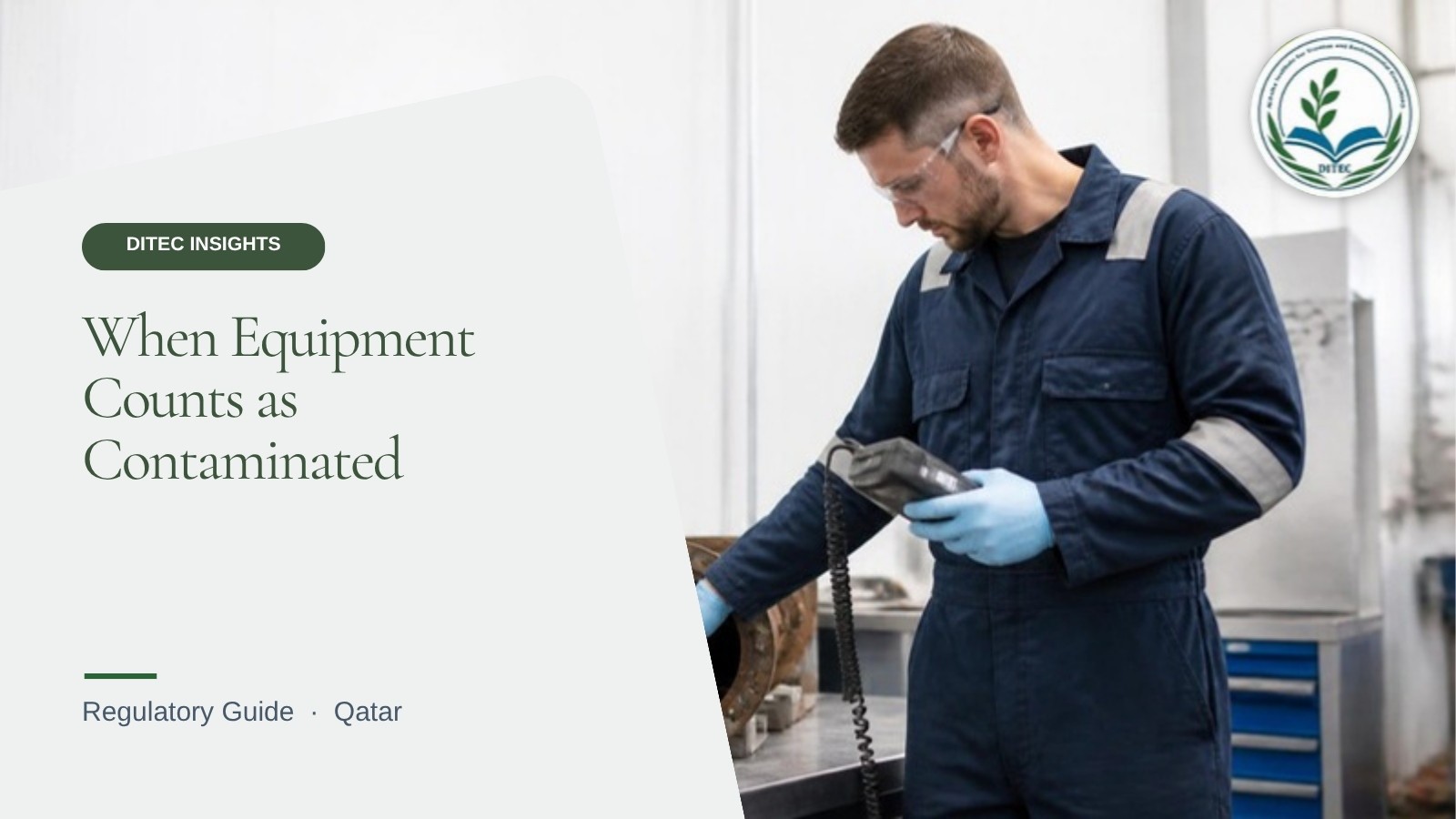
One threshold, and a value that is not in the text
Before any exemption level matters, a prior question has to be answered: is this equipment contaminated at all. Article 6 answers it with one threshold, and the threshold is not a number. It is a comparison: the dose at the surface of the equipment against twice the radiation background in the State.
The article reads: equipment is considered contaminated with naturally occurring radioactive material if the radiation dose at the surface of the equipment is more than twice the radiation background in the State, at the routine radiation survey during work or before the equipment is taken out of service.
Two things in that sentence are easy to pass over. It says more than twice, so equality is not exceeding. And it names two occasions for the reading: during work at the routine radiation survey, or before the equipment is taken out of service. A routine survey is the periodic check a facility runs as a matter of course, not a special investigation.
And the thing that decides the whole article is missing from it. The radiation background is a defined term in these rules: the radioactive activity arising from natural radioactive sources, the cosmic ones and the terrestrial ones. But the value of that background in the State is not in this decision. So the definition is present and the number is not, and the number is one the Ministry adopts. We do not supply a figure, and we do not import one from another source and attribute it to this article.
The two categories of surface contaminated object
A separate definition in article 1 carries its own figures, and it is a different subject from article 6. A surface contaminated object is any solid object that is not itself radioactive but carries radioactive material distributed over its surface in a regular pattern, and such objects are one of two categories.
The first category: category one: a solid object whose non fixed contamination, meaning contamination that can transfer spontaneously or be removed easily from the contaminated surface during transport in normal conditions, on an accessible surface averaged over 300 square centimetres, or the whole surface area if it is less than 300 square centimetres, does not exceed 3.7 per square centimetre for gamma ray, beta particle and low toxicity alpha emitters, or 0.37 per square centimetre for all other alpha emitters.
The second category: category two: a solid object whose fixed and non fixed contamination on its surface exceeds the limits in force specified for a surface contaminated object, where the non fixed contamination on an accessible surface averaged over 300 square centimetres, or the whole surface area if it is less than 300 square centimetres, does not exceed 400 per square centimetre for gamma ray, beta particle and low toxicity alpha emitters, or 40 per square centimetre for all other alpha emitters.
Two terms inside those definitions carry weight. Non fixed contamination is defined inside the first category itself as contamination that can transfer spontaneously or be removed easily from the contaminated surface during transport in normal conditions. And the figures are not per square centimetre of anything: they are averaged over 300 square centimetres, or over the whole surface if it is smaller than that.
The two categories, and the kind of limit they are
| What is measured | First category | Second category |
|---|---|---|
| Gamma rays, beta particles and low toxicity alpha emitters | Not exceeding 3.7 per square centimetre | Not exceeding 400 per square centimetre |
| All other alpha emitters | Not exceeding 0.37 per square centimetre | Not exceeding 40 per square centimetre |
| The reference area | 300 square centimetres, or the whole surface if smaller | 300 square centimetres, or the whole surface if smaller |
| What kind of limit this is | Not an exemption level. The definition itself speaks of transport in normal conditions | Not an exemption level. The definition speaks of the limits in force for a surface contaminated object |
These figures are not exemption levels
This is the guard that matters most on this page. The figures of the two categories are not the figures of Annex 1, and a facility that treats them as exemption levels will call a contaminated object exempt. The ground for saying so is in the definitions themselves: the first category speaks of contamination during transport in normal conditions, and the second speaks of the limits in force for a surface contaminated object. Neither of them speaks of exemption.
The exemption levels live in Annex 1, and the transcribed text refers to that annex in two places: article 5, and item 5 of article 8, where a sample from each container is measured by a gamma spectrum analyser, an instrument that identifies which isotopes are present by the energies of the gamma rays they emit, and if it is within the levels specified in Annex 1 attached to these rules it may be discharged as industrial waste, and otherwise it is moved to the stores
A third figure sits nearby and belongs to neither set. Item 4 of article 8 names a surface activity on the outside of a container: that the radioactive contamination on the surface of each container is measured, and if the surface radioactive activity emitted from beta particles and gamma rays is greater than 4 becquerel per square centimetre, the outer surface must be washed with pressurised water until the surface activity becomes less than 4 becquerel per square centimetre, and the drum may also be placed inside another drum to reduce the surface activity. That is a washing instruction tied to a container surface, and it is not an exemption level either.
The same numbers in two places with two meanings
The pair 3.7 and 0.37 appears twice in this decision. It appears in the first category above, where the Arabic text spells the unit one way and the subject is a surface contaminated object. And it appears in the equipment row of Annex 1, where the Arabic text spells the unit another way and the subject is an exemption level. Numerical sameness is not sameness of rule, and we do not write the same limit.
The difference in how the unit is spelled between the two places is transcribed and not corrected, and the quotations in the Arabic text of this article keep each spelling where it belongs. A reader can see both and judge for himself, which is the point of quoting rather than paraphrasing.
What to do at the survey
The order below is about readings and records. It does not classify an object for you and it does not replace the background value the Ministry adopts.
Two worked readings
First: a tube is pulled from a well and the dose at its surface reads almost exactly twice the background figure the facility has been using. Article 6 says more than twice, so equality is not exceeding, and the honest answer is that the test is not met on that reading.
But the deeper problem in that case is the background figure itself. The value of the radiation background in the State is not in this decision, so a facility using a figure of its own is comparing against something the article does not supply. The step is a written question to the Ministry about the adopted value, not a calculation.
Second: non fixed contamination on an accessible surface, averaged over 300 square centimetres, is measured at 2 per square centimetre for beta emitters. That is below the 3.7 named in the first category, so by the wording the object sits inside the first category description.
What does not follow from that is exemption. The categories are not Annex 1, and the exemption levels are there. So the record says which category the object answers to and keeps that separate from any statement about exemption.
Four habits at the routine survey
Write the background value you compared against, and where it came from. A comparison with no stated reference is not a result.
Record the area the reading was averaged over, because the categories are written on 300 square centimetres and not on a point.
Keep category statements and exemption statements in separate fields of the record, so no reader merges them.
Ask the Ministry in writing for the adopted background value for article 6, quoting the article in full.
Frequently asked questions
What is twice the radiation background in figures?
The decision does not say. The radiation background is defined in article 1, but the value adopted in the State is not in this decision, and we do not supply one or import one from elsewhere and attribute it to article 6. It is one of the three questions this batch puts to the Ministry.
Is an object in the first category exempt?
No, and the two are different subjects. The categories carry their own figures and their own definitions, which speak of transport in normal conditions and of the limits in force for a surface contaminated object. Exemption levels are in Annex 1, and a category is not an exemption.
Does a reading exactly twice the background make equipment contaminated?
The wording is more than twice the radiation background in the State. Equality is not more, and we read the text as it is written. What a facility should do about a reading that sits on the line is a question to put to the Ministry rather than to settle by rounding.
When is the survey required?
Article 6 names two occasions for the reading it describes: during work at the routine radiation survey, or before the equipment is taken out of service. The frequency of a routine survey is not fixed in this article.
What is a gamma spectrum analyser for?
It identifies which radionuclides are present from the energies of the gamma rays they emit, rather than only counting activity. Item 5 of article 8 names it for samples taken from each container, and compares the result with the levels of Annex 1.
Technical note
Keep three kinds of figure apart in your own notes, because the decision keeps them apart. A detection threshold answers whether equipment is contaminated. An exemption level answers whether a material falls below Annex 1. A category limit describes a surface contaminated object. Three questions, three places, and a number carried from one to another answers the wrong question.
And an area is part of a figure. The category limits are averaged over 300 square centimetres, or over the whole surface where it is smaller. A hot spot on a small fitting and the same reading on a large vessel are not the same finding.
One more thing on measurement, because every figure on this page is a measured figure. The reading is taken by someone qualified to take it, with an instrument whose calibration is current and whose response was checked before the work, and the instrument has to respond to the radiation actually present and at the energies present. A gamma probe does not reliably detect an alpha emitter. And a result is written down with its date, its instrument and its method, because a reading without those three is not evidence a year later.
Where DITEC stands, and what this text is
ALDuha Institute for Training and Environmental Consulting (DITEC) works in training and consulting only. Explaining what a threshold asks to be compared, and training the people who run the routine survey and write its records, is training and consulting work. Taking the reading is measurement work. The Institute does not run a laboratory analysis service, does not calibrate instruments and does not test equipment, and field surveys are carried out through specialist partners. Licensed training is what the Institute offers, and nothing in a training programme or in this explanation is an undertaking that a licence will be issued or that it will be issued within any period.
A note on the authority: the text names the Ministry of Environment. Today that competence sits with the Ministry of Environment and Climate Change, Radiation Protection Department. The background value that article 6 turns on is adopted by that department. The successor reading is ours, not the wording of the decision, and where the decision is quoted, the original wording is kept in the Arabic text of this article.
This article is an introductory explanation of a published regulatory text and is not a legal opinion.
Quick Actions
Radiation protection programmes for NORM in oil and gasRequest a radiation protection consultationIn this article
Related Blog
Explore more articles in NORM & Oil & Gas
October 14, 2026
Produced Water Discharge Limits Under Qatar NORM Rules
The produced water row of Annex 1 allows direct discharge on two conditions together: a concentration at the discharge point, and a four week total.
Read more
October 14, 2026
Exemption Levels for Soil, Sludge and Scale in Qatar
Annex 1 of Decision 45 of 2013 gives three rows for soil, sludge and hard scale. The soil row carries two different units in one sentence.
Read more
October 14, 2026
When Contaminated Equipment Is Exempt Under Qatar NORM Rules
Article 5 of Decision 45 of 2013 exempts waste below the Annex 1 levels. The equipment row gives two surface figures and one dose figure.
Read more