
Who the NORM Waste Rules Cover in Qatar
 October 12, 2026
 7 min read
 DITEC Experts, Radiation Protection Team, ALDuha Institute for Training and Environmental Consulting

Why the question of scope comes first
An operator who finds a reading on a separator vessel asks one question before any other: do these rules apply to me at all. Decision 45 of 2013 answers that in article 3 of the attached rules, and the answer is wider than the title of the decision suggests.
The rules apply to anyone who deals with naturally occurring radioactive material, or who otherwise deals in it in any of the ways the rules set out, and that expressly includes collection, transport, storage and disposal of the radioactive waste produced by the oil and gas industry.
The purpose the rules state for themselves
Article 2 states two purposes: protecting workers inside the facility whose equipment concentrates naturally occurring radioactive material, including while decontamination and disposal are being done, and protecting people and the environment from undue exposure to ionising radiation from naturally occurring radioactive material. It also states that the rules fix the main requirements and the constraints governing the management of this waste, and the tasks of everyone who handles it.
Three limbs of the scope article
Article 3 has three limbs, and reading one without the other two gives a wrong answer. The first limb is the oil and gas industry. The second extends the same provisions to the management of radioactive waste arising from mining activities and from the production of phosphate fertilisers. The third excludes radioactive material in its natural, raw state.
The second limb is the one most often missed. A phosphate fertiliser plant and a mining operation are inside these rules by the text of the article, not by analogy, even though the title of the decision speaks of the oil and gas industry.
What the exclusion of the raw state means in the text
The article gives its own examples for the excluded case: geological formations, and soils whose concentration owes nothing to human activity. Reading that next to the definition of naturally occurring radioactive material in article 1 makes the line visible: the defined material is material in which the concentration of radionuclides increases as a result of human activity. Our reading, and we attribute it to ourselves, is that the exclusion and the definition turn on the same hinge.
What this article does not say
Article 3 does not exempt the oil and gas industry from anything. It adds to it. The only exclusion in the article is radioactive material in its raw natural state, and the article names no other excluded sector, no threshold and no quantity.
Exemption levels do exist in this decision, but they sit in a place we have not transcribed in this batch, so we neither name it nor describe what it contains. They are not part of the scope article, and a reader who mixes the two ends up believing that a sector is outside the rules when the subject of the other provision is a level and not a sector.
A negative claim, measured against what we transcribed
Across the issuing decision and articles 1 to 4 of the attached rules, the figures that govern a duty are periods and not levels: six months, every two months, and three months. Two further figures sit in the definitions and nowhere else: the range of the transport index, and the limits of the two categories in the definition of a surface contaminated object. Those limits are the subject of another batch and we build no rule on them here. We say this of that section only, because that is the section we transcribed letter by letter.
Oil and gas beside mining and fertiliser production
The three sectors are named in one article, and the operational difference between them is in where the material concentrates rather than in the vocabulary of the rules. In oil and gas the text puts the isotopes inside the definition of hard scale, naming radium isotopes in oil production and lead-210 and polonium-210 in gas, and placing the deposit on the internal surfaces of the lower opening of the tubing inside the well, on equipment installed at surface, on production equipment and on oil and gas transfer pipework. That is the place of scale alone, and sludge and produced water have their own places in their own definitions.
For a contractor the practical consequence is one of vocabulary: the duties of managing radioactive waste at a phosphate fertiliser plant are written in these same rules, by the text of article 3, so no separate set of terms has to be built for them. What else that sector may require of a facility, and what the other limbs of activity may require, is not answered by the text of article 3 and is a question to ask.
A crossing we flag and do not settle
When material becomes radioactive waste is answered by the definition in article 1, which refers the concentration to the concentration fixed by the competent authority in the licence. The decision also sets exemption levels in a place we have not transcribed in this batch, so we build no rule on them. Whether these rules displace the general provisions on radioactive waste elsewhere in Qatari regulation is not something the text of article 3 answers, and we do not assume an exemption that the article does not state.
Reading your own operation against article 3
A short, honest reading of the article against an operation takes four steps: three of them are questions of description and of documents, and the fourth separates what has been measured from what has not.
Four questions in order
First: is my sector one of the three named, that is oil and gas, mining, or phosphate fertiliser production.
Second: does my operation accumulate scale or sludge or produced water in the equipment, or is the material in front of me still in its raw natural state, such as a geological formation or soil. Whether the concentration of radionuclides has in fact risen is a measurement question for a specialist to answer by survey or analysis, recorded with its date and its source, and not estimated in house.
Third: am I doing one of the acts the rules set out, that is collection, transport, storage, decontamination or disposal.
Fourth: have I written down what has been measured and what has not, and kept the two apart. A survey that was never carried out is not a finding of absence.
Frequently asked questions
Does the decision apply to a phosphate fertiliser plant?
Yes, by the text of article 3, which extends the provisions to the management of radioactive waste arising from mining activities and the production of phosphate fertilisers.
Is natural soil on a site covered?
Article 3 excludes radioactive material in its raw natural state and gives geological formations and soils whose concentration owes nothing to human activity as its examples. Soil that has been contaminated by the activity is a different case and the exclusion does not reach it.
Does the decision cover a contractor or only the facility owner?
The article speaks of anyone who deals with the material or otherwise deals in it in the ways the rules set out, and it does not distinguish between an owner and a contractor.
Where are the exemption levels?
Not in the scope article. Where they sit in the decision is the subject of another batch, and we name no article and no annex whose text we have not transcribed, and we carry no figure out of it.
Does being inside the scope by itself mean a licence is needed?
The licensing duty is in article 4, which requires the generation of radioactive waste to be under a licence from the Ministry of Environment. The scope article settles who the rules reach, and the licensing article states the duty.
Technical note
Keep two words apart. Scope is who the rules reach. Exemption is a separate subject, in a provision we have not transcribed here, and we do not describe what it contains. A sector is never exempt by a level, and a level never widens a scope.
The hinge of the definition is human activity. Concentration that rose because of the work is inside. Concentration that was always there is outside.
Where DITEC stands, and what this text is
ALDuha Institute for Training and Environmental Consulting (DITEC) works in training and consulting only. Reading a decision against an operation, and building the training that the duties in it require, is consulting and training work. The Institute does not run a laboratory analysis service, does not calibrate instruments and does not test equipment, and field surveys are carried out through specialist partners. Licensed training is what the Institute offers, and nothing in a training programme or in this explanation is an undertaking that a licence will be issued or that it will be issued within any period.
A note on the authority: the text names the Ministry of Environment. Today that competence sits with the Ministry of Environment and Climate Change, Radiation Protection Department. The scope article is read today against that department. The successor reading is ours, not the wording of the decision, and where the decision is quoted, the original wording is kept in the Arabic text of this article.
This article is an introductory explanation of a published regulatory text and is not a legal opinion.
Related Blog
Explore more articles in NORM & Oil & Gas
October 12, 2026
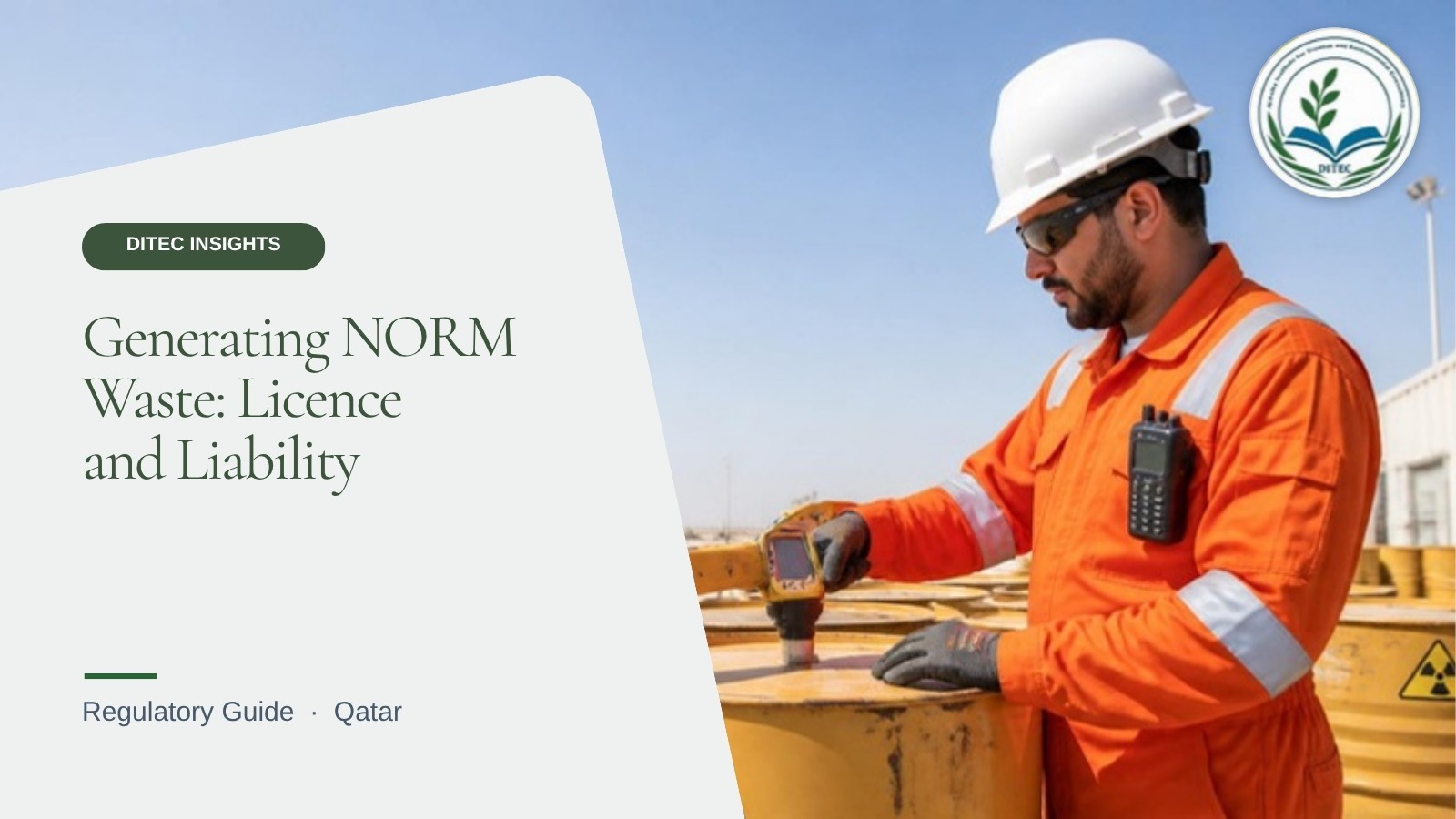
Generating NORM Waste: Licence and Liability
Article 4 of Decision 45 of 2013 requires NORM waste generation to be under a Ministry licence, and puts liability for human or environmental damage on the generator.
Read more
October 12, 2026
The Six Month Window in the Issuing Decision
Article 2 of the issuing decision gave existing facilities six months to regularise, with a report every two months and a possible three month extension, now long closed.
Read more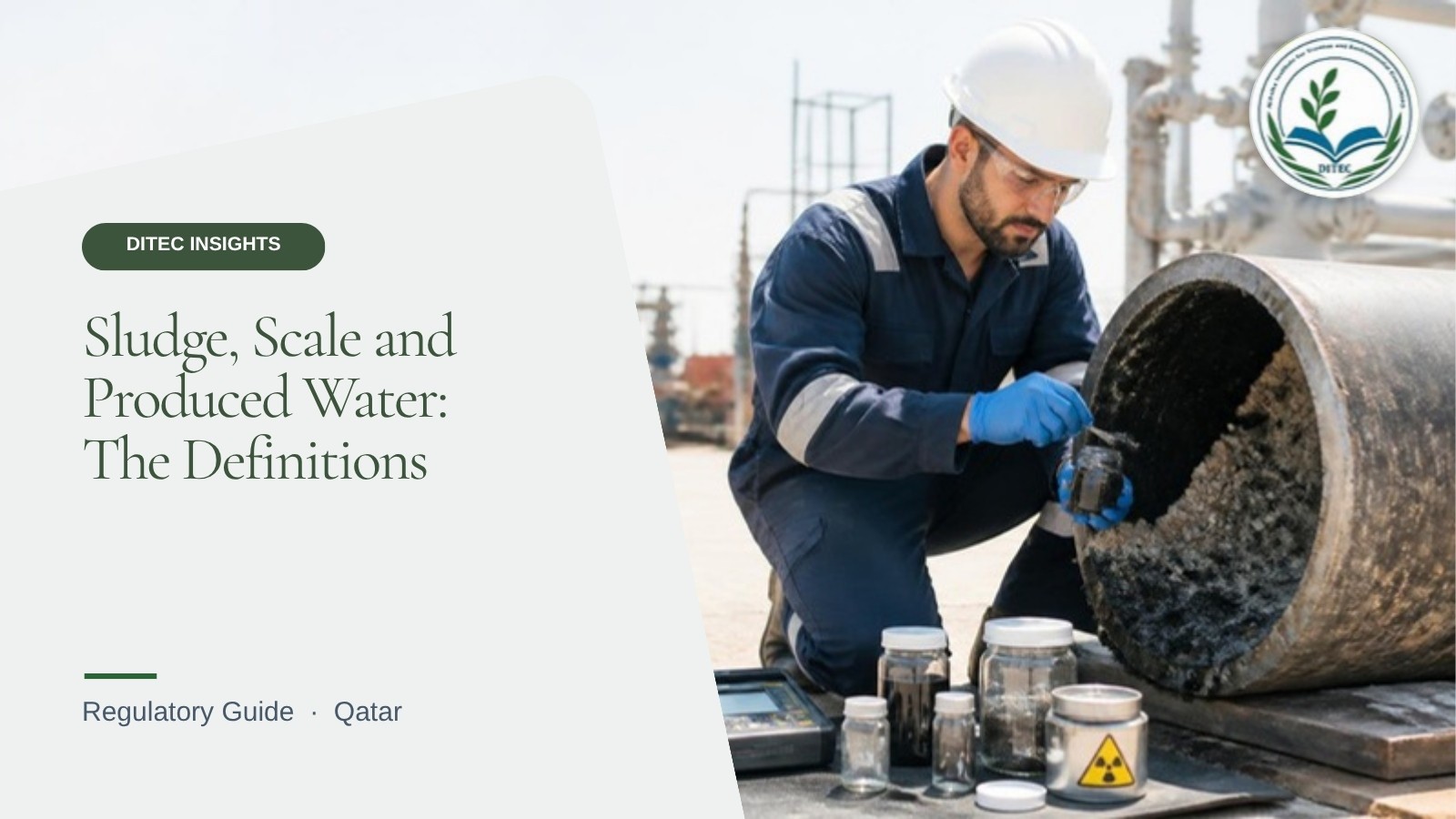
October 12, 2026
Sludge, Scale and Produced Water: The Definitions
Decision 45 of 2013 defines sludge, hard scale, produced water and radioactive waste. The definitions decide which duty applies to which stream on a Qatari site.
Read more