
Generating NORM Waste: Licence and Liability
 October 12, 2026
 7 min read
 DITEC Experts, Radiation Protection Team, ALDuha Institute for Training and Environmental Consulting
One article with two separate sentences
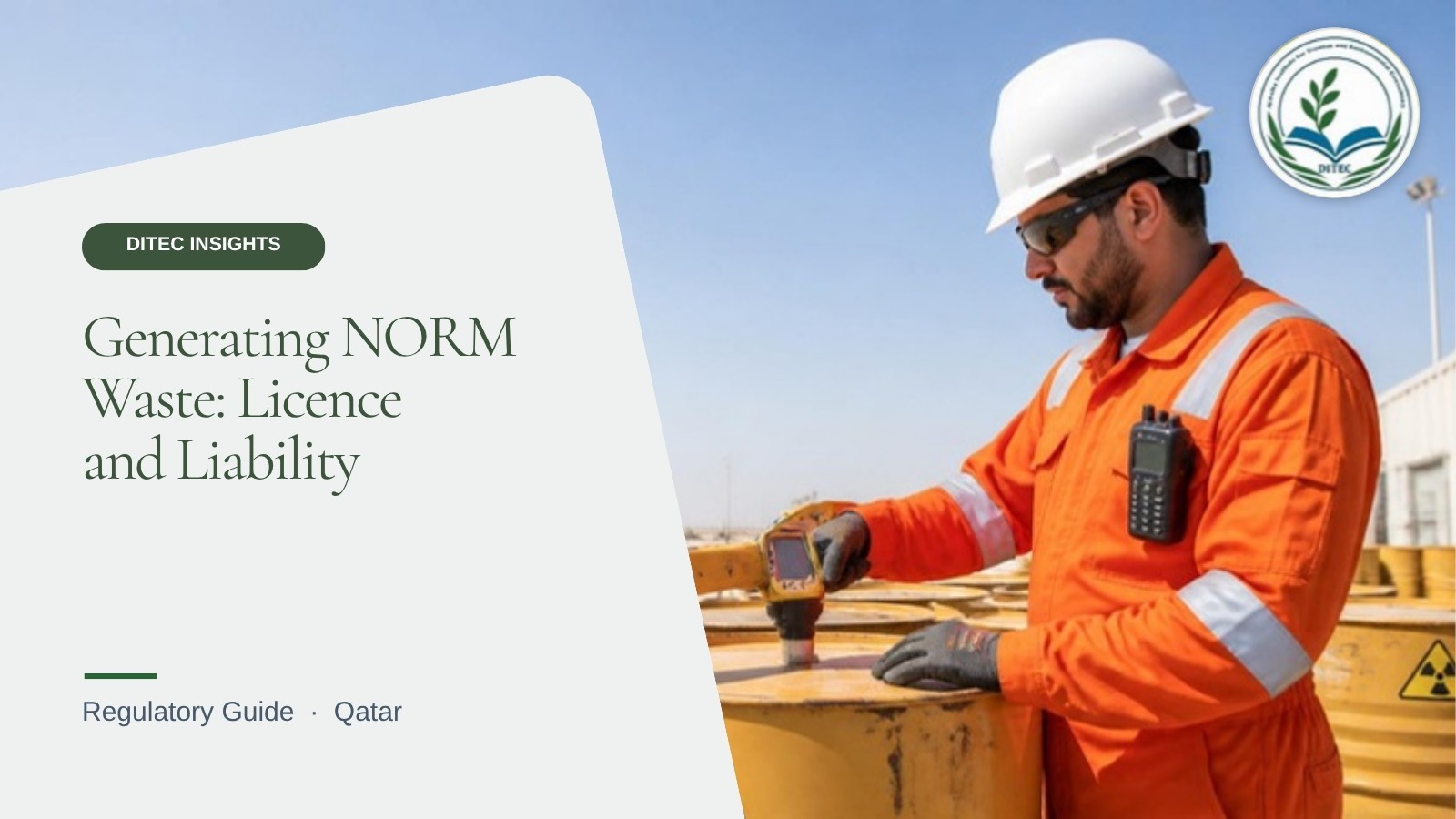
Article 4 is short and carries two distinct burdens. The first sentence makes the generation of radioactive waste conditional on following the procedures the rules set out, including collection, transport, storage, decontamination and final disposal, and on that being done under a licence from the Ministry of Environment.
The second sentence places on whoever undertakes the generation of radioactive waste the liability for the human or environmental damage resulting from his work. Two obligations, and the second does not depend on the first being satisfied.
What the licensing sentence actually requires
The licence in article 4 runs in one direction: it is a licence from the Ministry of Environment to the person generating the waste. The article names the Ministry as the granting side and names no other body.
The requirement is also tied to the chain of operations and not to a single act. The article lists collection, transport, storage, decontamination and final disposal inside the same sentence, so a generator who has arranged storage but nothing beyond it has not satisfied a sentence that names disposal too.
The liability sentence, read as it is written
The liability is on whoever undertakes the generation, and its subject is human or environmental damage resulting from his work. The article does not make it conditional on having or not having a licence, and it does not name a penalty, a fine or a sanction. Articles 1 to 4 of these rules name none of those.
What article 4 leaves silent
The article requires a licence and does not describe how it is obtained. There is no period for consideration, no list of documents, no office of submission, no fee and no renewal inside the rules themselves. We record the silence and we ask the Ministry about it, and we do not import a procedure from another decision and attribute it to this article.
This is also why there is no promise in this article for us to pass on. Whether a licence is issued, and when, is a matter for the competent authority alone. Nothing in this explanation and nothing in any training programme is an undertaking on that.
A licence duty next to a definition that points back at it
The definition of radioactive waste in article 1 fixes the concentration by reference to what the competent authority determined in the licence. Article 4 then makes generation subject to a licence from the Ministry. The two provisions lean on each other, and that is worth seeing before anyone treats the licence as a formality attached at the end.
The practical reading is that the concentration which the definition in article 1 refers onward is read from the licence and not from article 1, so it is a document question before it is a measurement question. The decision carries figures in a place we have not transcribed, so we do not say that the licence is the home of every governing figure.
What a generator can put in order now
None of the following creates a licence, and none of it shortens a procedure. It is the file that a generator is asked about.
Four items in the file
The licence itself, with the concentration the authority fixed in it, kept where the people who write waste records can read it.
A written description of the chain: who collects, who transports, where it is stored and how final disposal is intended, because the article names all of these in one sentence.
A record of who is trained for which task, since the words trained workers and specialists appear in later articles.
A list of the questions the rules do not answer, addressed to the Ministry rather than answered internally by guesswork.
Frequently asked questions
Who grants the licence under article 4?
The article requires the work to be under a licence from the Ministry of Environment, and it names no other body.
Does the article say how long a licence takes?
No. The article states the requirement and is silent on the procedure, and we do not supply a period that the text does not contain.
Does holding a licence remove the liability in the second sentence?
The article places liability for human or environmental damage on whoever undertakes the generation and does not condition that on the licence. The two sentences are separate.
Does article 4 name a penalty?
No. What it names is liability for damage. Articles 1 to 4 of these rules do not name a penalty, a fine or a sanction.
Does a contractor need the licence or the facility?
Article 4 attaches the duty to the generation of the waste and the liability to whoever undertakes it. Which party that is in a given contract is a question of facts and of the contract, and the article does not divide the roles for you.
Technical note
Read the direction of the licence. It is granted by the Ministry and held by the generator. The article states the direction and is silent on how the licence is obtained.
Liability here is about damage, not about a fine. The article says damage to people or to the environment, and it stops there.
Where DITEC stands, and what this text is
ALDuha Institute for Training and Environmental Consulting (DITEC) works in training and consulting only. Preparing a duty file, and training the people named in it, is training and consulting work. The Institute does not run a laboratory analysis service, does not calibrate instruments and does not test equipment, and field surveys are carried out through specialist partners. Licensed training is what the Institute offers, and nothing in a training programme or in this explanation is an undertaking that a licence will be issued or that it will be issued within any period.
A note on the authority: the text names the Ministry of Environment. Today that competence sits with the Ministry of Environment and Climate Change, Radiation Protection Department. The licence that article 4 requires is a matter for that authority alone, and we give no undertaking about it. The successor reading is ours, not the wording of the decision, and where the decision is quoted, the original wording is kept in the Arabic text of this article.
This article is an introductory explanation of a published regulatory text and is not a legal opinion.
Quick Actions
Radiation protection programmes for NORM in oil and gasRequest a radiation protection consultationIn this article
Related Blog
Explore more articles in NORM & Oil & Gas

October 12, 2026
Who the NORM Waste Rules Cover in Qatar
Decision 45 of 2013 covers anyone handling NORM material in oil and gas, and reaches mining and phosphate fertiliser production too. Raw natural material is outside it.
Read more
October 12, 2026
The Six Month Window in the Issuing Decision
Article 2 of the issuing decision gave existing facilities six months to regularise, with a report every two months and a possible three month extension, now long closed.
Read more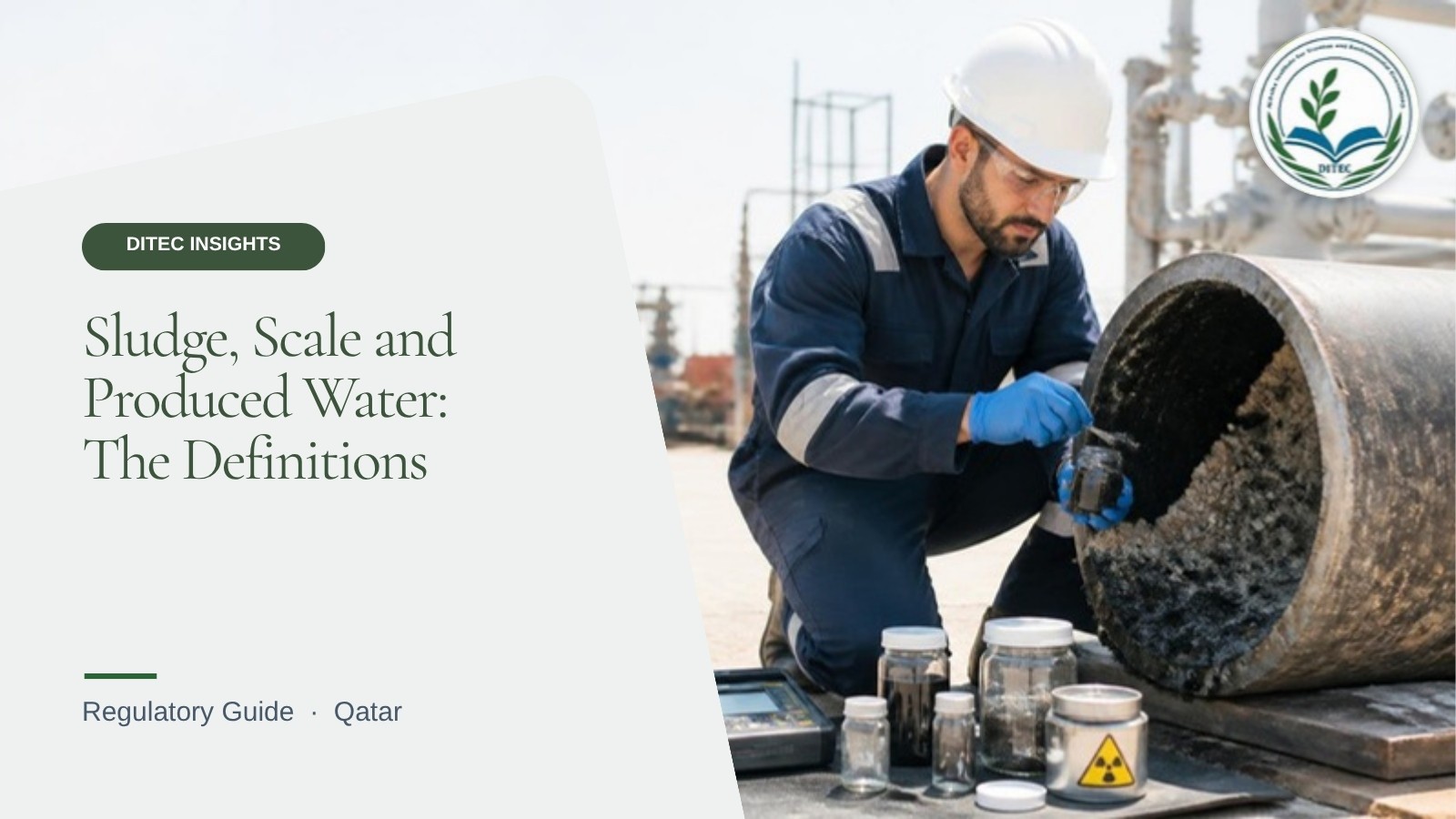
October 12, 2026
Sludge, Scale and Produced Water: The Definitions
Decision 45 of 2013 defines sludge, hard scale, produced water and radioactive waste. The definitions decide which duty applies to which stream on a Qatari site.
Read more