
Sludge, Scale and Produced Water: The Definitions
 October 12, 2026
 8 min read
 DITEC Experts, Radiation Protection Team, ALDuha Institute for Training and Environmental Consulting
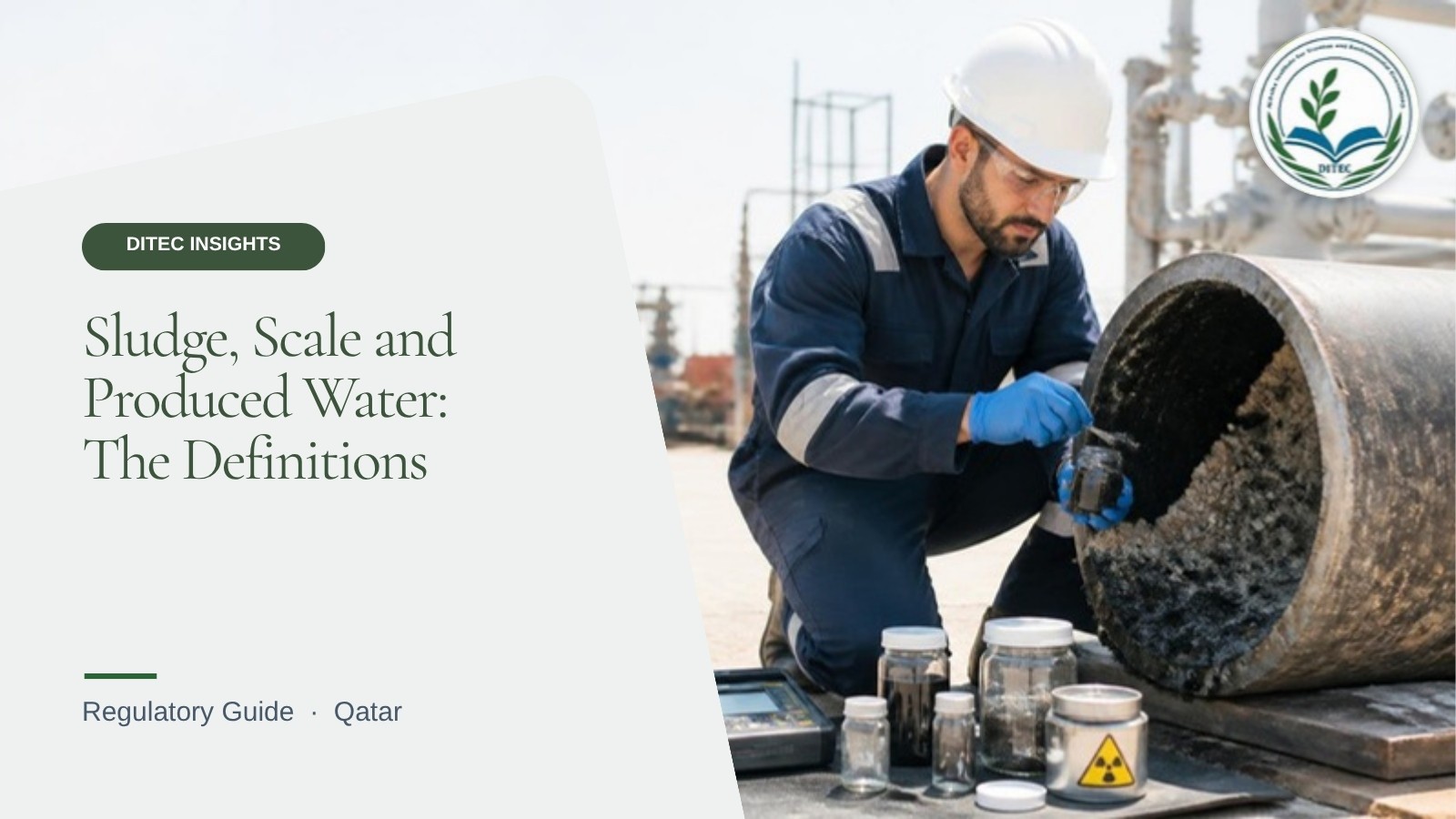
Why a definitions article is the useful one
Article 1 of the attached rules defines twenty one terms, and the rest of the decision is written in those terms. A duty about decontamination, a duty about transport and a duty about storage all take their subject from this article, so a stream that is mislabelled on site is a stream matched to the wrong duty.
The article opens by saying that these meanings apply in the application of the rules unless the context requires another meaning, which is the ordinary form of a definitions clause and worth noticing before anyone treats a definition as universal.
The four streams the text names
Four defined terms carry most of the work on an upstream site, and each is defined by its source or its place or its make-up or its use, not by how active it is.
Produced water
Defined as the water flowing from the well, contaminated with radium isotopes dissolved in the water and reaching the surface. The definition is about origin and carrier, and it says nothing about a discharge limit.
Sludge
Defined as an accumulation of solids contaminated with naturally occurring radioactive material, together with heavy hydrocarbons, strongly bound emulsions, sand and a small amount of corrosion products from drilling tools and equipment, inside separator vessels, wellhead equipment, tanks and the like. The definition is a mixture, which is why a single number rarely describes a sludge pile fairly.
Hard scale
Defined as solids contaminated with naturally occurring radioactive material, chiefly radium isotopes in oil production and lead-210 and polonium-210 in gas, depositing on the internal surfaces of the lower opening of the tubing inside the well, on equipment installed at surface, on production equipment and on oil and gas transfer pipework.
Equipment
Defined as the materials and devices used in the oil and gas industry or in the activities referred to in article 3, such as containers, pipes and tanks. The definition carries the scope article inside it, so the three sectors share one vocabulary.
The definition that decides when waste is radioactive
Radioactive waste is defined as naturally occurring radioactive residues containing radionuclides at a concentration greater than the concentration fixed by the competent authority in the licence, and which may be stored or retained in order to restrict their release to the surrounding environment.
The definition refers the concentration to the licence rather than naming a figure in article 1, and that is the thing to carry out of this article. The decision does set exemption levels elsewhere in its text, in a place we have not transcribed in this batch, and those figures are a subject in their own right.
What we did not find in the definitions
We read the twenty one definitions one by one. There is a definition of radiation background, and there is no definition of twice the radiation background as a phrase. The doubling appears in article 6, which is a different subject with its own reading. We state this of article 1 only.
Material, and the waste that material becomes
Article 1 defines naturally occurring radioactive material as material in which the concentration of radionuclides increases as a result of human activity. Separately it defines radioactive waste as naturally occurring radioactive residues containing radionuclides at a concentration greater than the concentration fixed by the competent authority in the licence.
The two definitions are not two names for one thing. The first describes material by why its concentration rose. The second describes a residue by a concentration measured against a figure in a licence. A site can hold the first while the second has not been established, and the step between them is a document and a measurement rather than a label.
What follows for a record
Write the stream name and the basis of the waste classification in two separate fields. A reader who sees one field cannot tell whether a name was given by eye or a classification was made against the licence.
Putting the right name on each stream
Naming is a cheap step with a large effect, because every later duty in the decision is written against a name.
Three practical habits
Write the stream name from the decision on the record, not a local nickname, so that an inspector and a contractor read one word.
Separate a mixture from a deposit in the paperwork. Sludge is defined as a mixture and scale is defined as a deposit on surfaces, and they do not travel the same way.
Keep the licence in the same file as the waste records, since the definition of radioactive waste refers the concentration to what the competent authority fixed in the licence.
Frequently asked questions
Does the decision put a number on when waste becomes radioactive?
The definition in article 1 refers the concentration to what the competent authority fixed in the licence. The figures by which waste is exempted sit outside the articles we transcribed, and we neither name that place nor build on it.
Is produced water treated as waste by the definition?
The definition of produced water describes water flowing from the well contaminated with dissolved radium isotopes. Whether a given stream is radioactive waste is answered by the definition of radioactive waste and by the exemption levels, not by the name produced water on its own.
Why does scale name different isotopes for oil and for gas?
Because the text itself does. It names radium isotopes as the chief ones in oil production and lead-210 and polonium-210 in gas.
Are surface contaminated objects defined here?
Yes, article 1 defines a surface contaminated object as a solid object that is not itself radioactive but carries radioactive material distributed in a regular pattern on its surface, and it puts such objects in two categories with numerical limits of their own. We have not transcribed those limits here and we build no rule on them. In the article itself they sit among the definitions of transport, of the package and of the transport index, so their subject is not the naming of streams.
How many terms does article 1 define?
Twenty one, counted one by one on the text we transcribed.
Technical note
A name is not a measurement. The decision names a stream by where it sits and what it contains. How active it is, is a separate question with its own article.
Sludge is a mixture by definition. One sample from one drum does not describe a pile. Keep the sample record and the stream record separate.
Where DITEC stands, and what this text is
ALDuha Institute for Training and Environmental Consulting (DITEC) works in training and consulting only. Explaining what a defined term means, and training the people who write the records that use it, is training and consulting work. Deciding the activity of a sample is laboratory work. The Institute does not run a laboratory analysis service, does not calibrate instruments and does not test equipment, and field surveys are carried out through specialist partners. Licensed training is what the Institute offers, and nothing in a training programme or in this explanation is an undertaking that a licence will be issued or that it will be issued within any period.
A note on the authority: the text names the Ministry of Environment. Today that competence sits with the Ministry of Environment and Climate Change, Radiation Protection Department. The concentration that the definition of radioactive waste refers to the licence is fixed by that authority. The successor reading is ours, not the wording of the decision, and where the decision is quoted, the original wording is kept in the Arabic text of this article.
This article is an introductory explanation of a published regulatory text and is not a legal opinion.
Quick Actions
Radiation protection programmes for NORM in oil and gasRequest a radiation protection consultationIn this article
Related Blog
Explore more articles in NORM & Oil & Gas
October 12, 2026
Generating NORM Waste: Licence and Liability
Article 4 of Decision 45 of 2013 requires NORM waste generation to be under a Ministry licence, and puts liability for human or environmental damage on the generator.
Read more
October 12, 2026
Who the NORM Waste Rules Cover in Qatar
Decision 45 of 2013 covers anyone handling NORM material in oil and gas, and reaches mining and phosphate fertiliser production too. Raw natural material is outside it.
Read more
October 12, 2026
The Six Month Window in the Issuing Decision
Article 2 of the issuing decision gave existing facilities six months to regularise, with a report every two months and a possible three month extension, now long closed.
Read more