
NORM Transport Surface Contamination Limits in Qatar
 October 17, 2026
 16 min read
 DITEC Experts, Radiation Protection Team, ALDuha Institute for Training and Environmental Consulting
The short answer: two readings release the drum
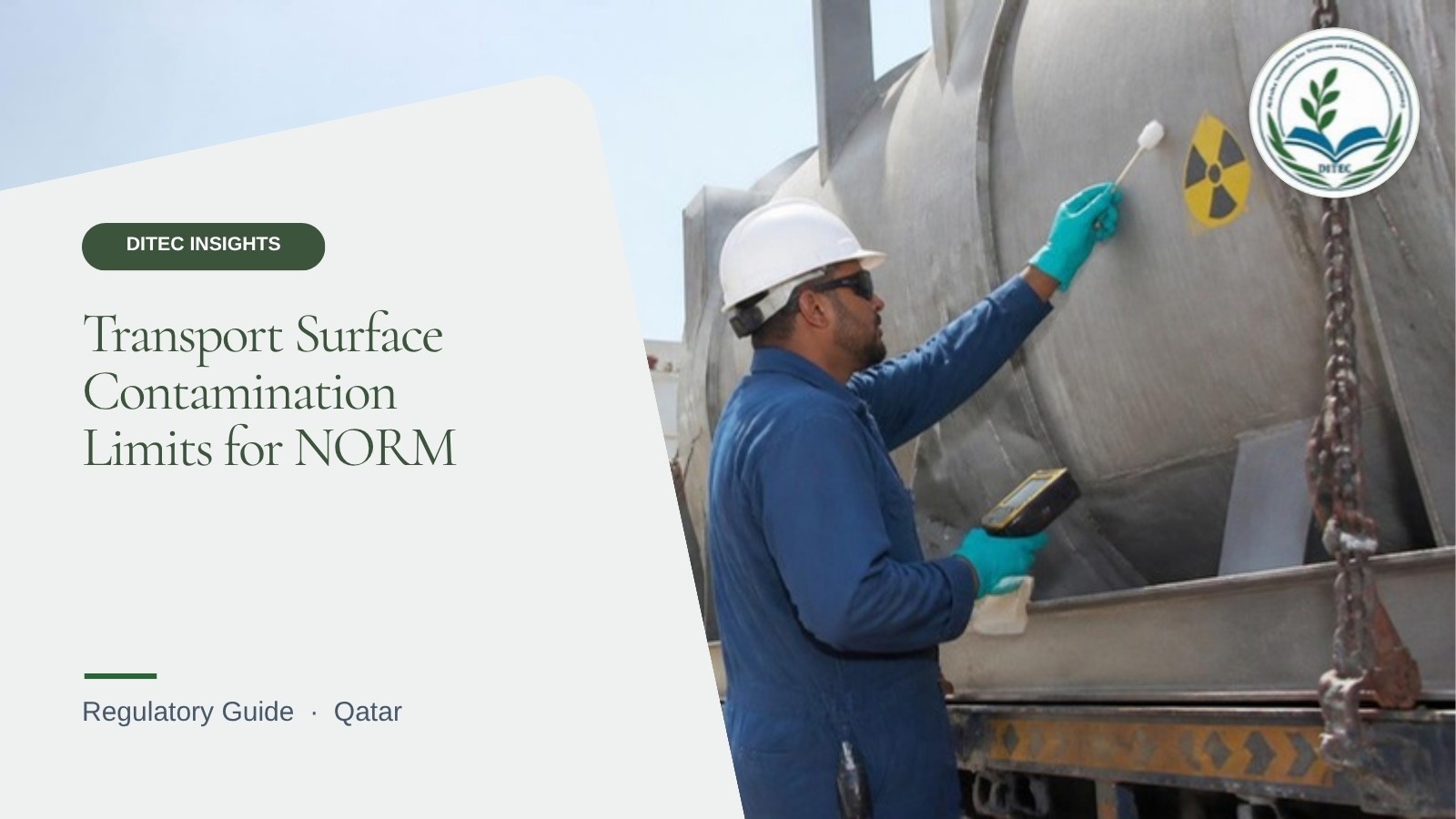
Before a drum of NORM waste leaves your yard in Qatar, two readings decide whether it may move. The first is loose contamination on the outside surface. The second is the radiation level at the surface of the package itself. Clause 1 of article 9 of the rules attached to Decision 45 of 2013 carries three figures between them: two for the first reading and one for the second. NORM is naturally occurring radioactive material, and the rules describe it as material in which the concentration of radionuclides is increased as a result of human activity.
The figures are as follows. Among the most important of the transport requirements, the clause asks that loose surface contamination not exceed 0.4 Bq/cm2 for beta or gamma emitters and low-toxicity alpha, and not exceed 0.04 Bq/cm2 for all alpha emitters; and that the radiation level at the package surface not exceed 5 microsieverts per hour. The becquerel is a unit of activity, one disintegration per second, so Bq/cm2 is activity on each square centimetre of surface. The microsievert is a unit of dose, so microsieverts per hour is the rate at which a person standing there would receive it.
This page is for the person who signs that the load may travel: a radiation protection officer, a yard supervisor, an HSE engineer, or a transport contractor's representative. It reads clause 1 and clause 6 side by side, because a contaminated valve travels under a different description from a drum of sludge.
A word on wording before anything else. Clause 1 of article 9 and the definitions article do not use one and the same Arabic expression for this quantity; our English renders the first as loose surface contamination and the second as non-fixed contamination. We record the difference in the Arabic and do not call either of them a slip. The Arabic spells the unit of activity one way in articles 8 and 9 and another way in the definitions article; we record that, we do not correct it, and in our own text we keep one spelling. We read the drum surface and the package surface as one thing in practice, and that reading is ours, not the decision's.
What clause 1 asks for, term by term
Clause 1 opens with the container, not with the figure. The defined quantities of NORM travel in a package, tanks, or containers in which all the transport requirements are met. Then it names figures as among the most important of those requirements. So the figures are a part of a larger duty, not the whole of it.
Package has a definition in the rules: the radioactive material together with the packaging for the purpose of preparation for transport. So the figure on the package surface is a figure on the outside of the whole assembly, material and packaging together, not on the material alone.
Non-fixed contamination, in the definitions article, means contamination that can transfer by itself, or be removed easily from the contaminated surface, during transport under ordinary conditions. That description belongs to the definitions article, inside its account of category one of surface contaminated objects. The point of it is that this is the part that can leave the surface and reach a hand, a glove, or a road.
Two readings, two different instruments and two different methods. Loose contamination in becquerels per square centimetre is an activity per unit area. The 5 microsieverts/hour is a dose rate. A contamination monitor answers the first. A dose rate meter answers the second. One instrument reading does not satisfy both lines of the clause.
Which alpha figure applies is a question about the emitter, not about the instrument. If the alpha emitter in your material is of low toxicity, the applicable figure is 0.4 Bq/cm2. If it is any other alpha emitter, the figure is 0.04 Bq/cm2. Radium is not among the low toxicity alpha emitters: in the international transport references that class is confined to natural uranium and thorium, their ores and their concentrates, and radium is not one of them. The decision neither defines the class nor lists its emitters, so the classification comes from those references and not from the decision. Where an emitter has not been named and there is doubt, our advice is to apply the stricter figure, 0.04 Bq/cm2; that is our advice and not a ruling in the clause. And naming the emitter is not one instrument reading: gamma spectrometry names the gamma emitters, and alpha emitters are inferred from the decay chain.
Does clause 1 say what to do if the reading is above the figure?
No. The clause states the figures as requirements and stops there. It carries no instruction to wash, no instruction to overpack, and no instruction to halt. We say so plainly rather than fill the silence, and we raise the question in the section below.
Where the exemption levels sit, and where they do not
A reader who has been through Annex 1 will notice 3.7 Bq/cm2 and 0.37 Bq/cm2 there as well, the same two figures that appear in category one of the definitions article, and will be tempted to treat them as one and the same rule with the transport figures. They are not. Annex 1 holds exemption levels, reached through article 5: waste whose activity level is below them is outside the application of the regulations in force, and waste above them counts as radioactive contaminants.
The equipment row of Annex 1 gives, in its own structure, radiation contamination from alpha particle emitters not exceeding 0.37 Bq/cm2 for alpha sources and 3.7 Bq/cm2 for beta sources, or a radiation dose not exceeding 0.5 microsieverts/hour including background at any accessible point. That is an exemption gate for equipment. It is not a transport limit, and the fact that the same figure also appears in category one of the definitions article does not make the two doors one door.
So four doors — transport, washing the container, exemption, and the description of a surface contaminated object — and we do not merge them. The table below gives the place of each figure, with the three transport figures in three rows. We do not say of any two of them that they are the same threshold.
One row of Annex 1 we leave alone. The soil and sludge row carries 0.185 picocuries/gram and 5.55 Bq/gram inside one sentence, for two different depths, and the two units are not equivalent to each other. We render the row as it stands, without converting it and without correcting it, and this is a point we find open in the text rather than one we fill ourselves.
Does an exempt reading mean the load travels freely?
That is not a step we take here. Article 5 speaks about the application of the regulations in force to waste, and the transport figures of article 9 are a separate matter in the text we read. We do not widen the reach of the exemption beyond what that article states.
The four doors, in one view
The table below is the part of this page worth printing and pinning above the survey bench. Every row names the place the figure comes from, so that nobody carries a figure out of its door.
Why does the table separate the measured thing from the figure?
Because the usual error is not reading the wrong number. It is reading the right number against the wrong surface: a drum lid, a truck bed, a glove, or a piece of equipment that is still in service.
Where each figure belongs
| Place in the decision | Figure | Measured on | The door it governs |
|---|---|---|---|
| Article 9, clause 1 | 0.4 Bq/cm2 | Loose surface contamination, beta or gamma and low toxicity alpha | Transport |
| Article 9, clause 1 | 0.04 Bq/cm2 | Loose surface contamination, all other alpha emitters | Transport |
| Article 9, clause 1 | 5 microsieverts/hour | Radiation level at the package surface | Transport |
| Article 8, clause 4 | 4 Bq/cm2 | Beta and gamma surface activity on the outside of each container | Washing the container |
| Annex 1, equipment row | 0.37 and 3.7 Bq/cm2, or 0.5 microsieverts/hour including background | Alpha and beta contamination on equipment, at any accessible point | Exemption |
| Definitions article, surface contaminated objects | Not to exceed: 3.7 and 0.37 Bq/cm2 for category one; 400 and 40 Bq/cm2 for category two | Non-fixed contamination on an accessible surface over 300 square centimetres, while category two turns on fixed and non-fixed contamination together exceeding the applicable limits | The description of the object and its category |
A smear on a scale-covered drum, worked through
Take a drum of solid scale from a separator in an oil facility, ready for dispatch. Gamma spectrometry names the isotope, and it is radium 226. Radium is not in the low toxicity class, as the previous section sets out, so the applicable alpha figure is 0.04 Bq/cm2 and not 0.4 Bq/cm2. In gas facilities the definitions article names others in its definition of solid scale deposits: lead 210 and polonium 210 in the gas industry. Polonium 210 is an alpha emitter that is not of low toxicity either, and it is not measurable in practice by gamma spectrometry, its line there being far too weak to rely on, so it needs dedicated laboratory analysis. Naming the emitter is the first step, before any instrument is switched on.
A smear is taken over 100 square centimetres of an accessible part of the outer surface, and the smear is counted. That area is ours: clause 1 names no wiped area, while the definitions article averages over 300 square centimetres for the two categories of surface contaminated objects. Suppose the count gives 2.5 becquerels after correcting for the counting efficiency of your probe, a value taken from the instrument's calibration and declared beside the result. Dividing by the wiped area gives 0.025 Bq/cm2. At this point a reader is tempted to compare 0.025 Bq/cm2 with 0.04 Bq/cm2 and sign. That comparison is wrong, and the reason is the next paragraph.
A smear lifts only a part of the loose material, not all of it. To get from what the smear collected to what sits on the surface, a removal fraction has to be assumed. Take 0.1, which is a common working assumption: the smear lifted a tenth. Then the loose activity on the surface is 0.025 divided by 0.1, which is 0.25 Bq/cm2. Against the figure of 0.04 Bq/cm2, this surface does not meet the requirement of clause 1.
The number 0.1 is ours, and it is the weak joint in the whole calculation. In what we have read of this decision there is no removal fraction named, and clause 1 names neither a wiped area nor how many points on a drum are to be wiped. Changing the assumed fraction moves the answer by a factor, and averaging over 100 or over 300 square centimetres moves it again. So declare the fraction and the area you used, beside the result, every time, and keep the smear itself.
Now the second line of the clause. A dose rate meter on the drum surface reads 3 microsieverts per hour. That is under 5 microsieverts per hour, so this line is met. The two lines are independent: a package can pass the dose rate line and fail the contamination line, which is exactly what happened here. A single signature covering both readings hides that.
A caution on the contact reading itself, because it is the highest reading on the load and the closest to a hand. Take it in the shortest time that gives a stable number, wear a personal dosimeter, and remember that the hands take more than the trunk does at that distance, so extremity dose is the one to watch. This is the nature of measurement, not a reading of the clause.
If you wash the outside with pressurised water, two hazards come with it: inhalable spray carrying activity, and the water that comes back, which is now contaminated. Respiratory protection, a waterproof suit and eye protection belong to that task; the water is collected and managed as liquid waste rather than allowed to run; and the worker is surveyed afterwards. Article 11 requires decontamination of contaminated equipment to be done by specialist persons and gives priority to pressurised water in a closed circuit. A closed circuit contains the returning water by its nature; that is a description of the method, not an interpretation of it. Our own reading is this: since we found no referral between the two in what we have read, we take article 11's priority as guidance when a container is washed under article 8, and we do not impose it here.
And a word on who does this. The survey, the smear, the register entry and the signature are the operator's people and its contractors. So the person doing the survey writes the reading, the wiped area, the assumed fraction and the date in the record. We train on that record and are consulted about it, and we do not carry out the survey.
Survey questions we are asked
Is 0.04 close to what my instrument can even detect?
For many alpha monitors in field use, yes, it is close to the detection limit, and that is before the surface itself works against you. Alpha particles are stopped by a film of moisture, by a layer of scale, and by paint. A low reading on a drum that is wet, scaled or painted is not by itself evidence of a clean surface. Dry the spot, choose an accessible surface, and record the instrument, the probe and the counting time.
Can the instrument separate non-fixed contamination from the total?
No, it does not separate them. A contamination monitor held against the surface reads what is there, fixed and loose together. The loose part is reached by wiping and then counting the wipe, and by assuming a removal fraction. So the separation is a method with an assumption inside it, not a setting on the instrument.
A contaminated valve: does it travel as waste or as a surface contaminated object?
Clause 6 answers this one directly. Components such as valves and pipes that are not radioactive in themselves, if their surface is contaminated, are transported as surface contaminated objects, according to the level of fixed and non-fixed surface contamination that emits beta and alpha particles. So the description follows the measured level, and the definitions article holds the two categories.
What makes an object fall in the second category?
The definitions article describes the second category as a solid object whose fixed and non-fixed contamination on its surface exceeds the applicable limits set for the surface contaminated object. Exceeding is the condition. It then sets figures not to exceed 400 Bq/cm2 for gamma, beta and low toxicity alpha, and not to exceed 40 Bq/cm2 for all other alpha emitters, both measured on the non-fixed contamination over 300 square centimetres, or over the whole surface area if it is less than that. The 400 is not a gate you walk through by default.
The truck bed after unloading: is it covered here?
Not in the clauses we read. Clause 1 speaks about the package, and clause 6 about components. In practice the bed and the straps touch the drums, so a survey after unloading is the sensible step, and the decontamination article in the rules names specialist persons for equipment. We train on that step and advise it; it is carried out by the operator's people or by a specialist survey partner; and we do not present it as a duty the clause imposes.
Notes for the person holding the survey meter
Start from the emitter, not from the probe: the choice between 0.4 Bq/cm2 and 0.04 Bq/cm2 turns on whether the alpha emitter is of low toxicity, and that comes from spectrometry and the decay chain, not from a surface reading.
Keep the two instruments and the two records apart: a form with one box for both readings invites a reading from the wrong meter.
If a drum falls and splits in the yard, the first minutes are about keeping the material where it is. Stop traffic over the spill, cover it so it does not dry and lift, keep people on the side the wind comes from rather than the side it blows towards, and do not sweep dry. Let nobody and no vehicle leave the area before boots, gloves and tyres are surveyed. Survey comes after control. The rest of the named steps belong to the written transport plan under clause 5, and the transport plan and packaging page sets them out in full.
Record the quantity and the activity per unit weight, not one without the other. A drum with a low activity per kilogram and a large mass is one matter, and a small sample with a high figure is another. The container labelling clause in article 8 asks for the size and weight of the waste together with the activity level per unit of weight.
And protect the person doing the wrapping. Cutting and capping a contaminated pipe end raises dust and makes contact unavoidable. Cut cold, never with a flame, an arc or a grinder. Gloves, a suit and respiratory protection belong to the task, and a survey of the hands and of the capped end belongs at the end of it; the transport plan and packaging page sets that out in full. The packaging duties themselves are in clause 2, and they are about preventing spread, which is the same aim as this page.
So the instrument is the smaller half of this page. The larger half is naming the emitter first, keeping each figure inside its own door, and writing down the assumption you made when you turned a smear into a surface figure.
How DITEC helps, and where its work stops
On this page the question we are asked is nearly always about the two alpha figures, and which of them a drum of scale falls under. We train on reading clause 1 with the definitions article beside it, and on writing a survey record that states the wiped area and the assumed removal fraction.
ALDuha Institute for Training and Environmental Consulting (DITEC) works in training and consulting. The Institute does not run a laboratory analysis service, does not calibrate instruments, and does not test equipment. Field survey work is arranged through specialist partners.
Our training is licensed. Nothing here is an undertaking that a licence will be issued, and nothing here promises how long any application takes. The decision rests with the Ministry of Environment and Climate Change, Radiation Protection Department.
Reference: DITEC Experts and the Radiation Protection team. This page is an introductory explanation of a published decision and is not a legal opinion.
Quick Actions
Radiation protection programmes for NORM in oil and gasRequest a radiation protection consultationIn this article
Related Blog
Explore more articles in NORM & Oil & Gas

October 17, 2026
The NORM Transport Factor and Warning Labels in Qatar
Clause 7 and clause 11 of article 9 of Decision 45 of 2013: setting the transport factor for each drum in Qatar, and the labels and statement that travel with it.
Read more
October 17, 2026
Exclusive-Use Vehicles and Sea Transport of NORM in Qatar
Clauses 3, 4, 8 and 9 of article 9 of Decision 45 of 2013 in Qatar: exclusive-use vehicles, the no-mixed-load rule, sea containers, and loads off offshore platforms.
Read more
October 17, 2026
The NORM Transport Plan and Packaging Duties in Qatar
Clauses 2, 5 and 10 of article 9 of Decision 45 of 2013 in Qatar: wrapping contaminated pipe ends, the written transport plan, and notifying the receiving party.
Read more