
Exclusive-Use Vehicles and Sea Transport of NORM in Qatar
 October 17, 2026
 14 min read
 DITEC Experts, Radiation Protection Team, ALDuha Institute for Training and Environmental Consulting
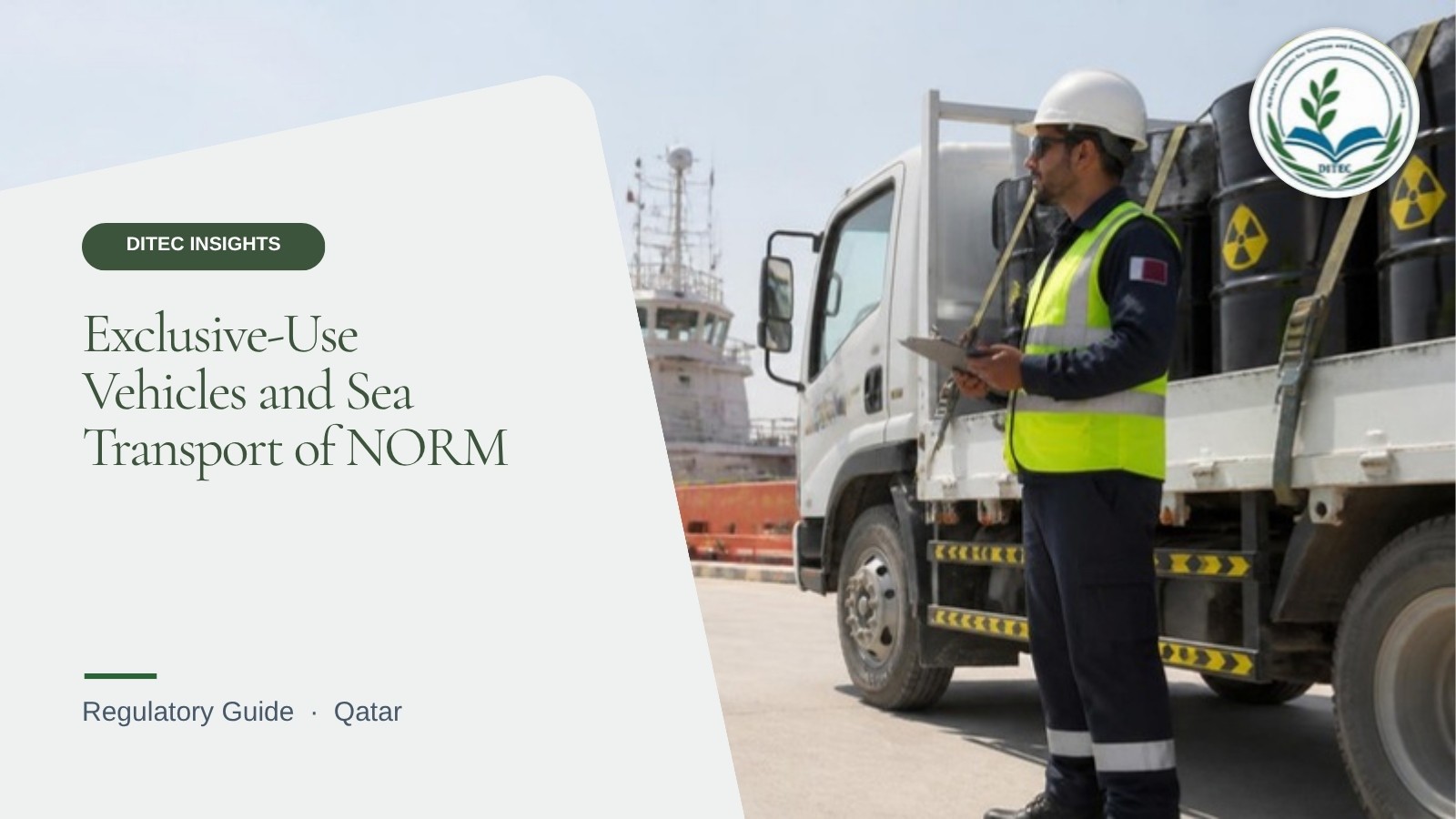
The short answer: one load, and a truck of its own
A truck that carries NORM-contaminated material in Qatar carries nothing else, and it is a vehicle of exclusive use. NORM is naturally occurring radioactive material, which the rules describe as material in which the concentration of radionuclides is increased as a result of human activity. Those are two separate clauses of article 9 of the rules attached to Decision 45 of 2013, and together they decide how a shipment is planned long before it is loaded.
Clause 3 ends with the mixed-load rule: it is not permitted to transport any other material in the vehicle that transports materials or equipment contaminated with natural radioactive materials. Clause 8 adds that natural radioactive materials, or materials contaminated with them, are transported in vehicles of exclusive use.
Exclusive use has a definition in the rules, and it is about control rather than about ownership: use confined to a single consignor using a means of transport or a large freight container, such that none of the initial, intermediate and final unloading and loading operations relating to it take place except in accordance with the instructions of the consignor or the consignee. A package, in the rules, is the radioactive material together with the packaging for the purpose of preparation for transport.
Then the sea. Two clauses speak to it, and they are not the same clause repeated. Clause 4 is about transporting contaminated materials at sea generally. Clause 9 is about the vessels that carry materials or equipment off the offshore platforms. This page is for the logistics engineer, the marine coordinator and the radiation protection officer who sign the same movement.
The four clauses, each on its own terms
Clause 3 begins with a kind of material, not with a vehicle. Relatively large quantities of solid contaminants arising from sludge or solid scale deposits in tanks and separation vessels, and large decontaminated materials, are to be transported as materials of low specific activity in drums or tanks to which the conditions of industrial packages apply. Sludge, in the rules, is an accumulation of solid material contaminated with natural radioactive materials, heavy hydrocarbons, strongly bound emulsions, sand, and a little of the corrosion products of drilling rigs and equipment, inside separation vessels, wellhead equipment, tanks and others. Solid scale deposits are the solids that settle on the inner surfaces of tubing and equipment. The clause and the definitions article use two different Arabic words for those deposits, and we record the difference and read them as one thing, which is our reading.
Low specific activity material is defined in the rules as material whose specific activity is low by its nature, or radioactive material to which the limits of medium specific activity apply, with shielding material surrounding it not taken into account when average specific activity estimates are determined. So the description is about the material, and the surrounding shielding is excluded from the estimate.
The conditions of industrial packages are named in the clause and are not defined in the definitions article, in what we have read of this decision. We say that plainly, because it is a duty whose content has to be found outside the text we are explaining, and it is a point we find open in that text.
Clause 4 asks that at sea a suitable container dedicated to transport be used, securing that contaminants do not leak or spill from it. The test in the clause is the outcome, leaking and spilling, not a named container type.
Clause 9 is tighter, and it has two halves. Vessels used to transport contaminated materials or equipment from the offshore platforms are to use transport containers that are standard and marked. Then contaminated materials that cannot be stored in the standard transport containers must be protected in a tight manner to ensure that radioactive materials do not leak or spill during transport. We read the second half as the route for what does not fit a standard container, and that reading is ours.
Two of the terms in these clauses are separate defined terms, and we do not read one for the other. The vessel is any means of sea transport, or a ship for carrying goods on inland waterways. The vehicle is the means of land transport, including agricultural tractors, trailers and railway wagons, and each locomotive counts as a vehicle in its own right. Clause 8 is written about the land term and clause 9 about the sea term; we render them vehicles and vessels.
Does exclusive use mean the truck must be owned by us?
The definition does not speak about ownership. It speaks about a single consignor and about the loading and unloading operations happening only in accordance with the instructions of the consignor or the consignee. A hired truck can meet that, and an owned truck shared on the same trip cannot.
Where the quantity question is left open
Clause 3 turns on relatively large quantities and on large materials. Neither expression carries a figure, a weight or a volume in the clause, and the definitions article does not define either of them in what we have read. So the boundary between an ordinary load and the one this clause describes is not drawn in the text.
We do not fill that gap with a number of our own and present it as the decision's. What we do instead is write the quantity and the activity per unit weight into the record for every shipment, so that whatever boundary is later stated can be applied to shipments already made.
A second open point sits in the same clause. Large materials whose contamination has been removed are named among what travels under this description. What their status is after decontamination, for purposes other than transport, is not in this clause, and we do not rule on it.
As for the exemption levels themselves, they are reached through article 5 and Annex 1, and they are a different question from how a load travels. We keep the two apart on purpose, because a load can be inside the rules for transport and still be below an exemption level for a different purpose.
Is a decontaminated tank section free to travel as ordinary steel?
Not under the clause we are reading. Large decontaminated materials are named inside clause 3 among what is transported as low specific activity material in drums or tanks meeting industrial package conditions. What a survey after decontamination permits is a separate question, and it is not answered in this clause.
Which clause governs which movement
The table puts the four clauses beside the means of transport each one names. Reading them as one rule is how a sea movement ends up planned against a land clause.
Can one shipment fall under more than one of them?
Yes, and that is the ordinary case for waste coming off a platform to a yard inland: the vessel clause governs the sea stage, and the exclusive-use and mixed-load rules govern the truck that takes it on.
The four clauses in five rows, and the means each names
| Clause | What it requires | The means it names |
|---|---|---|
| Article 9, clause 3, first part | Transport as low specific activity material in drums or tanks meeting industrial package conditions | The container, not a named vehicle |
| Article 9, clause 3, last sentence | No other material may be transported in the vehicle that transports the materials or equipment contaminated with natural radioactive materials | Land vehicle |
| Article 9, clause 4 | A suitable container dedicated to transport, securing no leak or spill | At sea |
| Article 9, clause 8 | Transport in vehicles of exclusive use | Land vehicles |
| Article 9, clause 9 | Transport containers that are standard and marked, and tight protection for what does not fit them | Vessels from the offshore platforms |
A platform load that changes hands twice
Six items of scale waste come off an offshore platform, bound for a yard inland: five drums and one cut section of tubing. Trace the movement against the clauses, and the plan writes itself.
First, at sea. Clause 9 asks for transport containers that are standard and marked. The five drums go into a standard container. The sixth item is the cut section, too long for it. The first thing done to that section is to wrap and cap its ends, under clause 2, which requires the ends of contaminated pipes to be wrapped to prevent the spread of radioactive materials. We read the duty of clause 2 and the duty of clause 9 as independent, neither standing in for the other, and that reading is ours. The section then travels protected in a tight manner that ensures no leak or spill during transport, and the manner used is written in the plan.
Second, from the quay to the yard. Now the words change. The truck is a vehicle, so clause 8 applies and the vehicle is of exclusive use, and the last sentence of clause 3 applies so nothing else travels on that truck bed. A tempting arrangement is to put two loaded pallets of ordinary pipe on the same trip to save a run. The clause does not permit it.
Third, the control test of exclusive use, which runs across both stages. The definition asks that none of the initial, intermediate and final loading and unloading operations happen except in accordance with the instructions of the consignor or the consignee. So a stop at a third party depot where a forklift driver rearranges the truck bed breaks the condition, even if nothing is added or removed. Write the route with its stops into the plan and name who gives instructions at each one.
Fourth, back to the sixth item. It travelled at sea under the tight protection route. On the truck it is still a large item in a mixed-size load, and clause 3 describes large materials travelling as low specific activity material in drums or tanks meeting industrial package conditions. Which container that section ends up in is a decision to take at the quay, not at the gate of the yard.
As for who does this, the container selection, the lashing, the route and the instructions at each stop fall to the operator's people and its contractors. So the marine coordinator writes the container numbers and the protection method for the item that did not fit, and the transport supervisor writes the stops. We train on that movement plan and are consulted about it, and we do not run the shipment.
Movement questions we are asked
What exactly are the conditions of industrial packages?
The clause names them as a requirement and the definitions article does not define them, in what we have read of this decision. So the content has to come from the packaging standard the regulator and the carrier work to. This is a point we find open in the text, and we do not substitute a standard of our own choosing and call it the decision's.
Does the mixed-load rule stop us carrying our own empty drums on the return trip?
The sentence speaks about the vehicle that transports the contaminated materials or equipment, and about any other material in it. A return trip with an empty truck bed is a different movement, and an empty drum that previously held contaminated material is not obviously another material within the meaning of that sentence. We do not settle that by reading. The cautious course is that an emptied drum is treated as contaminated until a survey shows otherwise: keep the lid closed, survey inside and outside, do not carry it open, and then clear and survey the bed.
Is a standard container at sea the same as a suitable container?
They are two expressions in two clauses. Clause 4 asks for a suitable container dedicated to transport, with a leak and spill test. Clause 9 asks for transport containers that are standard and marked on the vessels coming off the platforms. We keep the wording of each clause with its clause rather than merge them into one requirement.
Marked with what?
The clause says standard and marked and does not say what the marking carries. The labelling duties elsewhere in the article name the warning signs, the transport guide and the other labels particular to transport, the transport guide being the number placed on the warning sign, set out on its own page. Those are a sensible reading of what a marked container shows. That reading is ours.
Our contaminated items go out on a supply boat with the catering stores. Is that permitted?
The mixed-load sentence in clause 3 names the vehicle, which is the land term in the definitions article, and the sea clauses speak about containers rather than about sharing a vessel's deck. So the text we read does not give a plain answer for a supply boat, and we do not manufacture one. What it does require is a container that secures no leak or spill, and separation from foodstuffs is ordinary practice we would advise on its own merits.
Notes for the person planning the movement
Start the plan from the words, not from the truck yard. The clauses change their requirement when the means changes, so a movement with a sea stage and a land stage carries two sets of duties on one consignment, and a single transport note covering both tends to carry the weaker set.
Decide the exclusive-use question at planning, not at the gate. Once a load is on a shared truck bed the condition is already broken and the remedy is an unloading operation, which is itself the thing the definition controls.
Lashing is a radiation protection matter here, not only a cargo matter. A drum that shifts at sea and splits turns a transport job into a decontamination job on a deck, and the leak-and-spill test in both sea clauses is written in terms of that outcome.
Photograph the tight protection you used on the item that did not fit a standard container, and keep the photograph with the shipment record. The clause states an outcome and names no method, so the evidence that an outcome was secured is the method you can show afterwards.
Survey the truck bed and the lashings after unloading, as a practice we advise. The clauses we have read do not impose it, and we say so, but the straps touch the drums and the next load on that bed may be anything.
So the plan is a short document holding the terms of four clauses and a route with named stops. That is all this page asks for, and it is written before the first drum is lifted.
How DITEC helps, and where its work stops
On this page the question we are asked is almost always whether a shared trip can be arranged for one load. We train on reading clause 8 with the exclusive-use definition beside it, and we are consulted on the movement plan for a platform to yard shipment.
ALDuha Institute for Training and Environmental Consulting (DITEC) works in training and consulting. The Institute does not run a laboratory analysis service, does not calibrate instruments, and does not test equipment. Field survey work is arranged through specialist partners.
Our training is licensed. Nothing here is an undertaking that a licence will be issued, and nothing here promises how long any application takes. The decision rests with the Ministry of Environment and Climate Change, Radiation Protection Department.
Reference: DITEC Experts and the Radiation Protection team. This page is an introductory explanation of a published decision and is not a legal opinion.
Quick Actions
Radiation protection programmes for NORM in oil and gasRequest a radiation protection consultationIn this article
Related Blog
Explore more articles in NORM & Oil & Gas

October 17, 2026
The NORM Transport Factor and Warning Labels in Qatar
Clause 7 and clause 11 of article 9 of Decision 45 of 2013: setting the transport factor for each drum in Qatar, and the labels and statement that travel with it.
Read more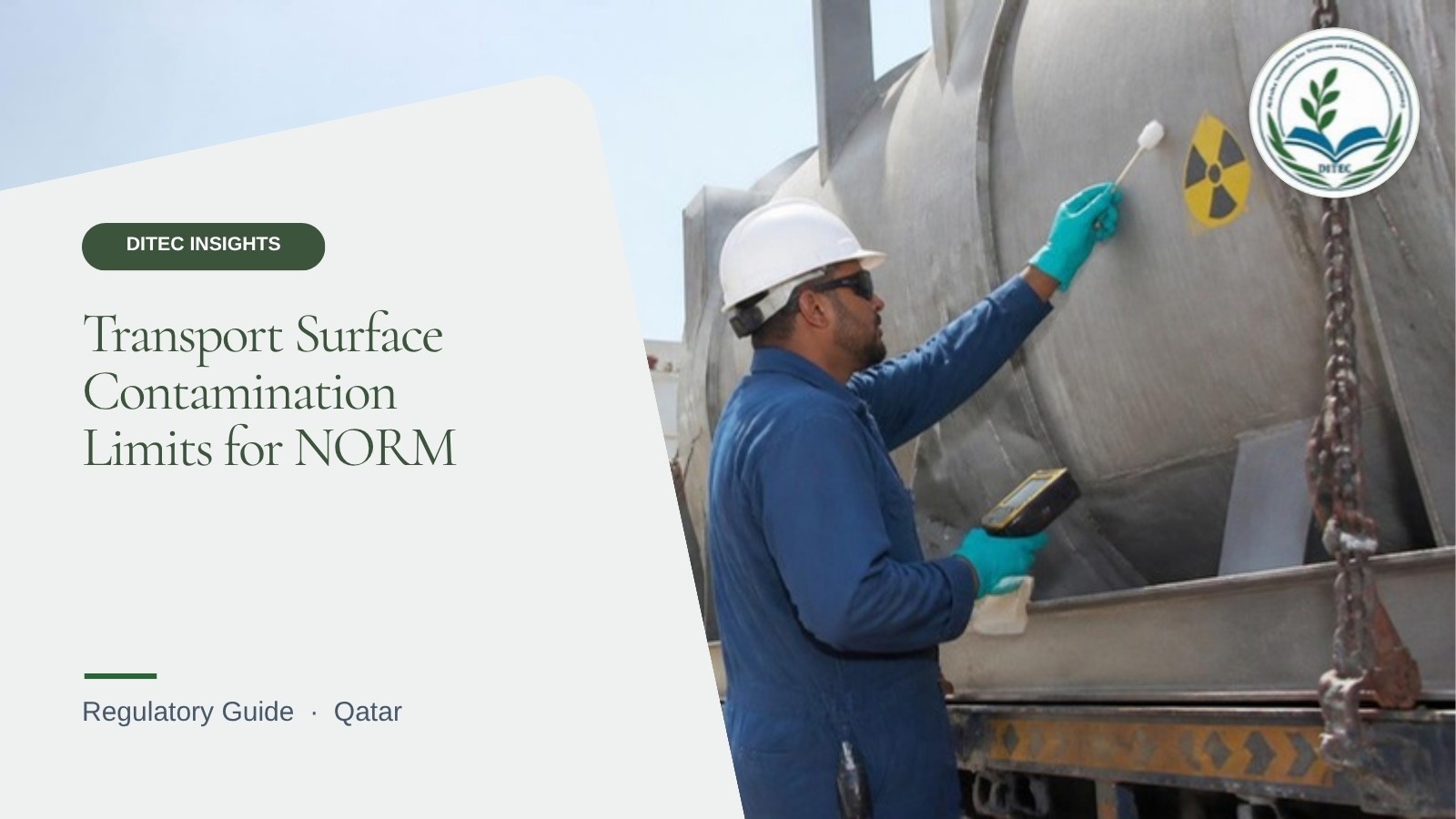
October 17, 2026
NORM Transport Surface Contamination Limits in Qatar
Clause 1 and clause 6 of article 9 of Decision 45 of 2013: the loose surface contamination figures for NORM transport in Qatar, and the package surface radiation level.
Read more
October 17, 2026
The NORM Transport Plan and Packaging Duties in Qatar
Clauses 2, 5 and 10 of article 9 of Decision 45 of 2013 in Qatar: wrapping contaminated pipe ends, the written transport plan, and notifying the receiving party.
Read more