
What the Protection Officer Must Verify in a Laboratory
 October 19, 2026
 12 min read
 DITEC Experts, Radiation Protection Team, ALDuha Institute for Training and Environmental Consulting
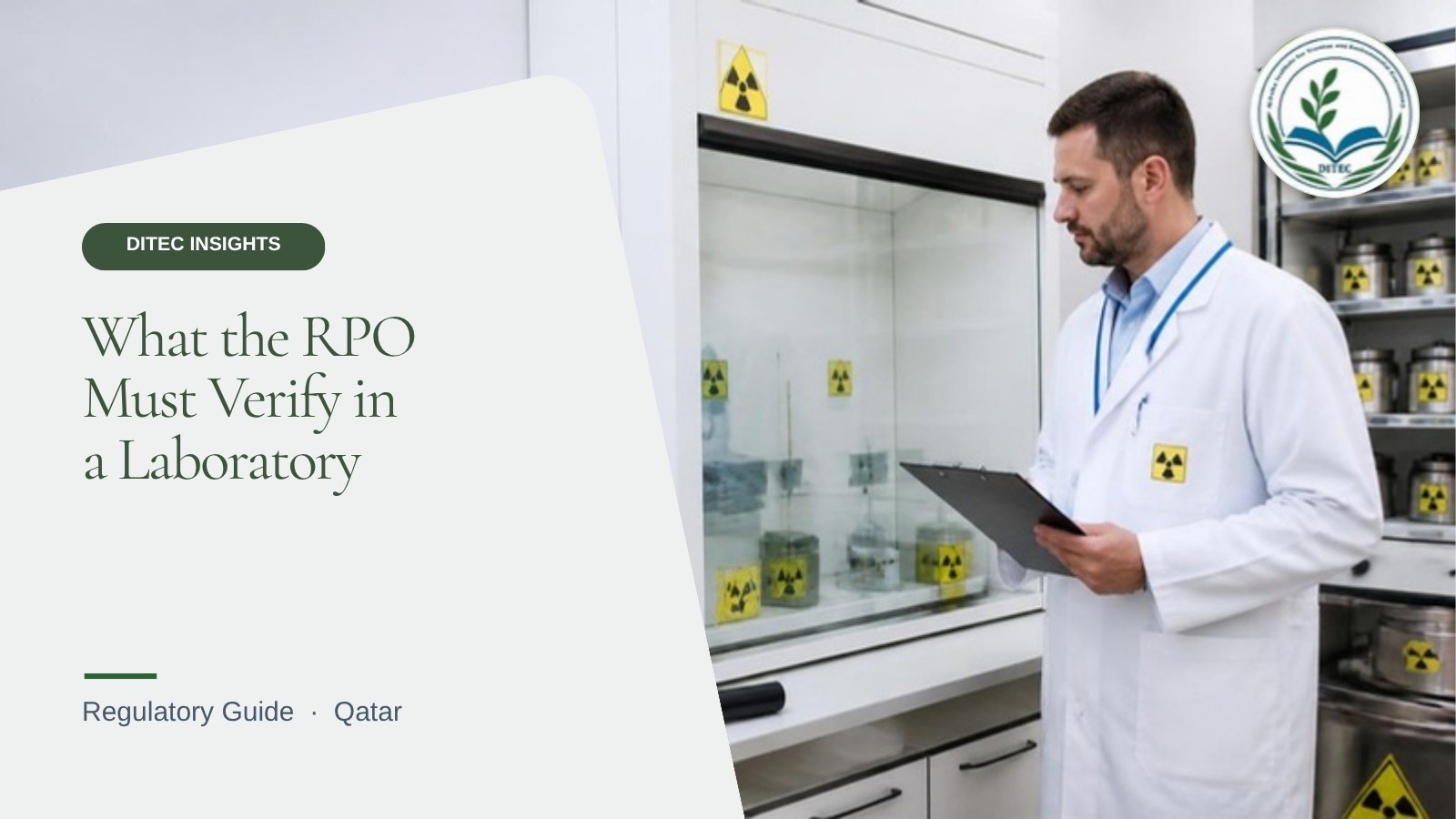
Who this page is for, and what it answers
The duty of the radiation protection officer in a laboratory is one of standing verification, not verification at the moment of an incident. Article 2 of the instructions in decision 3 of 2007 binds him to two things: that first aid supplies be available at all times, and that three places be free of contamination. The time qualifier in the first clause is stated in terms.
Four words are needed on this page. The radiation protection officer is the person named in the laboratory to see to radiation protection. Verification is an act of checking that comes before an incident and does not wait for one. First aid supplies are materials of which the text gives examples. And a radiation survey is a measurement taken to look for contamination in a place.
The page is for the protection officer himself. It is for the laboratory manager who signs the readiness record. And it is for whoever prepares a periodic checklist in a laboratory that handles radioactive material.
Where this sits in the text: the opening of article 2 and its first clause, together with its second clause so far as the places are concerned. The article is in the instructions attached to the decision, not in its two enacting articles.
The most important caution: the list of supplies in the text is given by way of example and not as a closed list. Its wording is introduced by a word of likeness. So we give no count of its items, and we do not say that whoever has gathered the named items has satisfied the requirement.
The wording is one of verification rather than provision. The officer verifies what follows, and that is an act of checking and recording. Whoever buys the supplies and equips the place is the licence holder. That is our reading of the wording of the opening.
There is no measurement figure in this article and no acceptance limit. The limits sit in other articles of the instructions, which have their own pages. Numbers from one place are not imported into another.
The two duties as the instructions of 3/2007 state them
The opening of the article fixes who is bound and how far: radiation protection officers in all laboratories are required to verify what follows. So the address is to radiation protection officers, in all laboratories, and not in large laboratories alone.
The first duty concerns first aid supplies: the clause requires that first aid supplies be available at all times, and gives as examples filter paper, bandages, cotton, soft and coarse brushes, as well as cleaning and disinfecting solutions and soap. The examples are introduced by a word of likeness. And the time qualifier is at all times.
The meaning of that time qualifier is that verification is periodic and not a single occasion. A supply whose shelf life has expired is not available. A supply in a locked cabinet whose key is not to hand at night raises the question whether it counts as available, and that is a point the text leaves open. That is our reading of the wording of the qualifier.
The second duty concerns the absence of contamination: the clause requires the absence of radioactive contamination in the work areas, in the areas where radioactive material is stored, or when it is moved, using the available survey instruments and following the two methods below. The three places are named, and the two methods come after them and have their own page in this batch.
Moving the material is the least noticed of the three places. It is a state rather than a place, and it happens in the corridor, in the lift and on the trolley. So a verification record that names the two places and forgets the state is incomplete. That is our reading.
What the text does not say here
The clause states no quantity of each supply. It states no shelf life and no place of keeping. It does not say who buys them or who renews them. It states no written record and no form for one. And it states no sanction for a shortfall.
First aid supplies, not a first aid service
The clause requires verifying that the supplies are available. It does not make the protection officer a first aider or a physician. First aid and treatment belong to the medical bodies the instructions name elsewhere. The institute takes on none of that.
What falls outside this article
Article 2 gives no numerical limit. It names no unit of radioactive activity and no area of surface over which a rate is worked out. The limits sit in other articles of the instructions, which have their own pages.
It does not deal with what is done when an incident occurs. That is another article, with its own page in this batch. This is an article about readiness before an incident.
It does not deal with personal contamination or with medical referral. Their place is another article of the instructions. A person is not judged by a rule written for a place.
It does not deal with training the workers or with the officer's qualification. We do not say what we have not read. And we do not carry a condition from another instrument into this place.
The places we have read contain no penalty and no transition period. So it is not said that a shortfall in supplies carries a particular sanction. What we have not read, we do not judge.
The places to be verified, in brief
The table below gathers the places to be verified and the condition required in each. Take it up when you write your record, not on a first reading.
The last column suggests when verification falls due: it is our reading, we impose nothing by it, and the text states no interval and no occasion. The names of the places are given as the text gives them, except the third, where the text says only that the material is moved and we have spelled out what it refers to. The middle column summarises what the text provides, in our words. The table carries no figure and no limit, because the article contains none.
The places to be verified in article 2
| Place to be verified | The condition required | When verification falls due, our reading |
|---|---|---|
| First aid supplies | That they be available at all times | Periodically, and not once only |
| The work areas | That they contain no radioactive contamination, using the available survey instruments and both methods | With each radiological practice carried out in them |
| The areas where radioactive material is stored | That they contain no radioactive contamination, by the same two methods | With each introduction or removal of a source |
| When radioactive material is moved | That there be no contamination when it is moved | With each movement inside the facility, moving being a state rather than a place |
A case of a first aid cabinet, and four steps
Suppose a laboratory whose first aid cabinet was stocked two years ago and has not been opened since. It is opened, and the soap is there while the disinfectant solution has passed its expiry date. The stated qualifier is availability at all times, and a supply past its expiry date is not available. That is our reading of the wording of the qualifier, not a provision in it. Had the shortfall been in the brushes the position would be the same, because the list is by way of example and not closed, so a shortfall is judged against the purpose and not against a count of what is written.
Step one: make the verification periodic and written. The stated qualifier is availability at all times, and we read from it that one stocktake a year does not satisfy it.
Step two: list in your checklist the items the text gives as examples, and add what your laboratory requires. Do not say that the list in the text is closed.
Step three: name the three places in the survey record, including the moment of moving the material. What is not named does not get verified.
Step four: raise any shortfall with the licence holder and no one else. The protection officer verifies, records and reports: this is what we train on, not what we do for you.
Questions people ask
How many items must the first aid cabinet hold?
We give no number. The wording of the text offers examples introduced by a word of likeness, not a closed list. Whoever counts the named items and treats that as a ceiling has read something other than what is written.
Is verifying once a year enough?
The stated qualifier is availability at all times. We read from it that verification is periodic, and that is our reading. The text states no interval.
Is the officer required to buy the supplies?
The wording of the opening is verification and not purchase. Buying and equipping belong to the licence holder. That is our reading of the wording, and how the cost is divided is a point the text leaves open.
Does the duty cover small laboratories?
The wording is in all laboratories. It draws no distinction by size. So we do not introduce a distinction it does not make.
Will the institute equip the first aid cabinet and approve it?
No. Our work is training and consulting. The institute does not provide first aid, treatment or medical assessment. It does not test equipment or certify it as safe. Equipping belongs to the licence holder, through specialist partners where needed.
Notes on transcription and reading
Article 2 is sound in transcription, containing no symbol and no figure whose reading is in doubt. So we have withheld nothing from this page. What we have withheld elsewhere sits in other articles of the instructions and is declared on their own pages.
The list is by way of example and not closed, and that is a judgement about the form of the wording rather than an estimate of ours about the number. The word of likeness at the head of the list is the evidence. Had the text intended a closed list, it would have given the list without that word.
A point the text leaves open: the clause states no written record of the verification. Whether a verification without a record is accepted, it does not say. We advise keeping a record and do not attribute that to the text. We have not raised the question with the competent authority, so we do not speak in its name.
What the institute offers, its limits, and the reference
This page is about the standing duty of verification on the radiation protection officer in a laboratory. The institute trains people to build the checklist and to document it.
ALDuha Institute for Training and Environmental Consulting works in training and consulting. Its training is licensed. It does not run a laboratory analysis service for smears. It does not calibrate radiation survey instruments. It does not test equipment or certify it as safe. It does not carry out decontamination in a laboratory or on a site.
The institute does not provide first aid, treatment or medical assessment. First aid and treatment belong to the medical bodies the instructions name. We train people to know who is notified and when, and to write down what happened.
Surveying and decontamination are the work of the licence holder and his radiation protection officer. Where outside expertise is needed, it is arranged through specialist partners. We train people to read, measure and document. We do not do the work in place of the licence holder.
Neither our training nor our consulting gives any undertaking that a licence will be issued. There is no undertaking about how long an approval will take. That decision belongs to the competent authority alone.
Reference: decision 3 of 2007 of the chairman of the Supreme Council for the Environment and Natural Reserves, on radioactive decontamination instructions. Location: the opening of article 2, its first clause, and the places named in its second clause, in the attached instructions. The decision rests on decree law 31 of 2002, and on the executive regulation issued by decision 4 of 2003. The decision's own preamble points in particular to article 17 of the first and article 97 of the second. We name the two enabling instruments and carry the preamble's reference to them, and we do not quote their text.
A note on the names of authorities: the decision was issued by the Supreme Council for the Environment and Natural Reserves. The authority addressed today is the Ministry of Environment and Climate Change, which houses the Radiation Protection Department. The name changed and the duty stands.
This page is an introductory explanation of a published text, and is not a legal opinion. It does not replace reading the decision itself. It does not replace checking with the competent authority.
In this article
Related Blog
Explore more articles in Radiation Protection
October 19, 2026
Direct and Indirect Surveying for Contamination
Article 2 of the 2007 Qatari decontamination instructions names two ways to detect laboratory contamination: a direct instrument survey and an indirect smear.
Read more
October 19, 2026
Eight Immediate Steps After Laboratory Contamination
Article 4 of the 2007 Qatari decontamination instructions sets eight immediate steps before the contamination is removed, notification of two authorities first.
Read more
October 18, 2026
The Four Radiotoxicity Groups, and How to Read Them
Article 3 of Qatar decision 3 of 2007 divides radioactive materials into four radiotoxicity groups, with table 1 giving group one its own column and table 2 its own row.
Read more