
Direct and Indirect Surveying for Contamination
 October 19, 2026
 12 min read
 DITEC Experts, Radiation Protection Team, ALDuha Institute for Training and Environmental Consulting
Who this page is for, and what it answers
There are two methods of looking for radioactive contamination in a laboratory, not one: a direct method, by passing a survey instrument over the surfaces, and an indirect method, by taking a smear with a special filter paper and then examining it with a measuring instrument. This is the substance of clause 2 of article 2 of the instructions in decision 3 of 2007, in our words, and we do not reproduce its wording in English. The text names the two following methods, and we read from it that both are required together.
A few words are needed on this page. A radiation survey is a measurement taken to look for contamination in a place. A survey instrument is a device passed over a surface to read what is on it. A smear is a quantity of dust or material wiped off a surface so that it can be examined afterwards. A filter is a special paper by which the smear is taken. And a measuring instrument is the device by which the smear is examined once taken.
The page is for the radiation protection officer in a laboratory. It is for whoever prepares a written survey procedure. And it is for whoever reads a survey report and wants to know whether both methods were used.
Where this sits in the text: clause 2 of article 2 of the instructions attached to the decision, not of its two enacting articles. The opening of the article names who is bound by it.
The most important caution: the direct method on its own is not enough. The wording names the two following methods and does not treat them as alternatives. So whoever passes the instrument and takes no smear has done half of the duty.
The difference between them is a difference of question. The direct method asks what the reading on this surface is now. The indirect method asks what transfers off this surface when it is wiped. The second is what reveals whatever would stick to a hand or a glove.
There is no measurement figure in this article. It names no unit of radioactive activity and no area of surface over which a rate is worked out. The limits and their areas sit in other articles of the instructions, which have their own pages. Numbers from one place are not imported into another.
The two methods as the instructions of 3/2007 state them
The opening of the article names who is bound: radiation protection officers in all laboratories are required to verify what follows. So the duty falls on radiation protection officers, in all laboratories, and the wording is one of verification rather than removal.
Clause 2 states what is to be verified: the absence of radioactive contamination in the work areas, in the areas where radioactive material is stored, or when it is moved, using the available survey instruments and following the two methods below. So three places are named: the work areas, the storage areas, and the moment of moving the material.
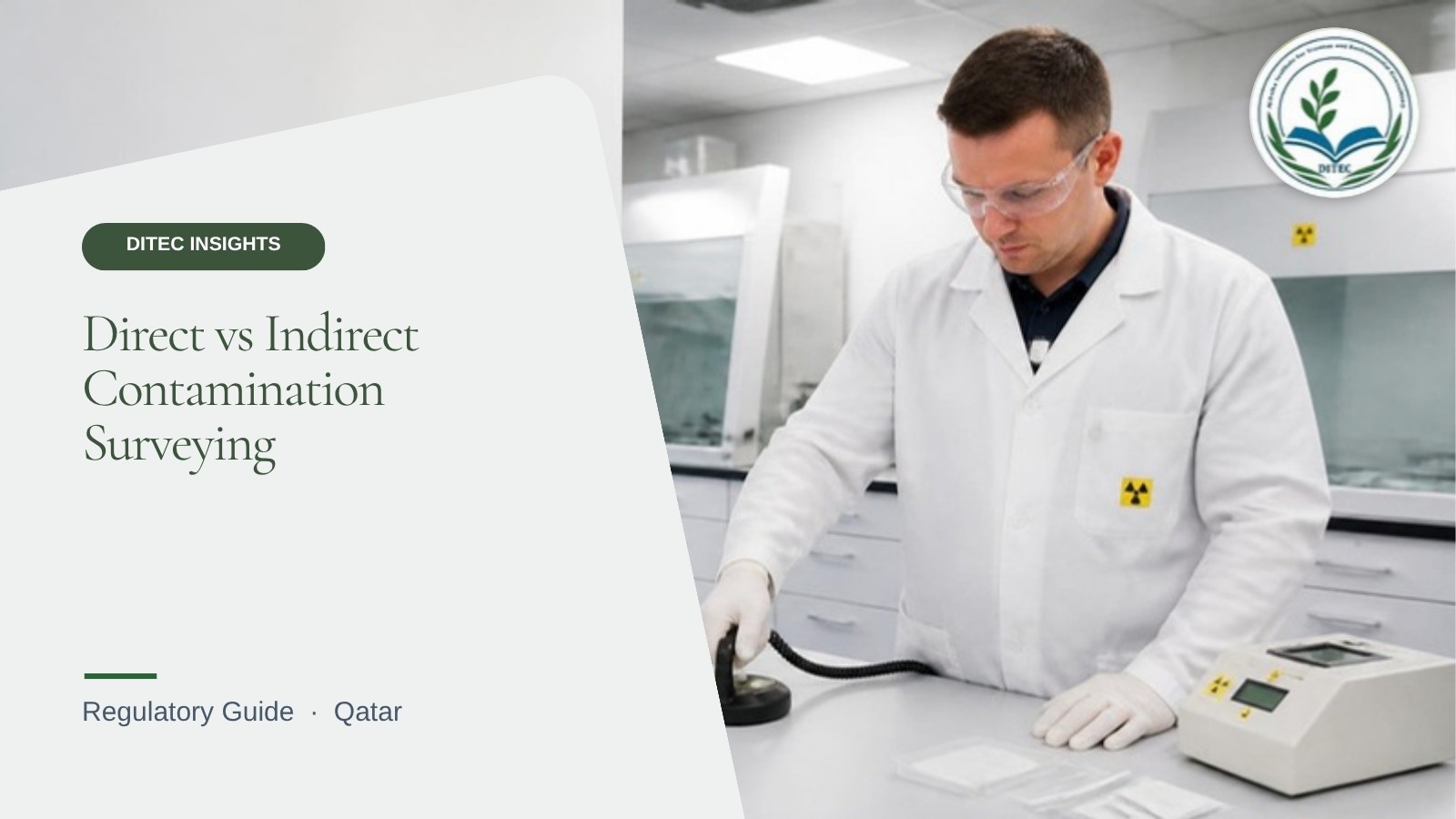
The first method is direct, and its wording describes using the radiation survey instruments by passing them over the various surfaces and places where radioactive material is used. So the instrument is the survey device, and the act is passing it over the surfaces and places.
The second method is indirect, and its wording describes taking smears, which are quantities of dust or material wiped off the surfaces by means of special filters or paper strainers, and examining those smears with the radiation measuring instruments. So there are two tools: a special filter or paper strainer to take the smear, and a measuring instrument to examine it. The examination comes after the wiping, not with it.
Why does the text speak of the available survey instruments? Because it names no model and no type. And this is our reading: choosing the instrument is left to the licence holder and his protection officer. The text does not make the word available a technical fitness requirement. As a technical description of our own: what is fit for measuring contamination on a surface differs from what is fit for measuring radiation in the air. An instrument that measures radiation in the air may not show contamination on a surface. An instrument that does not respond to the material's radiation reads nothing while the contamination stands. Calibration is the comparison of an instrument with a known reference and its adjustment to that reference, so that its reading can be relied on. This place states no calibration requirement, and we do not read that silence as meaning that an uncalibrated reading can show a place to be free of contamination. That is our reading; the text itself gives no reason.
What the text does not say here
This place states no interval between one survey and the next. It names no instrument model. It states no calibration and no certificate for it. It states no number of smears per occasion. And it states no numerical limit against which a reading is compared.
Why both methods are needed together
A smear reveals what transfers off the surface and does not reveal what is fixed on it. A survey instrument reads what is on the surface, fixed or transferable, and does not say whether it would stick to a hand. This is our technical explanation, and the text gives no reason. Taken together the two methods tell the transferable from the fixed, and that is our reading. The limits themselves sit in other articles of the instructions, which have their own pages, and we pass no judgement on their content here.
What falls outside this place
This clause gives no permitted limit. Anyone looking in it for an acceptance figure will not find one. The limits sit in other articles of the instructions, which have their own pages in this series.
It gives no area of surface over which the rate is worked out. The method is one thing, and the area it is worked out over is another.
This clause does not deal with what is done if contamination is found. It is a clause about detection and not about an incident, and the incident sits in another article of the instructions. This page is about clause 2 alone; clause 1 of the same article has its own page in this batch.
It does not state a method of removal. Those sit in other articles, belonging to a later batch in this series. We name them, and we neither quote them nor describe their content here.
The places we have read in these instructions contain no penalty and no transition period. So it is not said that omitting the survey carries a particular sanction. What we have not read, we do not judge.
The two methods compared, in our words
The table below sets the two methods against each other, with their instruments and what each involves. Skip it on a first reading; the explanation above carries the point.
The last column in the table is our reading of what the place does not state, and is not drawn from it. The second column summarises what the text provides, in our words. In the instrument column the names of the instruments are the text's own, and any words about how an instrument is used are ours. We quote nothing of the law in English.
The two detection methods in article 2
| Method | What the officer does | Instrument named | What is not stated, our reading |
|---|---|---|---|
| Direct | Passing the survey instruments over the various surfaces and places where radioactive material is used | The available radiation survey instruments | No instrument model, no calibration and no interval between surveys |
| Indirect | Taking smears of dust or material off the surfaces, then examining those smears | Special filters or paper strainers to take the smear, and the radiation measuring instruments to examine it | No number of smears, no sampling location and no interval between one smear and the next |
A case of an incomplete survey, and four steps
Suppose a laboratory with a work area and a source cabinet. The officer passes the instrument over the surfaces, and his reading does not rise above the background measured in that place before the survey. He then takes no smear at all. On our reading the duty has not been completed, because the text names the two following methods and does not present them as alternatives. Had he taken a smear from the bench and none from the cabinet, one of the three places would be left unverified. Moving the material is a third place named in terms, and it is often forgotten.
Step one: write a procedure that names both methods together. The direct survey on its own is not enough, which is our reading of the wording of the text.
Step two: list the three places in the procedure by name. The work areas, the storage areas, and the moment of moving the material. What is not named does not get verified.
Step three: keep each smear with its location, its date and the instrument used to examine it. A smear without a location cannot be reviewed.
Step four: if contamination is found, the governing place is another article of the instructions. Raise the matter with the licence holder. The protection officer surveys, takes the smear and writes it up: this is what we train on, not what we do for you.
Questions people ask
May I choose one of the two methods?
The wording names the two following methods and does not present them as alternatives. We read it as requiring both together, and that is our reading of its wording.
How many times a month should I survey?
This place states no interval between one survey and the next. We do not supply an interval of our own. And we do not say what the places we have not read contain.
Which filter is suitable for taking a smear?
The text says special filters or paper strainers. It names no type and no size. We render the wording and name no product.
Is one instrument enough for both methods?
The text names survey instruments for the direct method, and measuring instruments for examining the smears. Whether one device can serve both is a point the text leaves open, and we have not put it to any authority.
Will the institute take the smears and examine them for me?
No. Our work is training and consulting. The institute does not run laboratory analysis of smears and does not calibrate survey instruments. The work belongs to the licence holder and his protection officer, through specialist partners where needed.
Notes on transcription and reading
What we work from is a written transcript, not a scanned image. Article 2 is sound in transcription: it contains no symbol and no figure whose reading is in doubt. So we have withheld nothing from this page. What we have withheld elsewhere sits in other articles of the instructions and is declared on their own pages.
A point the text leaves open: the clause does not say who examines the smear or where it is examined. Whether an examination inside the laboratory suffices, or another laboratory is needed, it does not say. We have not raised it with the competent authority, so no view of theirs is reported here.
What the institute offers, its limits, and the reference
This page is about the two methods of detecting contamination in a laboratory. The institute trains radiation protection officers to write a procedure that covers both methods and to document the smear.
ALDuha Institute for Training and Environmental Consulting works in training and consulting. Its training is licensed. It does not run a laboratory analysis service for smears. It does not calibrate radiation survey instruments. It does not test equipment or certify it as safe. It does not carry out decontamination in a laboratory or on a site.
The institute does not provide first aid, treatment or medical assessment. First aid and treatment belong to the medical bodies the instructions name. We train people to know who is notified and when, and to write down what happened.
Surveying and decontamination are the work of the licence holder and his radiation protection officer. Where outside expertise is needed, it is arranged through specialist partners. We train people to read, measure and document. We do not do the work in place of the licence holder.
Neither our training nor our consulting gives any undertaking that a licence will be issued. There is no undertaking about how long an approval will take. That decision belongs to the competent authority alone.
Reference: decision 3 of 2007 of the chairman of the Supreme Council for the Environment and Natural Reserves, on radioactive decontamination instructions. Location: clause 2 of article 2 of the attached instructions. The decision rests on decree law 31 of 2002, and on the executive regulation issued by decision 4 of 2003. The decision's own preamble points in particular to article 17 of the first and article 97 of the second. We name the two enabling instruments and carry the preamble's reference to them, and we do not quote their text.
A note on the names of authorities: the decision was issued by the Supreme Council for the Environment and Natural Reserves. The authority addressed today is the Ministry of Environment and Climate Change, which houses the Radiation Protection Department. The name changed and the duty stands.
This page is an introductory explanation of a published text, and is not a legal opinion. It does not replace reading the decision itself. It does not replace checking with the competent authority.
In this article
Related Blog
Explore more articles in Radiation Protection

October 19, 2026
Eight Immediate Steps After Laboratory Contamination
Article 4 of the 2007 Qatari decontamination instructions sets eight immediate steps before the contamination is removed, notification of two authorities first.
Read more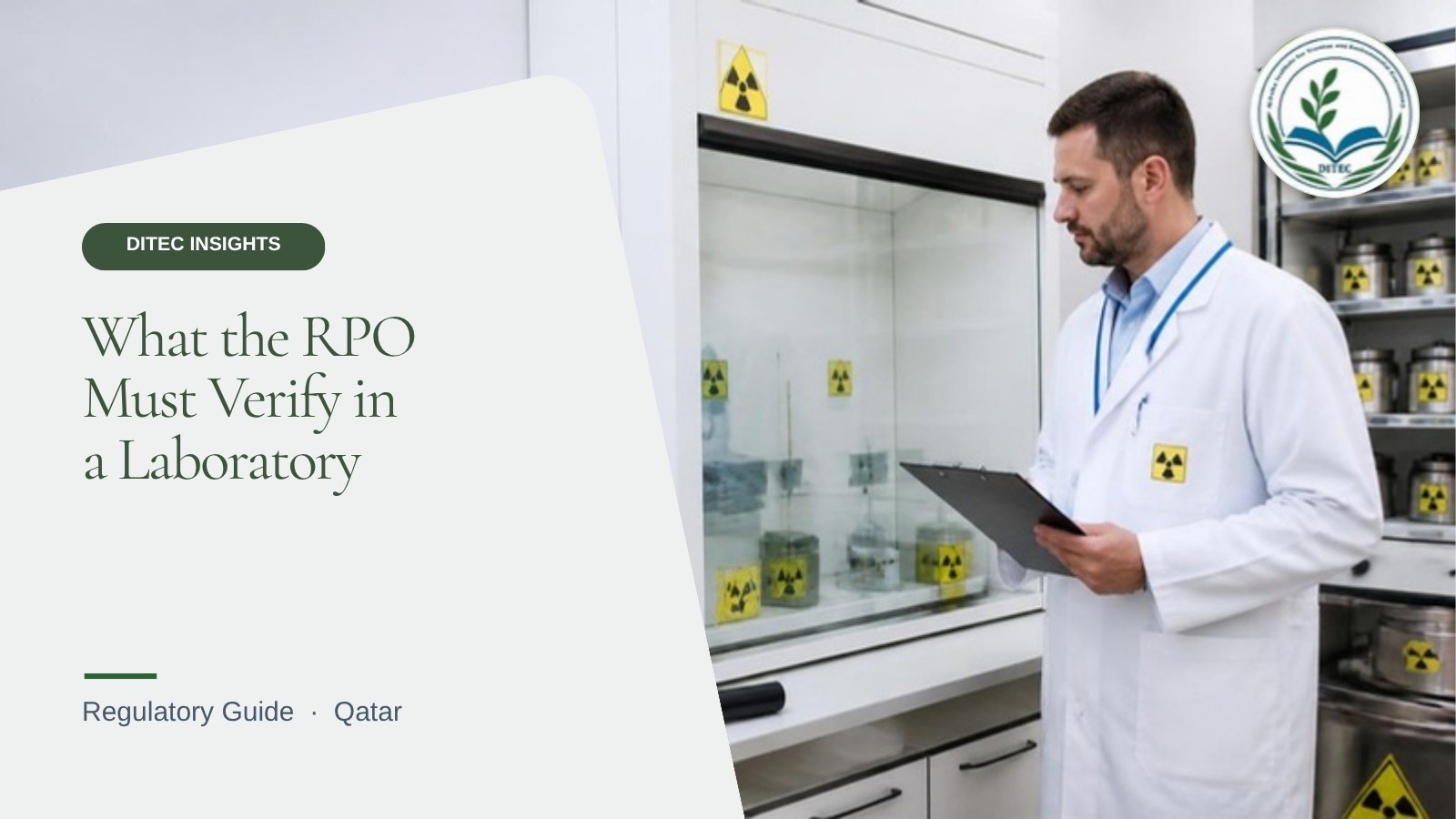
October 19, 2026
What the Protection Officer Must Verify in a Laboratory
Article 2 of the 2007 Qatari decontamination instructions puts two checks on the protection officer: first aid supplies at all times, three places free of contamination.
Read more
October 18, 2026
The Four Radiotoxicity Groups, and How to Read Them
Article 3 of Qatar decision 3 of 2007 divides radioactive materials into four radiotoxicity groups, with table 1 giving group one its own column and table 2 its own row.
Read more