
Radiation Worker Protection — Medical
Designed to IAEA radiation safety standardsRadiation Worker Protection Course — Medical Sector
Also available on request, including in-house at your own site.Also known as: Radiation Awareness · Occupationally Exposed Worker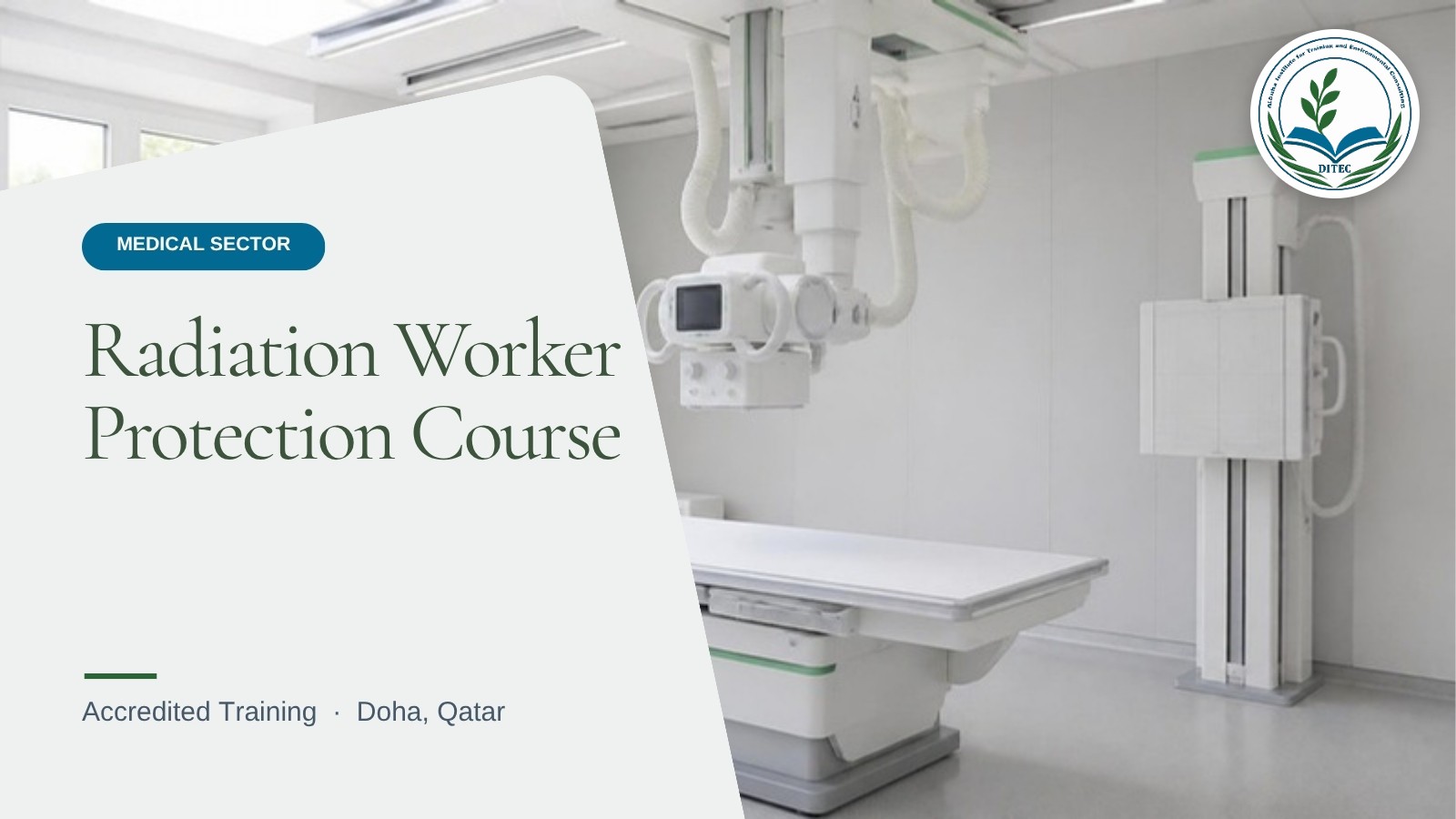
 Duration
Two days
Twice weekly, Sunday to Wednesday
 Who it is for
Medical radiation workers
Anyone assigned to work with or near a source in a clinical setting
 Certificate
QR-verifiable
Issued by ALDuha Institute and verifiable on this site
Upcoming dates
Fixed schedule: Twice weekly, Sunday to Wednesday — ask us for the next intake
 Programme overview
Who must attend a radiation worker course in a hospital or clinic in Qatar, and how is it different from the Radiation Safety Officer course? Every person who works with or near a radiation source in a medical facility — a radiographer, a CT or fluoroscopy technologist, a nuclear medicine technologist, a cath-lab or theatre nurse, a dental assistant, a porter who moves patients through a controlled area — has to be trained before being assigned to the work. This two-day programme covers what the medical radiation worker must know to keep his own dose low, to spare the patient exposure that serves no clinical purpose, and to act correctly when something goes wrong. The Radiation Safety Officer supervises; the radiation worker is the one standing beside the tube.
 A specialised radiation protection programme for clinical staff
 Course content
 Ionising radiation in the clinical setting: X-ray tubes, CT, fluoroscopy, sealed sources in brachytherapy and unsealed radiopharmaceuticals — and how each differs in the hazard it presents.
Biological effects and the honest picture of risk: deterministic effects such as skin injury in prolonged fluoroscopy, stochastic effects, what a millisievert means in practice, the difference between worker dose and patient dose, and the declared pregnant worker.
Time, distance and shielding inside the room: lead aprons, thyroid shields and mobile screens, scatter from the patient as the dominant source of the worker's dose, and the inverse-square rule at the table.
Controlled and supervised areas in a hospital: signage, door interlocks, warning lights, and who may remain in the room at the moment of exposure.
Personal dosimetry: badge placement over or under the apron, what TLD and OSL readings mean, investigation levels, and what follows a high reading.
Patient protection as part of the worker's own job: collimation, correct exposure factors, avoiding unnecessary repeats, pregnancy checks before exposure, and awareness of paediatric dose.
What to do when it goes wrong: an exposure that will not stop, a contaminated spill in nuclear medicine, a missing brachytherapy source, a dose incident — who to call, in what order, and what never to do.
 Who should attend
Radiographers and radiologic technologists.
CT, fluoroscopy and interventional radiology technologists.
Nuclear medicine technologists and staff handling radiopharmaceuticals.
Cath-lab and operating theatre nurses who are present during exposure.
Dental assistants and dental clinic nurses.
Porters, cleaning and maintenance staff who enter controlled areas.
 What you leave with
A certificate of completion from ALDuha Institute, verifiable by QR code on this website.
The ability to read a personal dose report and know what the numbers require of you.
A written personal action card for the emergency scenarios of your own department.
Documentation your employer can place in the training record the Ministry inspects.
 Regulatory basis
Decree-Law 31 of 2002 on protection from radiation and its Executive Bylaw 4 of 2003.
Radiation Protection Department requirements — Ministry of Environment and Climate Change, Qatar.
IAEA GSR Part 3 — occupational dose limits and the training of workers.
Frequently asked questions
How long is the course?
Two days — Twice weekly, Sunday to Wednesday