
Who Counts as a Radiation Worker in Qatar: Ten Occupations
 October 25, 2026
 11 min read
 DITEC Experts, Radiation Protection Team, ALDuha Institute for Training and Environmental Consulting
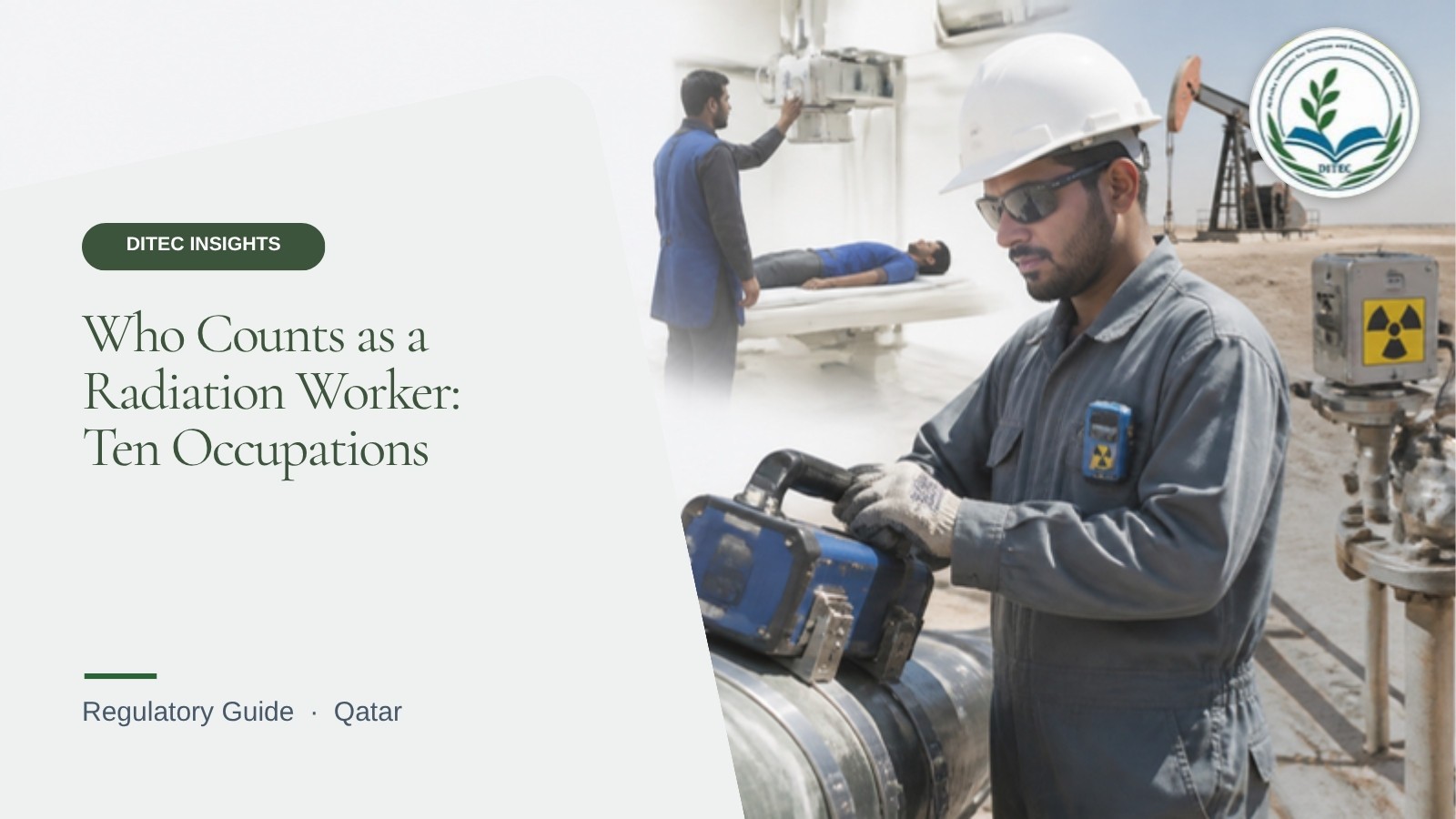
The Answer First
Who the description covers
You are a radiation worker if your job is one of ten occupations named by the instructions issued by Decision 2 of 2005.
Article 1 of the instructions issued by Decision 2 of 2005 lists those ten occupations expressly.
The opening of the article ties that list to the definition of a radiation worker in article 1 of the executive regulation of Law 31 of 2002.
The list does not displace the definition, and the definition does not displace the list.
Why the description matters
The description is the gateway on which the practical duties are built: licensing, a dosimeter, a record, and medical examination.
The licence is stated in item 10 of this same article. These instructions impose no general duty of dosimetry or of records. Article 5 governs a damaged dosimeter and refers to the records. Article 6 provides for the necessary medical examinations once an excess dose is confirmed, not a periodic examination. Anything beyond that sits in other texts, which we do not transcribe here.
A dosimeter is a personal device the worker carries, read periodically to estimate what they received.
Getting the description wrong makes every duty that follows it wrong.
Who asks this question
The licensee asks it when building the list of workers.
The radiation protection officer asks it when issuing dosimeters.
The human resources manager asks it when writing the job description.
The inspector asks it when matching the list against the roles actually present.
They all have one answer: the ten items, then the definition.
The Ten Occupations as the Article Names Them
The first six
The first item is the radiographer, in the medical field or the industrial field.
The second, third and fourth are the nuclear medicine technician, the radiation therapy technician, and the technician who maintains radiation equipment.
The fifth is the medical or health physicist working in the radiation field.
The sixth covers diagnostic and therapeutic radiology doctors, the nuclear medicine doctor and the dentist.
The condition that the person actually practises the radiation work comes after the dentist in the wording.
Whether it reaches the other doctors is a point we see as open in the text, and we do not use it to exclude anyone.
The remaining four
The seventh covers qualified persons working in radiation protection at the competent body.
The eighth covers workers in laboratories using radioactive material, provided the activity handled daily is not less than one hundred kilobecquerels.
The ninth covers workers at accelerators, reactors and nuclear facilities, operators and maintenance technicians, and then others to whom the definition of a radiation worker applies.
The operator and the maintenance technician are named, and the condition that the definition applies attaches in the wording to the others.
The tenth covers workers in any other work to whom the definition applies, after a licence from the competent body, or from the Ministry of Public Health for medical applications.
The tenth item sends the test back to the definition expressly, and the ninth does so for the others.
How the list works with the definition
The opening of article 1 says that the list applies with due regard to the definition of a radiation worker.
The list therefore works under the definition rather than apart from it.
This shows in the tenth item, which requires the definition to apply expressly, and in the ninth, which requires it for the others.
A person the item names directly enters by being named. A person not named is tested against the definition.
The ten items cannot be said to exhaust radiation workers, because the tenth item opens the door to any other work.
Nor can they be said to add nothing to the definition, since the text set them out as a list of their own.
What the Article Does Not Say
Three places readers get wrong
First: the eighth item does not cover a laboratory handling less than one hundred kilobecquerels a day.
A kilobecquerel (kBq) is one thousand becquerels, and a becquerel is one disintegration per second.
Falling outside the eighth item does not place a person outside the description altogether, because the definition in the regulation still stands.
Second: the tenth item is not a promise that a licence will be granted. It ties the status to the licence having been obtained.
Third: the six articles of these instructions contain no penalty and no compliance period, so neither is stated here.
A worked case: a laboratory under the threshold
A laboratory handles eighty kilobecquerels of a radioisotope a day.
The eighth item does not apply, because the text requires the activity not to be less than one hundred.
The question then rests on the definition in the regulation, and we see that as an open point in the text.
The figure here is assumed for the example, and the reading is ours rather than anything the Decision states.
The Ten Occupations and What Is Attached to Them
How to read this table
The first column is the item number in the article, so cite it by number rather than by description.
The second column is the occupation as the text names it, not as we name it in a job description.
The third column is a condition stated in the item itself, not a condition we added.
Items one, two, three, four and seven state no condition, while items five, six, eight, nine and ten each carry one stated in their wording.
Reading the third column shows that five items carry a stated condition. Being named is not enough on its own in items five, eight and ten. The condition in item six comes after the dentist, and how far it reaches is a point we see as open. The condition in item nine attaches to the others rather than to the operator and the maintenance technician.
An empty cell carries no ruling: it means the item stated no condition, not that nothing is required.
The ten occupations in article 1 of the instructions issued by Decision 2 of 2005
| Item | Occupation | Condition stated in the item |
|---|---|---|
| 1 | Radiographer, medical or industrial | None |
| 2 | Nuclear medicine technician | None |
| 3 | Radiation therapy technician | None |
| 4 | Radiation equipment maintenance technician | None |
| 5 | Medical or health physicist | Works in the radiation field |
| 6 | Radiology and nuclear medicine doctors, dentist | Practice condition comes after the dentist |
| 7 | Qualified radiation protection staff at the competent body | None |
| 8 | Workers in radioactive material laboratories | Daily activity not less than 100 kBq |
| 9 | Workers at accelerators, reactors, nuclear facilities | Named, with the definition condition on the others |
| 10 | Workers in any other work | The definition applies and a licence has been obtained |
What a Facility Does With This Article
Four practical steps
List the roles in the facility and match them against the ten items one by one.
Work out the daily figure as the total of everything handled that day across all radionuclides. Read it from each source certificate, its reference date and half life, with decay correction. The way this is worked out is our reading, since the item states the amount and not a method. Write down the computation and its basis rather than estimating by eye.
The eighth item is numerical. Anyone needing a source activity verified turns to the licensee and an approved laboratory for measuring source activity. The approved dosimetry service is not the place for it.
Review the sixth item against anyone who holds the title without practising, since the condition is actual practice.
The radiation protection officer draws up the list of people the description covers. That is what we train for, not what we do.
What goes into the record
For each person on the list, record the item number that brought them in.
Record with it the basis: being named, or the definition applying.
For anyone entering under the eighth item, record the daily activity in kilobecquerels and the basis for working it out.
For anyone entering under the sixth item, record that they actually practise the radiation work, because the condition is stated.
A record kept this way carries the basis for every entry, and reads at inspection without spoken explanation.
Frequently Asked Questions
Is a dentist a radiation worker?
The sixth item names the dentist, with a stated condition: that they actually practise the radiation work.
Holding the title without practising does not bring a person in under the item; practising does, even if the work is little.
Our laboratory handles under 100 kBq. Are we out?
On the wording of the eighth item, you are outside it. The definition of radiation worker in the regulation still stands, and we see that as an open point.
The question returns to the definition in the regulation rather than to our estimate, and we do not rule on it.
Is an administrator in the radiology department among the ten occupations?
The ten items do not name that role, and we add nothing to it.
The ten items name occupations while the definition describes a situation, so someone the items do not name may still be covered.
Does the article state the number of occupations?
The items are numbered one to ten in the text, so the count is read from the numbering itself.
We add no count of our own beyond the numbering, and we do not say the items exhaust radiation workers.
Does the article penalise a facility that fails to register a worker?
These instructions contain no penalty and no compliance period. Penalties sit in other texts, and we do not build on them here.
A question about penalties belongs to its own chapter; these instructions carry neither penalty nor period.
Notes on the Text
How we cite and transcribe
Article numbering restarts after the two enacting articles, so we say article 1 of the instructions issued by Decision 2 of 2005.
The reference to the definition of a radiation worker in article 1 of Regulation 4 of 2003 is cited by name, and its wording is not reproduced on this page.
Where a body is named in the wording we transcribe, the name is the one in force when the Decision was issued. The competent body today is the Ministry of Environment and Climate Change, Radiation Protection Department.
The articles of these instructions do not name the radiation protection officer. What we say of that role describes practice rather than wording in these articles.
In the Arabic the eighth item names the quantity twice, adding a second term as a gloss on the first. We render it with one term and do not treat the pair as two requirements.
The item spells the unit in the Arabic in a non-standard form, and we leave the transcription as it stands; in our own explanation we write kilobecquerel.
Where DITEC Fits
What we do and what we do not
ALDuha Institute for Training and Environmental Consulting is a training and consulting provider. The training is licensed.
We do not measure a dose, issue dosimeters, read a dosimeter, or calibrate one.
We do not carry out medical examinations, assess an individual exposure, or issue a worker dose record.
Who carries the duty
Monitoring and assessing exposure is the duty of the licensee, its radiation protection officer, and the approved dosimetry service.
We do not measure on a facility's behalf, nor through anyone else, and we do not contract to read its workers' dosimeters.
The licensee turns to specialist partners where needed, and chooses the approved dosimetry service itself.
We give no promise that a licence will be issued, and no promise of a timeframe.
How to read the figures here
What is published here explains a binding text, and any figure in it is a regulatory limit rather than a reading of anyone's situation.
This page does not tell any reader that a particular dose is safe or exceeded.
We do not decide for a facility who its radiation workers are. We train people to read the ten items and match them against the roles.
Notice
This is an introductory explanation of a published text. It is not a legal opinion, and it does not replace consulting the competent authority.
Related Blog
Explore more articles in Radiation Protection
October 26, 2026
Public Dose Limits in Qatar: Four Limits and the Critical Group
Article 4, second, of the 2/2005 instructions sets four public dose limits for the critical group, one a conditional allowance of five.
Read more
October 26, 2026
Excess or Abnormal Exposure in Qatar: The Article 6 Procedures
Excess exposure under article 6 of the 2/2005 instructions: colleagues' readings with time, area monitors with working hours, removal, examinations.
Read more
October 26, 2026
A Damaged Dosimeter in Qatar: Three Methods in Article 5
Article 5 of the 2/2005 instructions on a damaged dosimeter: the period limit plus the replacement reading, the other dosimeter, or records.
Read more