
What Counts as Radiation Work in Qatar: Six Source Types
 October 25, 2026
 10 min read
 DITEC Experts, Radiation Protection Team, ALDuha Institute for Training and Environmental Consulting
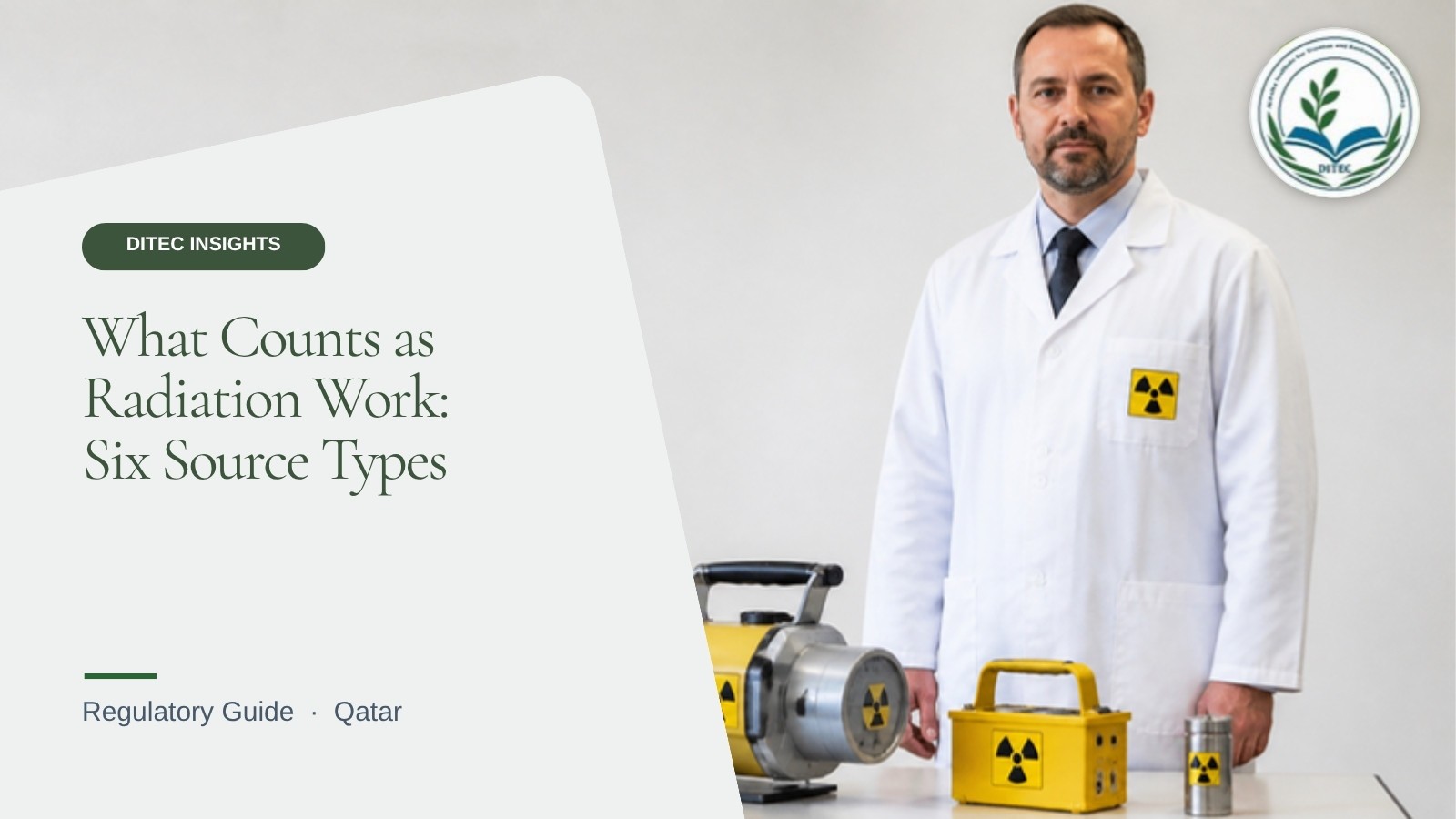
The Answer First
What makes work radiation work
Work is radiation work if it uses one of six sources named in article 3 of the instructions issued by Decision 2 of 2005.
Ionising radiation carries enough energy to strip an electron from an atom.
The article then adds a general clause that reaches what it did not name.
Why this question comes first
Describing the work comes before describing the worker. Without radiation work there is no radiation worker.
Areas, dosimeters and records are all built on this description.
When this question comes up
It comes up when buying a new device or introducing a new practice.
It comes up when classifying work areas, because classification needs a known source.
It comes up when contracting with a contractor that brings its own source onto your site.
In all three the item is read first, then the general clause.
The Six Sources as the Article Names Them
The six, named
X rays, and gamma rays.
Beta particles, and alpha particles.
Neutrons, and heavy ions.
The opening of the article states that radiation work is work with ionising radiation sources and the practices in which the sources it lists are used.
The test turns on the source and on the practice using it, rather than on the device alone.
The general clause
The article then states that any other work exposing its workers to radiation, directly or indirectly, also counts as radiation work.
The clause reaches indirect exposure expressly, which is wider than the list of sources.
The list cannot be called exhaustive, because the clause states the opposite of exhaustiveness.
What the six sources mean in practice
X rays and gamma rays are electromagnetic radiation that penetrates matter.
Beta particles are fast electrons. Their range in tissue is millimetres, and in air it is longer depending on their energy.
Alpha particles are heavier with a shorter range, so externally they are stopped by paper or the dead layer of the skin.
That is not to be read as safety, for their greater hazard is internal. Its route is inhalation or ingestion of the radioactive material, or entry through a wound or through skin that is not intact. Before that comes surface contamination, which then becomes internal.
Internal exposure sits in article 4, third, which sets the method for estimating it and sets no separate figure for it. The limits in article 4, first, are written on occupational exposure and draw no line between external and internal. The absence of a figure in the third part is therefore not read as placing internal exposure outside the limits, and that is our reading of the wording.
Neutrons are uncharged particles, and detecting them needs an instrument that responds to neutrons specifically. Shielding them is not inferred from the above, since it is a different matter from alpha, beta, X rays and gamma. What shielding each type requires is a matter this page does not explain; it rests on a calculation by the licensee rather than the reader's estimate.
Heavy ions are accelerated nuclei, found at accelerators and research centres.
This explanation introduces the terms. The text itself neither defines nor describes these sources.
What the Article Does Not Say
Three boundaries of the text
First: the article does not mention non-ionising radiation, so no ruling on it is built here.
Second: the article attaches no dose limit and no shielding requirement to the six sources.
Dose limits sit in article 4 of these instructions, and shielding is not mentioned in their articles at all.
Third: it draws no distinction between a sealed source and an unsealed one.
A worked case: a device switched off at end of day
A department has an X ray unit that is switched off after hours.
The article describes the work by the source and the practice, not by whether the unit is running at the moment of looking.
The work is radiation work as a practice. That is our reading of the wording rather than something the article states.
A distinction worth stating
This article describes the work; article 1 lists the occupations. They are two gates rather than one.
Work may be radiation work while not everyone present is a radiation worker.
The definition of a worker may apply to someone in work the six sources do not name, because the general clause stands.
Neither gate substitutes for the other, and reading them together is the sound approach.
What this article does not measure
The article classifies no area and sets no numerical threshold for classifying one.
It mentions no dosimeter, no monitoring and no record.
It attaches no qualification requirement for whoever works with a source.
Anyone needing those rules finds them in other texts, and we do not transcribe them onto this page.
The boundary of this page is the description of the work, and widening it would bring in what it does not contain.
The Six Sources and What Is Attached to Them
How to read this table
The first six rows are sources the items name expressly.
The seventh row is not a numbered item; it is the general clause after the list.
That is why its first column reads as a clause rather than a number, so it is not read as a seventh item.
The third column states whether the text named the source, which is a transcription question rather than a legal one.
No priority or hazard ranking follows from the order of the rows; the order is the order of the text.
The six sources in article 3 of the instructions issued by Decision 2 of 2005
| Item | Source | Named in the text |
|---|---|---|
| 1 | X rays | Named expressly |
| 2 | Gamma rays | Named expressly |
| 3 | Beta particles | Named expressly |
| 4 | Alpha particles | Named expressly |
| 5 | Neutrons | Named expressly |
| 6 | Heavy ions | Named expressly |
| Clause | Any other work that exposes its workers, directly or indirectly | Stated, and names no source |
What a Facility Does With This Article
Three practical steps
List the sources and practices in the facility and match them against the six items.
Then look at the general clause: is there work that exposes a worker indirectly?
The radiation protection officer records that inventory in writing. That is what we train for, not what we do.
What goes into the source inventory
For each source, record its item among the six, or that it enters under the general clause.
Record with it its location and the practice in which it is used.
Give anything producing neutrons its own line, because detecting it needs an instrument that responds to neutrons specifically.
A dosimeter is a personal device the worker carries, read periodically by the approved dosimetry service to estimate what they received. Ordinary personal dosimeters do not respond adequately to neutrons, so that service is the party to ask about them.
Review the inventory whenever the practice changes, not only when a device changes.
Who carries out this inventory
The inventory is the work of the licensee and its radiation protection officer, not of a training provider.
It is reviewed across all sites rather than at the main site alone.
A contractor's sources are listed under the contractor's name and location.
That is what we train for; we do not perform it and we issue no certificate about it.
Frequently Asked Questions
Is the list of six exhaustive?
No. The general clause after it covers any other work exposing workers directly or indirectly.
The list names six and the clause reaches what it did not name, so both are read together.
Does non-ionising radiation fall under the article?
The article does not mention it, so we build no ruling on it here. What the article did not mention, we do not assign to another text.
We transcribe no ruling from a text we have not matched against this article.
What does indirect exposure mean?
The phrase is stated and not defined in the article. We transcribe it and do not supply a meaning it does not carry.
The phrase indirect exposure may cover several situations; anyone needing a ruling on a specific one consults the competent authority.
Does work with these sources require a licence?
The article describes the work and does not create a licensing regime. Licensing sits in other texts, and we promise no licence.
The article is a description rather than a licence, so no permission or prohibition to work is read from it.
Are heavy ions really in the text?
Yes. They are the sixth item expressly. Naming them makes the article reach research accelerators, which is our reading.
The sixth item therefore reaches research settings not found in ordinary industrial facilities.
Notes on the Text
How we cite and transcribe
Article 3 is read with article 1: this one describes the work and that one lists the ten occupations.
This article contains no measured figure, so no figure is imported into it from another article or another decision.
The articles of these instructions do not name the radiation protection officer. What we say of that role describes practice rather than wording in these articles.
The general clause is not a numbered item in the text, so it is not counted as a seventh and not cited by number.
Where a body is named in the wording we transcribe, the name is the one in force when the Decision was issued. The competent body today is the Ministry of Environment and Climate Change, Radiation Protection Department.
Where DITEC Fits
What we do and what we do not
ALDuha Institute for Training and Environmental Consulting is a training and consulting provider. The training is licensed.
We do not measure a dose, issue dosimeters, read a dosimeter, or calibrate one.
We do not carry out medical examinations, assess an individual exposure, or issue a worker dose record.
Who carries the duty
Monitoring and assessing exposure is the duty of the licensee, its radiation protection officer, and the approved dosimetry service.
We do not measure on a facility's behalf, nor through anyone else, and we do not contract to read its workers' dosimeters.
The licensee turns to specialist partners where needed, and chooses the approved dosimetry service itself.
We give no promise that a licence will be issued, and no promise of a timeframe.
How to read the figures here
What is published here explains a binding text, and any figure in it is a regulatory limit rather than a reading of anyone's situation.
This page does not tell any reader that a particular dose is safe or exceeded.
We do not classify a facility's sources, and we do not decide that a particular task is indirect exposure. We train people to read the article.
Notice
This is an introductory explanation of a published text. It is not a legal opinion, and it does not replace consulting the competent authority.
Related Blog
Explore more articles in Radiation Protection
October 26, 2026
Public Dose Limits in Qatar: Four Limits and the Critical Group
Article 4, second, of the 2/2005 instructions sets four public dose limits for the critical group, one a conditional allowance of five.
Read more
October 26, 2026
Excess or Abnormal Exposure in Qatar: The Article 6 Procedures
Excess exposure under article 6 of the 2/2005 instructions: colleagues' readings with time, area monitors with working hours, removal, examinations.
Read more
October 26, 2026
A Damaged Dosimeter in Qatar: Three Methods in Article 5
Article 5 of the 2/2005 instructions on a damaged dosimeter: the period limit plus the replacement reading, the other dosimeter, or records.
Read more