
Well Logging Operator Licence Conditions in Qatar
 October 6, 2026
 12 min read
 DITEC Experts, Radiation Protection Team, ALDuha Institute for Training and Environmental Consulting
One role, two sets of conditions
One point before anything else. Meeting the conditions in the Decision is what you can prepare for. Whether a licence is granted, and when, is a decision of the competent authority alone, and nothing in this explanation and nothing in any course is a commitment that a licence will be issued or that it will be issued within a given period. What this article does is set out the condition as the instrument states it and point to the training that bears on it.
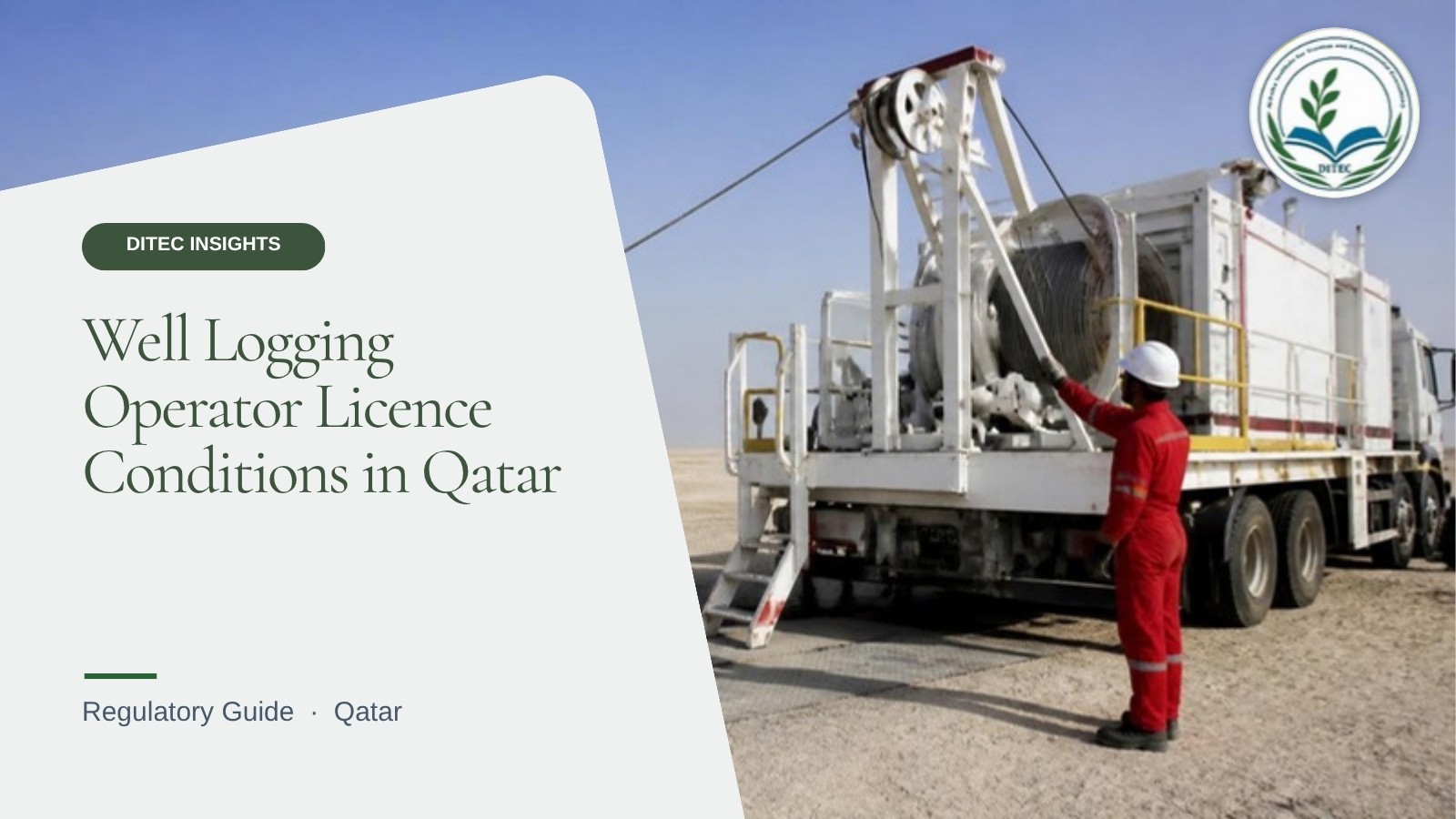
The well logging operator is the person who actually runs the source. He rigs up the source container on the wellsite, loads the tool, runs it into the hole, logs the formation on the way out, and recovers the source to its container, and he does not treat the run as finished until a measurement says where the source is. The supervisor decides and the operator does, and the schedule of Decision 4 of 2007 treats the two as separate licences with separate conditions at items 4 and 5 of the industrial applications.
What makes item 5 different from item 4 is that it is split in two. The schedule gives one set of conditions for the practices that existed before the Law was issued and another for the practices that came after it, under the headings A, practices before the issue of the Law and B, practices after the issue of the Law. The two are conditions for two practices, and they are not an easier and a harder version of the same thing: they differ in the academic floor and in the number of years, and they differ in opposite directions. Neither of the two paragraphs quoted here states an end date for either, and anything beyond that is a question for the Ministry. This article reads both.
One point of method before the reading. In the printed copy of the schedule that we hold, the tail of one condition in paragraph A has collapsed in the print. We quote from that condition only the parts that are clean, we say so where it arises, and we do not build any reading on the damaged words. That is the discipline this series follows: what is quoted is what is relied on, and what is not quoted is not argued from.
The paragraph for practices after the Law
This is the paragraph that applies to a practice set up after the Law, and it is the cleaner of the two to read, so we take it first. It opens with the formula the following conditions must be present in the person who is granted a licence to work as a well logging operator for the practices after the issue of the Law, and then sets five conditions. First, that he hold a diploma in a branch of engineering or sciences, two years after general secondary, at minimum. Second, that he pass a specialist training course in the field of well logging from an approved centre. Third, that he pass a training course in radiation protection in industrial applications from an approved centre. Fourth, that he have practical experience in well logging of not less than one year. Fifth, that he pass the prescribed medical examination.
Three observations. The academic condition is a diploma, and the Decision defines the level in the text itself as two years after general secondary, so there is no room to argue about what a diploma means here, and the field is fixed to a branch of engineering or sciences. The logging condition in this paragraph is a specialist training course, and it states no duration: the word specialist appears here as it does in the supervisor entry, and the figure of four weeks appears in the supervisor entry and not in this one. And the radiation protection condition is present, in the same words as in the assistant entry below.
A diploma and one year of practical experience make the lightest combination in the logging group that still carries a full set of five conditions, and it is worth being clear about what that year is. It is not a probation period created by the Decision and it is not satisfied by a year on a wellsite in another trade: it is a year of practical experience in well logging. The usual route to it is the trainee licence in the third part of the schedule, which excepts the experience condition and nothing else and requires practice under the supervision of a licensed person.
The paragraph for practices before the Law
The earlier paragraph lowers the academic floor and raises the experience. It opens with the following conditions must be present in the person who is granted a licence to work as a well logging operator for the practices before the issue of the Law. Its academic condition is that he hold the general secondary certificate or its equivalent, at minimum, with no field of study named at all. Its radiation protection condition is that he pass a course in radiation protection in industrial applications from an approved centre. Its experience condition is that he have practical experience in well logging of not less than three years. And it closes with the medical condition, that he pass the prescribed medical examination.
The logging condition in this paragraph is the one place where our copy of the text is damaged, so read what follows carefully. The part that is clean, and that we rely on, is the training-course limb, that he pass a training course in the field of well logging from an approved centre, with no mention of the word specialist and no duration at all. The condition then offers an alternative, and the clean part of that alternative is or that he pass the examination the Council decides. The words that follow arrive damaged in the printed copy we hold, so we do not quote them and we do not state what they say, and we do not treat the tail of the condition as settled.
What follows from that is practical, not theoretical. Anyone who intends to rely on the examination route has to establish, before relying on it, both what the full wording of the condition is and whether the examination exists today. The Decision does not describe the examination even in the clean part: it says the authority decides it, and that is all. So the step is to read the condition on the page image of the Official Gazette, or to ask the Ministry for the wording in force together with whether an examination is set, who is eligible to sit it and what it covers, and to keep the reply. Nothing here says the route is available.
Two wording differences between the two paragraphs are worth recording and not worth building an argument on. The radiation protection condition is written in paragraph A as a course and in paragraph B as a training course. And the logging condition is written in paragraph A as a training course in the field of well logging and in paragraph B as a specialist training course in that field. We note the differences because a reader comparing the two paragraphs will see them, and we do not read a rule into either: the Institute does not treat a difference in wording as a difference in requirement unless the authority says so. If the point matters to your file, put the two paragraphs side by side in your enquiry and ask.
The two paragraphs compared
The table sets the two paragraphs of item 5 against each other. It is a reading of those two paragraphs, both of which are quoted in full in the verified text behind this series, and nothing is added to it. The cell on the logging condition in paragraph A gives the clean part of the condition only, for the reason stated above.
Item 5, paragraph A against paragraph B
| Condition | A, practices before the Law | B, practices after the Law |
|---|---|---|
| Academic floor | General secondary certificate or its equivalent, at minimum, with no field of study named | Diploma in a branch of engineering or sciences, two years after general secondary, at minimum |
| Well logging training | A training course in the field of well logging from an approved centre, with an alternative examination decided by the authority. The word specialist does not appear, and no duration is stated | A specialist training course in the field of well logging from an approved centre, with no alternative stated and no duration stated |
| Industrial radiation protection course | Required, written as a course in radiation protection in industrial applications from an approved centre | Required, written as a training course in radiation protection in industrial applications from an approved centre |
| Experience | Practical experience in well logging of not less than three years | Practical experience in well logging of not less than one year |
| Prescribed medical examination | Required | Required |
Before you decide which paragraph you are on
Choosing the paragraph is the first decision in the file and the one most often made by assumption. The points below are the Institute's working practice when we review a logging operator file, not requirements of the Decision.
Reviewing a logging operator file
The paragraph follows the practice, not the person
- The two headings describe practices, not applicants: practices before the issue of the Law and practices after it. So the question is about the practice being licensed, and a long career does not by itself put a person on the earlier paragraph.
- If you are not certain which heading your practice falls under, that is the first question to put to the Ministry, because the academic condition and the number of years both change with the answer.
Do not plan around the examination alternative
- Two things are unsettled about it at once in our copy: the full wording of its tail, and whether the authority has set an examination at all. Both have to be established in writing before a timetable is built on it.
Keep the logging course and the radiation protection course apart
- They are two conditions in both paragraphs, with different subjects, and each is to come from an approved centre in the words of the item. One certificate cannot answer both, whichever paragraph applies, and a combined certificate leaves one of the two without evidence.
Document the year, or the three years, against well logging
- Both paragraphs tie the experience to well logging and both describe it as practical. Dates, the practice, the source types and the role held are what make a letter evidence of that field rather than evidence of employment.
- If the year is being gained now under a trainee licence, the records have to be created while it is being gained. They cannot be reconstructed later from a roster.
Questions we are asked about this item
Which paragraph has the harder conditions?
Neither, and that is the point. Paragraph A asks less academically, a general secondary certificate with no field named, and three years of practical experience. Paragraph B asks for a diploma in a branch of engineering or sciences and one year. They are two different balances struck for two different populations, and a person who satisfies one may fail the other. So the paragraph is not a choice to be optimised: it follows from the practice being licensed.
Does the logging course for the operator have to be four weeks long?
The figure of four weeks is in the supervisor entry, item 4, and it is not in either paragraph of item 5. Paragraph B asks for a specialist training course in the field of well logging from an approved centre and states no duration, and paragraph A asks for a training course in that field and states no duration. We read each entry on its own words and we do not carry a figure from one entry into another. Whether the authority applies a duration in practice is a question to put to it.
Can I work while I build up the one year of experience?
The third part of the schedule provides for this situation, and it is a licence of its own with a condition attached: a licence to practise radiation work as a trainee is granted to a person in whom the conditions of the licence sought are present with the exception of the experience condition, and then in that case he may not practise radiation work except under the supervision of a licensed person. So the exception is for the experience condition only. The diploma, the specialist logging course, the radiation protection course and the medical examination all still have to be present.
Is the examination route in paragraph A still open?
We cannot tell you, and we will not guess. Two separate things are unresolved on our side: the tail of that condition is damaged in the printed copy we hold, so we do not state its full wording, and even its clean part says only that the authority decides the examination, with no indication that one is currently set. Read the condition on the page image or ask the Ministry for the wording in force, and ask in the same letter whether an examination is set and who may sit it.
Does a diploma in business or administration satisfy paragraph B?
The condition names a diploma in a branch of engineering or sciences and defines the level as two years after general secondary. A diploma of the right length in a field outside those two families is not within the condition as written. Note that the general secondary route in paragraph A names no field at all, so the field restriction belongs to paragraph B, and which paragraph applies is settled by the practice and not by the qualification you happen to hold.
How the Institute can help
Two findings recur on logging operator files. The first is a paragraph chosen by the length of the applicant's career rather than by the practice being licensed, which produces a file assembled against the wrong academic condition and the wrong number of years from its first page. The second is a plan built on the examination alternative in paragraph A without having established either the full wording of that condition or whether an examination is set at all.
The Institute delivers radiation protection training for industrial applications, reads a file against the conditions of the paragraph that actually applies, drafts the enquiry to the Ministry on the paragraph question, on the wording in force of the examination condition and on the prescribed medical examination, and advises on how a trainee period is recorded so that the year of experience is evidenced when the licence is applied for. The specialist well logging training the Decision names is a separate qualification obtained from a provider that offers it, and the Institute does not issue it. What the Institute delivers is the radiation protection course in industrial applications that the operator and assistant entries name as a subject; whether a particular course at a particular centre satisfies the approved-centre limb of the condition is for the Ministry to say.
Scope of what the Institute does: training and consulting. Field radiation surveys are carried out through specialist partners. The Institute does not carry out laboratory analysis, instrument calibration or equipment testing.
A technical note. The conditions in this Decision are licensing conditions, not site work instructions. Meeting them, and the licence that may follow, replaces nothing in operational protection. A logging run lowers a sealed source into a borehole and brings it back, and the pattern that recurs in incidents in this practice is a source that did not come back and a crew that did not establish that it had not. The controlled area is monitored at its boundary with a survey meter that is within its calibration validity and response-checked before the run, and the run is not finished, and the source container is not handled as empty or as full, until a measurement says which it is. That is not inferred from a cable depth counter, from a mechanical indicator, or from the run having gone as planned. If the measurement does not establish that the source is in its container, the operation stops where it is, no one approaches the tool, and the licensee acts on his own emergency arrangements and notifies the Ministry. A source that may not have been recovered is not a matter to be settled on the wellsite between shifts. These are obligations on the licensee under the Law, the Regulation and the conditions of his own licence, and their place is not this Decision.
A note on two words the Decision uses for the source of a course. In the well logging entries the Decision asks for a course from a centre it describes with an Arabic word that this explanation renders as approved, and in one place, the supervisor entry, it asks instead for the course to come from a body described with that same word. The items set out in this explanation do not define either term, do not say who gives that approval, and do not say whether it is a general status or given for a particular course. In the Decision this description qualifies the provider of the training and no other party. The English word is a rendering chosen for this explanation and is not a term of art: our practical reading is to ask in the Arabic wording of the Decision, naming the specific course and the specific provider, and to keep the answer in writing, because what the instrument leaves open the authority settles. The Institute is a licensed training provider and describes itself that way and no other way.
A note on one place in the text. In the printed copy of the schedule that we hold, the tail of the examination condition in paragraph A of the well logging operator entry arrives damaged: the last word has collapsed in the print. We therefore quote from that condition only the two parts that are clean, and we do not quote its tail or build any reading on its wording. Anyone who intends to rely on that alternative should read the condition on the page image of the Official Gazette, or ask the Ministry for the wording in force, before acting on it.
A note on the authority named in the text. The word the Decision uses for the authority is the Council. It is the word of a 2007 instrument whose preamble refers to the Executive Regulation issued by decision of the President of the Supreme Council for the Environment and Natural Reserves, number 4 of 2003. The body that word names no longer exists. Competence today sits with the Ministry of Environment and Climate Change, and the unit concerned is named in the organisational decisions as the Radiation Protection Department. The word Council is kept only where this explanation renders what the instrument itself says, because that is the instrument's own word; in the Institute's own advice it is written as the Ministry. Read Council as the Ministry throughout.
This explanation is published for awareness by the radiation protection team at ALDuha Institute for Training and Environmental Consulting. The English text is an explanation, not a certified translation: the Arabic text published in the Official Gazette governs in case of any difference, and the official Arabic wording of every condition discussed here is quoted in full on the Arabic version of this article. This explanation is introductory. It is not a legal opinion, it does not replace the conditions of your own licence, and it does not replace review by the regulator. Last updated 6 October 2026.