
Radiotherapy Technician Licence Conditions in Qatar
 October 11, 2026
 12 min read
 DITEC Experts, Radiation Protection Team, ALDuha Institute for Training and Environmental Consulting
The entry with the largest prescribed doses in the building
One point before anything else. Meeting the conditions in the Decision is what you can prepare for. Whether a licence is granted, and when, is a decision of the competent authority alone, and nothing in this explanation and nothing in any course is a commitment that a licence will be issued or that it will be issued within a given period. What this article does is set out the condition as the instrument states it and point to the training that bears on it.
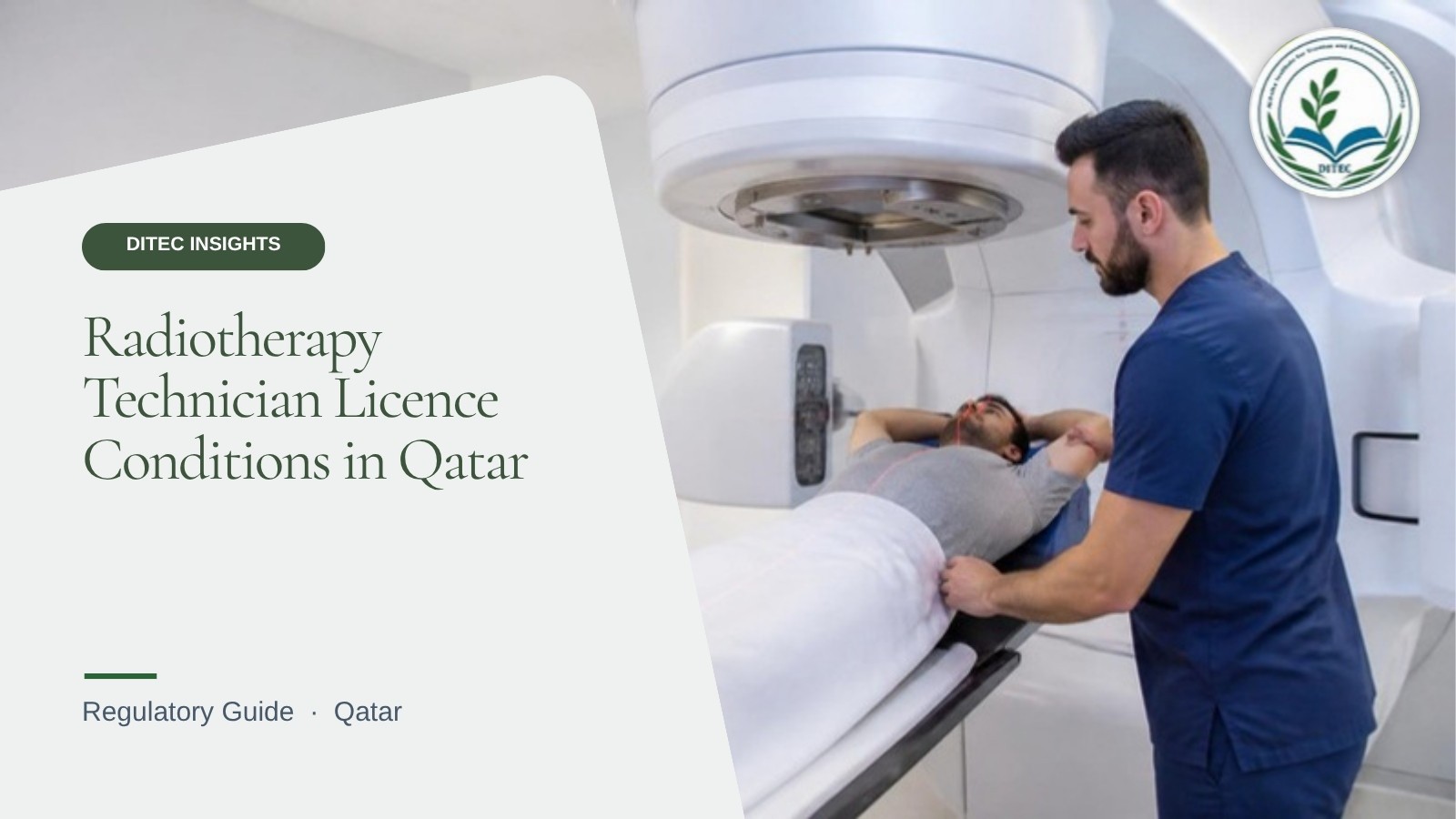
The radiotherapy technician is licensed in medical item 3 of the schedule attached to Decision 4 of 2007, and his practice is the one in the hospital where radiation is delivered deliberately in large amounts to a planned volume. He sets a patient up on a treatment couch, confirms the position, leaves the room and runs the beam from a console; or, where the department treats with sealed sources placed in or against the body, he works with material that has no off state at all. The three entries for technicians in this part of the schedule are identical in form, and this is the entry whose work leaves the least room for a protection state that was assumed rather than established.
The entry is short, and the shortness is a fact about the drafting rather than about the hazard. It sets three conditions, it contains no experience condition, and the three conditions are word for word the same as those of medical items 1 and 2; the three were compared line by line against the transcribed text before this article was written. What separates this entry from the two beside it is the function named in its opening formula, and through that function the speciality that both of its certificate conditions have to point at.
One point of orientation before the conditions. They are in the schedule attached to the Decision rather than in the body of it: the issuing article says that the conditions for licences to work in the fields of radiation work, attached to this Decision, shall apply. So a reader who opens the Decision and reads the article that issues it finds a referral and no conditions.
The opening formula, and the three conditions
Item 3 opens with the same formula as the two other medical entries transcribed for this explanation, differing only in the function it names, and the formula is worth reading before the conditions under it. It requires the conditions to be present in the person who is granted a licence to practise radiation work as a radiotherapy technician. Three things follow from that wording. The conditions attach to a person and not to an employer, so a department does not hold this licence for its staff. They are required cumulatively. And the licence is tied to a named function, so a title on an establishment chart does not decide which entry governs.
Then come three conditions, and that is all the entry contains. The academic condition asks that he hold a diploma certificate in the field of the speciality, at minimum. The training condition asks that he pass a training course in radiation protection in the field of the speciality from an approved centre. And the third asks that he pass the prescribed medical examination. There is no experience condition in the entry. The entry names the prescribed medical examination and does not describe its purpose. Our reading is that it is a condition in the person for the licence, that it does not stand in for the training course a numbered entry names, and that it does not stand in for anything in operational protection.
The phrase that does the work in this entry is the one that appears twice: in the field of the speciality. It qualifies the diploma and it qualifies the course, and the entry does not say what the speciality is. It does not have to, because the opening formula has already named the function. So the content of that phrase is taken from the function the formula names, and the two conditions are read as a pair pointing at the same speciality rather than as two unrelated certificates.
That pairing is where the files we review come apart, and it comes apart in two ways. A diploma in one of the three specialities held alongside a radiation protection course aimed at another leaves the entry with one of its two certificate conditions unanswered on the words of the condition, and nothing in the file shows it, because both documents are present and both look right. And a technician who moves between the three areas during his career holds a diploma in the speciality he trained in, which is not necessarily the speciality he now works in. Neither of those is a question we answer: both are put to the Ministry with the wording of the entry quoted and the two documents attached.
One further observation on the wording, and it is a difference between this part of the schedule and the industrial part. The formula here licenses a person to practise radiation work, whereas the industrial entries license a person to work in a named role. And the course here is described by the field of the speciality, whereas the industrial entries describe their course by a named field of application. We record both differences in wording and we read no rule into either of them.
The general conditions that reach into this entry
The three conditions of this entry are not the whole of what a file for a radiotherapy technician has to answer, because the medical part of the schedule opens with three general conditions that sit above the numbered entries. Two of the three bear directly on this one, and a file assembled from the entry alone will miss both.
The first general condition requires the applicant to hold a licence from the health authority to practise the medical work sought, so the radiation licence for this role presupposes a health practice licence for it. The two licences are granted by two different bodies, with two renewal cycles, and a register that holds only the radiation licences cannot show whether this condition is still answered.
The third general condition is the one candidates ask about, and it is narrower than it is usually reported to be. It exempts from the condition of passing training courses in radiation protection one who presents proof that he obtained courses in radiation protection in his university study of not less than three credit hours, which the text glosses as thirty training hours. So on this entry it bears on the training condition and the text at that place says nothing about the diploma condition or the prescribed medical examination. The evidence it names is academic, the proof has to be produced, and whether a particular transcript answers it is read by the competent authority.
One reading of our own, offered as ours and not as the text. The entry has no experience condition, and the trainee provision in the third part of the schedule grants a licence to a person in whom the conditions of the licence sought are present with the exception of the experience condition, and states that in that case he may not practise radiation work except under the supervision of a licensed person. Those two facts sit next to each other and we do not join them into a rule: how that provision applies to an entry that contains no experience condition is a question for the Ministry, and we do not answer it. What we do say is that the three conditions of this entry are three, and none of them is waived by the absence of a fourth.
A note on the exemption in the third general condition, because it is the provision in the medical part that is most often read more widely than it is written. On its words it exempts a person from the condition of passing training courses in radiation protection, and it does so for one who presents proof that he obtained courses in radiation protection in his university study of not less than three credit hours, a figure the text itself then glosses as thirty training hours. Three limits follow from the wording and we state no more than them. It is an exemption from that condition, and the text says nothing there about the diploma condition or about the prescribed medical examination. It operates on proof presented by the applicant, so whether a particular transcript answers it is read by the competent authority and not by us. And it names university study, which is not something the Institute awards: a course delivered by a training provider is not a university course and carries no credit hours, so this exemption is not a route the Institute can put anyone on.
The three technician entries, and the entry that follows them
The table sets the three technician entries against one another and against the medical physicist entry that follows them. It is a reading of medical items 1, 2 and 3, each quoted in full on the Arabic version of these articles, together with the route transcribed from medical item 4, and nothing is added to it. On this entry the row worth reading twice is the experience row: there is no experience condition in any of the three technician entries, while the route transcribed from medical item 4, for the medical physicist in radiotherapy, names ten years of practical experience in the field of the work. Those two facts are a difference between two entries in the same part, and we record it and read no ranking of the two roles into it.
Medical items 1, 2 and 3 compared, with the transcribed route of item 4
| Condition | Diagnostic radiography technician, item 1 | Nuclear medicine technician, item 2 | Radiotherapy technician, item 3 | Medical physicist in radiotherapy, the transcribed route of item 4 |
|---|---|---|---|---|
| Function named in the opening formula | To practise radiation work as a diagnostic radiography technician | To practise radiation work as a nuclear medicine technician | To practise radiation work as a radiotherapy technician | The role of item 4: medical physicist in the field of radiotherapy; its opening formula is not transcribed |
| Academic condition | A diploma certificate in the field of the speciality, at minimum | A diploma certificate in the field of the speciality, at minimum | A diploma certificate in the field of the speciality, at minimum | The first university degree (the bachelor's) in the field of the speciality, with the phrase at minimum not used in the transcribed route |
| Radiation protection course | Required, in the field of the speciality, from an approved centre | Required, in the field of the speciality, from an approved centre | Required, in the field of the speciality, from an approved centre | Required, in the field of the speciality, from an approved centre |
| Experience | No experience condition in the entry | No experience condition in the entry | No experience condition in the entry | Practical experience of not less than ten years in the field of the work, in the transcribed route |
| Prescribed medical examination | Required | Required | Required | Required |
| Conditions in the entry | Three | Three | Three | Four in the transcribed route |
What to settle before the file is assembled
Below is the order we use when a department asks us to look at a file on this entry before it is submitted. It is the Institute's own working practice, and the entry sets out no form of file.
Preparing a file on this entry
Read the diploma and the course as one pair, not two documents
- The phrase in the field of the speciality qualifies both of them, and the speciality is the one the opening formula names. So the question on each document is not whether it exists but whether it points at that speciality.
- Where one of the two points elsewhere, that goes to the Ministry with the wording of the entry quoted and both documents attached, before the file is submitted rather than after it is returned.
Confirm the provider in writing, because this entry describes it
- The training condition describes the course as coming from an approved centre, and the entry does not define that phrase, does not say who gives the approval, and does not say whether it is a general standing or given for a particular course. So we do not answer for the Ministry. Name the course and its provider together and ask, before the course is booked.
Pair the radiation licence with the health practice licence in one register
- The first general condition makes one the precondition of the other, and they expire on different dates. Record the scope of the health licence and not only its number, because the condition describes it as being for the medical work sought.
- Whoever watches one expiry date should watch both, because a file that was complete on the day it was submitted is not a file that stays complete.
Settle the prescribed medical examination once for the department
- Settle the prescribed medical examination once for the department: one written answer from the Ministry about which examination is prescribed and at what interval serves every licence holder in it, while the examination itself is a condition on an individual and each holder keeps his own record.
Questions we are asked about this item
The doses here are the largest in the hospital. Why are there only three conditions?
The entry contains three conditions, and we read it as it stands without explaining why it is drafted that way: attributing a purpose to the instrument is something this series does not do. Two things sit beside the entry. Three general conditions in the same part of the schedule bear on the file, and two of them bear on this entry directly. And a licensing condition is not the whole of the obligation: the protection duties the Law, the Regulation and the conditions of the facility licence place on a licensee are not reduced because one entry is short.
Our technician holds a diploma in radiotherapy and a general radiation protection course. Is that enough?
The course condition describes the course as being in radiation protection in the field of the speciality and as coming from an approved centre, so the course carries a description on two counts and both of them are read on the words of the condition. Whether a course described as general answers a condition that names the field of the speciality is a question for the Ministry, and it is a cheaper question to ask before a course is booked than after a certificate is in a file. Name the course, its content and its provider, quote the condition, and ask.
Does this entry cover the people who place sealed sources in a patient?
The entry licenses practising radiation work as a radiotherapy technician, and it does not divide that function into tasks or name any technique. Other entries in this part of the schedule name other functions, including the medical physicist and the resident doctors. Which entry governs a particular task in your department is a question for the Ministry, and the way to ask it is to describe the task as it is actually done rather than by the title of the person who does it, because the entries name functions and an establishment chart does not.
There is no experience condition. Can a newly qualified technician treat unsupervised?
The entry contains no experience condition, so no period of prior service is evidenced for this licence, and we state that as a reading of the entry and stop. What a holder is permitted to do unsupervised is not settled by this entry: it is a matter for the employer, for the protection duties the Law and the Regulation place on the licensee, and for the conditions attached to the facility licence. The entry for the resident doctors in this same part requires supervision in its own words, which shows that the schedule says so where it means it, and this entry does not say it either way.
Can one licence cover a technician who also works in the imaging department?
Each of the three technician entries ties both of its certificate conditions to the field of the speciality, and the speciality is fixed by the function its opening formula names. So a person working in two of the three areas is being described by two entries, and the documents that answer one do not automatically answer the other. Whether one licence can be made to cover both roles is a question for the Ministry: describe the two roles as they actually are, quote both entries, and keep the answer with the register.
A technical note: the licence is not the protection
A technical note, and it is the most important passage on this page. The conditions in this Decision are licensing conditions, not department work instructions. Meeting them, and any licence that follows, replaces nothing in operational protection, and no course makes anyone safe by itself. One rule governs every judgement about whether a source or a beam is live: it is settled by measurement, never by inference.
The measurement is made by the licensee, through a person qualified to make it, and the instrument has to respond to the radiation actually present and at the energies present. An instrument that reads only photons tells an operator nothing about a pure beta emitter beside it, and a survey meter outside its calibration validity reads a number rather than a dose rate. So the instrument is within its calibration validity and response-checked before work starts.
What does not count is an inference. Not an indicator lamp, not a position readout, not an interlock that has never been tested, and not the fact that the list was worked through as planned. And if the measurement does not establish that the beam is off or the source is shielded, the work stops where it is, no one enters, and the licensee acts on his own emergency arrangements and notifies the Ministry. The place of those duties is not this Decision: they fall to the Law, the Regulation and the conditions of the licensee's own licence, none of which is transcribed for this explanation.
This practice holds both kinds of hazard in one department, and the order in which they are dealt with matters. A treatment machine is energised and then not: the state relied on before anyone works at the head, the collimator or the couch is established by cutting the power and by removing the means of energising it, and then confirmed by measurement. At the higher beam energies, induced activity may remain in the head and the collimator after the beam stops, which is one more thing the measurement at the equipment settles and the power switch does not. A sealed source used for treatment is a different thing entirely, because it has no off state: it is shielded or it is not. A position readout on a console is an inference this rule does not count, and the source is treated as unshielded until a measurement says otherwise. The order matters for one reason that is worth stating plainly: nothing done to the machine changes the state of the sealed source. The machine is dealt with on its own terms, by cutting the power, then removing the means of energising it, then confirming by measurement. The sealed source remains exactly as it was throughout, so a de-energised machine is no evidence at all about the source, and entry to the room is governed by the source and not by the machine. Three further points belong to this work. The measurement is made with an instrument that responds to the radiation and the energies actually present, within its calibration validity and response-checked before work starts. A source that was placed in or against a patient is accounted for after the treatment as deliberately as before it, and that accounting is done by measurement and against the licensee's own records. And nobody enters a treatment room on the strength of the fact that the list ran as planned. Where the measurement does not establish the state relied on, the work stops where it is, nobody enters, and the licensee acts on his emergency arrangements and notifies the Ministry.
How the Institute can help
Two findings recur on radiotherapy files. The first is a course certificate described as general radiation protection, offered against a condition that describes the course both by the field of the speciality and by the provider, so the file rests on a reading of two descriptions that has never been put to the authority. The second is a department that treats the shortness of this entry as a measure of the hazard and assembles three documents, while two things are missing: the register that pairs the radiation licence with the health practice licence, and the written answer about the prescribed examination.
The Institute delivers radiation protection training, reads each role in a radiotherapy department against medical item 3 and against the three general conditions, drafts the enquiry to the Ministry on whether a described course answers both parts of the condition, the field of the speciality and the provider, on the placing of a named diploma and on the prescribed medical examination, and advises on the register that pairs each radiation licence with the health practice licence it depends on. The diploma in the field of the speciality that the three technician entries name is an academic qualification awarded by a college or a university, and the Institute does not issue it: the Institute awards no university qualification of any level and no credit hours. What the Institute delivers is radiation protection training, and whether a particular course at a particular provider answers the course condition in a numbered entry is for the Ministry to say.
Scope of what the Institute does: training and consulting. Field radiation surveys are carried out through specialist partners. The Institute does not carry out laboratory analysis, instrument calibration or equipment testing.
A note on the source of the course in the three technician entries. All three of them ask for a training course in radiation protection in the field of the speciality, and all three describe where it is to come from with an Arabic phrase this explanation renders as from an approved centre. The entries transcribed for this explanation do not define that phrase, do not say who gives that approval, and do not say whether it is a general standing or given for a particular course. Where the description appears, it qualifies the provider of the training and no other party. The English wording is a rendering chosen for this explanation and is not a term of art: our practical reading is to ask in the Arabic wording of the item, naming the specific course and the specific provider together, and to keep the answer in writing, because what the instrument leaves open the authority settles. The Institute is a licensed training provider and describes itself that way and no other way.
A second note on a name, and this one belongs to the medical part in particular. The first of the three general conditions ties a radiation licence to a licence to practise the medical work sought, and it names the body that grants that licence as the National Health Authority. That is the name the body carried when the Decision was issued in 2007. The authority that licenses health practitioners today is the Ministry of Public Health. So the medical part of this schedule points at two different authorities in two different conditions, and they are not the same body: the health practice licence on one side and the radiation work licence on the other. The old name is kept only inside the verbatim Arabic quotation on the Arabic version of this article.
A note on the authorities the text names, because the provisions transcribed for this explanation do not use one single word for the radiation authority. What they name is the Radiation Protection Committee: the preamble records that the Decision was issued on its recommendation, and the third part of the schedule refers applications for specialities that are not stated in the instructions to it. The preamble also refers to the Executive Regulation of Decree Law 31 of 2002, issued by decision of the President of the Supreme Council for the Environment and Natural Reserves, number 4 of 2003, and the body that name belongs to no longer exists. Competence today sits with the Ministry of Environment and Climate Change, and the unit concerned is named in the organisational decisions as the Radiation Protection Department. The older names are kept only inside the verbatim Arabic quotations on the Arabic version of this article; in the Institute's own advice the authority is written as the Ministry.
This explanation is published for awareness by the radiation protection team at ALDuha Institute for Training and Environmental Consulting. The English text is an explanation, not a certified translation: the Arabic text published in the Official Gazette governs in case of any difference, and every wording quoted from the Decision on this page is quoted verbatim, with the three general conditions set out in full on the general-conditions article. This explanation is introductory. It is not a legal opinion, it does not replace the conditions of your own licence, and it does not replace review by the regulator. Last updated 10 October 2026.