
Radioactive Material Carrier and Maintenance Technician Licences
 October 8, 2026
 12 min read
 DITEC Experts, Radiation Protection Team, ALDuha Institute for Training and Environmental Consulting
Two short entries that are read together for one reason
One point before anything else. Meeting the conditions in the Decision is what you can prepare for. Whether a licence is granted, and when, is a decision of the competent authority alone, and nothing in this explanation and nothing in any course is a commitment that a licence will be granted or that it will be granted within a given period. What this article does is set out the condition as the instrument states it and point to the training that bears on it.
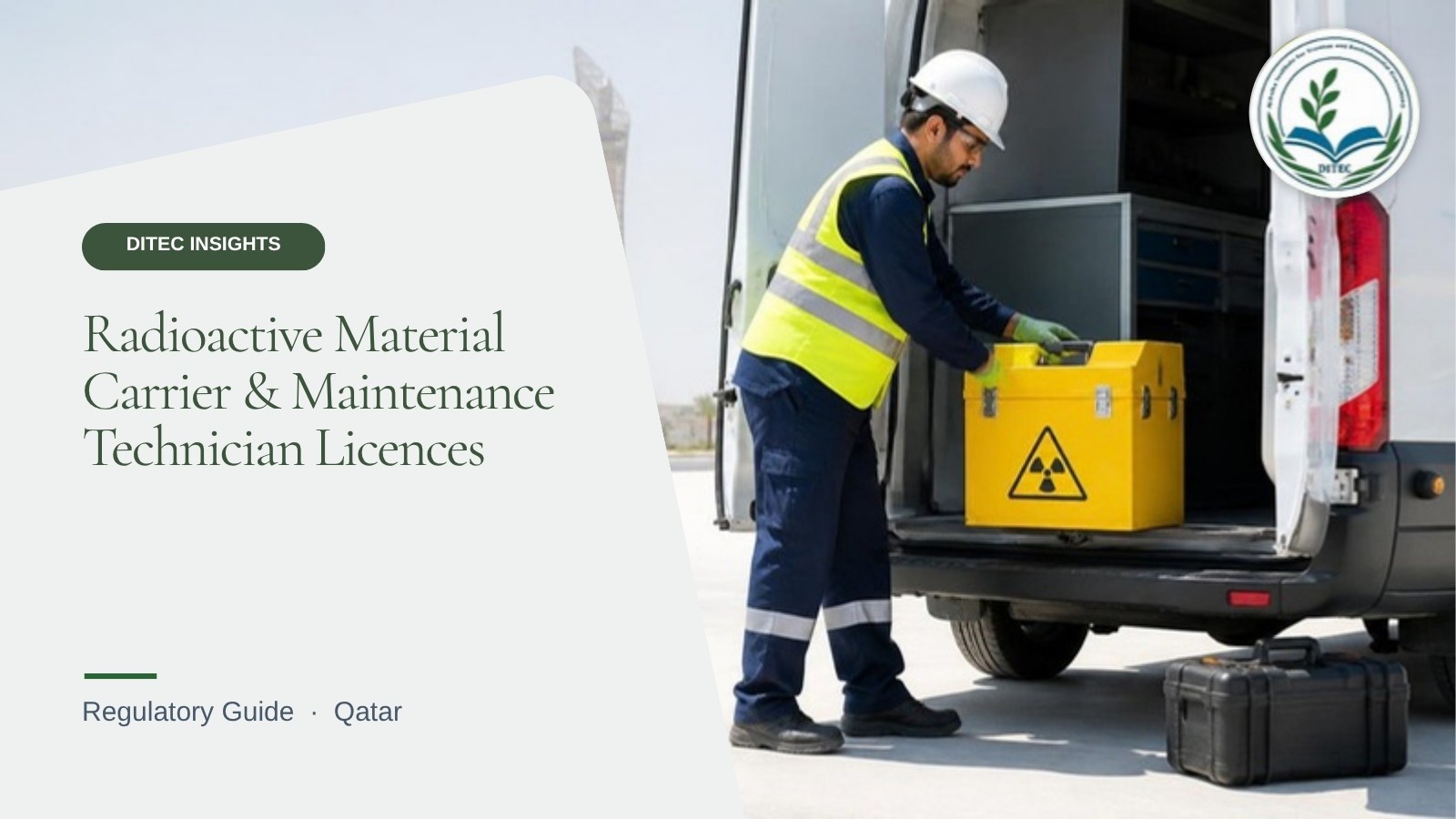
Items 15 and 16 of the industrial applications license two people a facility tends not to think of as radiation workers at all. One drives. The other repairs. The carrier moves radioactive material from where it is to where it is wanted, and on most sites that is a transport task handled by a transport department. The maintenance technician services devices that contain radioactive material, and on most sites that is a maintenance task handled by a maintenance department. Neither of them operates a source to take a reading, and that is precisely why both of them are so often working without the licence the schedule describes for them.
The two entries are read on one page here because they share the feature that makes them worth reading at all: neither of them contains an experience condition. Item 15 sets three conditions and item 16 sets four, and in neither of them is there a period of prior service to be evidenced. Items 6 and 9 of the entries transcribed here for comparison contain no experience condition either, so the fact is recorded and nothing is ranked on it. It is the thing most likely to be misunderstood, so it is set out carefully below. It is a reading of what the two entries contain, and it is not a statement that the work is light.
The second reason to read them together is the one that bears on a budget. Item 15 names one course. Item 16 names two, and one of those two is a course the Institute does not deliver and says so plainly below. So the two entries, which look alike in length, are not alike in what they cost to satisfy.
One point of orientation before the conditions themselves: they are in the schedule attached to the Decision rather than in the body of it. The preamble records that it was issued having regard to the Executive Regulation and in particular to Article 25 of it, and, on the Committee recommendation, on the recommendation of the Radiation Protection Committee, and the issuing article does one thing only: the conditions for licences to work in the fields of radiation work, attached to this Decision, shall apply. So a reader who opens the Decision and reads the article that issues it finds a referral and no conditions.
Item 15: the carrier, and three conditions
Item 15 opens with the formula the following conditions must be present in the person who is granted a licence to work as a carrier of radioactive material. The function it names is working as a carrier of radioactive material, and the conditions are attached to a person and required cumulatively.
Then come three conditions, and that is all the entry contains. The academic condition is that he hold the secondary certificate, at minimum. The training condition is that he pass a training course in the field of radiation protection in industrial applications from an approved centre. And the third is that he pass the prescribed medical examination. The prescribed medical examination stands as its own condition among the conditions the item sets, and the item says nothing about what it contains. Our practical reading is that it is not a protective measure, that it does not stand in for any course the item names, and that it does not stand in for anything in operational protection.
Two observations on the wording, both of them small and both of them the kind of thing a file turns on. The academic condition names the secondary certificate, at minimum, without the word that item 9 of this schedule attaches when it names the general secondary certificate, and without the words admitting an equivalent that items 6 and 8 attach. Item 16 writes general secondary only as the reference point for the duration of a diploma and not as a certificate floor at all. So among the entries transcribed for this explanation there are three different ways of writing a secondary-certificate floor. We record that and we read no rule into any of them: whether a particular certificate meets the condition, and how equivalence is treated, are matters for the competent authority.
The training condition is where item 15 differs in wording from items 16 and 17. It names the course as being in the field of radiation protection in industrial applications, inserting the words rendered here as in the field of before the subject, where items 16 and 17 name the same subject without them. Item 16 carries those same words in its own maintenance course condition. The difference is that phrase and it may well be nothing. We note it because this series quotes what the copy carries, and we build no reading on it.
There is no experience condition in item 15. No period of prior service has to be evidenced for this licence. What follows from that is narrow: it means the file does not need an employment record, and it does not mean that a person may be sent out with a package on his first day with nothing else in place. The duties the Law, the Regulation and the conditions of the facility licence place on the licensee are untouched by the length of this entry, and the transport of radioactive material is regulated in instruments that are not this one.
Item 16: the maintenance technician, a cross-reference and two courses
Item 16 is the only entry among the five read in this batch that opens with a cross-reference before the conditions formula. It begins: having regard to the definition of the worker in the field of radiation stated in Article 1 of the Executive Regulation of Decree-Law number 31 of 2002 referred to, and only then the following conditions must be present in the person who is granted a licence to work as a technician maintaining devices that contain radioactive material.
We record that the item opens by directing the reader to a definition in another instrument, and we stop there. The text of that definition is not transcribed in the verified-text file for this batch, so we do not state what it contains, we do not paraphrase it, and we do not tell you what follows from it. What we will say is why it is worth your attention: an entry that opens by directing the reader to the definition of a radiation worker is an entry whose application to a given person may depend on that definition, and the person most likely to be at the boundary of it is exactly the maintenance technician who attends a device twice a year. Read the definition in the Regulation itself, or ask the Ministry how it applies to your technician, before deciding that the entry does not reach him.
Then come four conditions. The academic condition is that he hold a diploma in a branch of engineering or sciences, two years after general secondary, at minimum. The first training condition is that he pass a training course in the field of maintaining devices that contain radioactive material. The second is that he pass a training course in radiation protection in industrial applications from an approved centre. And the fourth is that he pass the prescribed medical examination. There is no experience condition in this item either. The prescribed medical examination stands as its own condition among the conditions the item sets, and the item says nothing about what it contains. Our practical reading is that it is not a protective measure, that it does not stand in for any course the item names, and that it does not stand in for anything in operational protection.
The two training conditions are the substance of this entry, and the single most useful fact about them is that the item describes the source of one and says nothing about the source of the other. The radiation protection course is to come from an approved centre. The maintenance course is named, and the item says nothing at all about where it is to come from. That is the only course among the five items read in this batch that carries no such description. Silence in an instrument is not a permission and it is not a prohibition: we record it and read it neither way, and the useful step is a written enquiry naming your maintenance course and its provider before the course is paid for.
The item names two different subjects in two separate conditions, and it does not say what a single certificate does against them. Our practical reading, and it is the finding that recurs most often in our reviews of maintenance files, is that each condition is evidenced on its own: a maintenance course for devices containing radioactive material that includes a radiation safety module is not offered as evidence of the protection condition, and a radiation protection course that uses such a device as its worked example is not offered as evidence of the maintenance condition. A file that offers one combined certificate against both conditions may evidence only three of the four conditions of item 16, and reads on its face as a complete file. Whether one certificate answers both is a question to put to the Ministry in the words of the item, before a course is paid for.
The two entries compared
The table sets items 15 and 16 against each other. It is a reading of those two items, both quoted in full on the Arabic version of this article, and nothing is added to it. The rows worth reading across are the academic condition, where the two are written at different levels, and the course rows, where one entry names one course and the other names two.
Items 15 and 16 compared
| Condition | Carrier, item 15 | Maintenance technician, item 16 |
|---|---|---|
| How the entry opens | With the conditions formula | With a cross-reference to the definition of the radiation worker in Article 1 of the Executive Regulation, and then the conditions formula |
| Academic condition | The secondary certificate, at minimum, with no field named, and the words general and or its equivalent do not appear | Diploma in a branch of engineering or sciences, two years after general secondary, at minimum |
| Occupational course | None named in the item | A training course in the field of maintaining devices that contain radioactive material, and the item says nothing about its source |
| Radiation protection course | Required, from an approved centre, and written with the phrase in the field of inserted | Required, from an approved centre, written without that phrase |
| Experience | No experience condition in the item | No experience condition in the item |
| Full-time working | Not a condition in the item, and no sentence negating one | Not a condition in the item, and no sentence negating one |
| Prescribed medical examination | Required | Required |
| Conditions in the item | Three | Four |
What an employer should settle on these two entries
Below is the order we use when a client asks us to look at a transport arrangement or a maintenance contract against these entries. It is the Institute's own working practice, and the items set out in this explanation impose no form of file.
Reviewing carriers and maintenance personnel
Find the people these two entries describe before you review anything
- Both entries describe work that sits in a transport department and a maintenance department rather than in a radiation practice, so the names rarely appear on a radiation personnel list at all. The review starts with who moves the material and who attends the devices, not with the list you already have.
- Where the device maintenance is done by an outside contractor, the conditions are still conditions on the person who is granted a licence, so a contract is not an answer to them.
Read the definition item 16 points to before you decide it does not apply
- The entry opens by directing the reader to the definition of the radiation worker in Article 1 of the Executive Regulation. That text is not transcribed here so we say nothing about its content, and that is the reason to read it in the Regulation or to ask the Ministry how it applies to a technician who attends a device occasionally.
Buy the two courses in item 16 as two courses
- They are two of the four conditions, with different subjects, and the item does not say what a single certificate does against both. Our practical reading is that a combined certificate leaves one of the two without evidence of its own, so a file with four conditions evidences three and reads on its face as complete.
- The Institute does not issue the maintenance course, and the item says nothing about where that course is to come from, so that is the one to settle in writing first.
Do not read the absence of an experience condition as permission to assign the work
- Neither item contains an experience condition, so no period of prior service has to be evidenced for either licence. What follows is that the file needs no employment record, and nothing more: the protection duties the Law, the Regulation and the conditions of the facility licence place on the licensee are unaffected by how short an entry is.
Questions we are asked about these items
Our driver only moves sealed packages and never opens one. Is a licence needed?
Item 15 sets conditions for a licence to work as a carrier of radioactive material, and the entry does not distinguish between carrying a package and opening one: its conditions do not vary with what the carrier does to the package. Whether a particular transport task on a particular site falls inside the function the entry names is a question for the Ministry. What we can say is that this is the entry whose personnel are most often absent from a facility radiation personnel list, on exactly the reasoning in your question, and the transport of radioactive material is also regulated in instruments that are not this Decision.
The device vendor sends his own engineer for the annual service. Is that our problem?
Item 16 attaches its conditions to the person who is granted the licence, so they are conditions on an individual and a service contract does not satisfy them. Whether the vendor engineer needs this licence, and whose obligation it is to establish that he holds it, are questions the items read here do not answer: the entry opens by directing the reader to the definition of the radiation worker in another instrument, and the obligations of a licensee in respect of who works on his sources sit in the Law, the Regulation and the conditions of his own licence. Ask the Ministry with the arrangement described, and ask the vendor for the licence rather than for a statement that his people are trained.
Neither entry has an experience condition. Can we assign a new employee straight away?
The items as they stand contain no experience condition, so no period of prior service has to be evidenced for either licence. That is a reading of what the entries contain and it is the whole of what follows from it. The other conditions still have to be present: on item 15 the certificate, the protection course from an approved centre and the medical examination, and on item 16 the diploma, both courses and the medical examination. And the duties the Law, the Regulation and the conditions of the facility licence place on the licensee are not reduced because an entry is short.
Where should the maintenance course in item 16 come from?
The condition names the course and says nothing at all about its source, where the protection condition in the same item describes its source. It is the one course among the five items read in this batch that carries no such description. We record that and we read neither a permission nor a restriction into the silence, because the item does not supply one. Name your course and your provider, quote the condition, and ask in writing before the course is booked. The Institute does not issue that course.
Does the protection course for our carrier also answer our officer entry?
That is the distinction this batch exists to flag. Item 15 names a training course in radiation protection in industrial applications and items 13 and 14 name a radiation protection officer course in industrial applications. The two wordings are not identical, and the items do not say that a certificate in one answers a condition naming the other. So we do not say it either. Read which wording your own entry uses, and put the question of whether a particular certificate satisfies a particular condition to the Ministry in the words of the item.
A technical note: the licence is not the protection
A technical note, and it is the most important passage on this page. The conditions in this Decision are licensing conditions, not site work instructions. Meeting them, and any licence that may follow, replaces nothing in operational protection, and no course makes anyone safe by itself. One rule governs every judgement about where a source is and what is coming off it: it is settled by measurement, never by inference.
The measurement is made by the licensee, through a person qualified to make it, and the instrument has to respond to the radiation actually present and at the energies present. For a gamma source that means a gamma survey meter within its calibration validity and response-checked before work starts. Where neutron-emitting material may be present, a gamma-only meter can read clean beside an unshielded source and tell the person holding it nothing, so the instrument has to respond to neutrons as well.
What does not count is an inference. Not a mechanical indicator, not a position switch, not a painted mark, not a label on a container, and not the fact that the work went as planned. And if the measurement does not establish that the source is shielded, the work stops where it is, no one approaches, and the licensee acts on his own emergency arrangements and notifies the Ministry. These are obligations on the licensee under the Law, the Regulation and the conditions of his own licence, and their place is not this Decision.
These two entries describe the two practices in which the engineered protection is handled as part of the work rather than left where it was designed: in the one it is carried, in the other it is opened. For the carrier, the package is the protection. It is what keeps the dose rate at the surface and at distance where it belongs. It is not something to be opened, repacked or made good at the roadside. So the work begins and ends with a count against the record, and with a measurement establishing that what is in the container is shielded. The last measurement is the one the written procedure has to require by name and the record has to show. And the instrument has to respond to what the package contains: where the material may emit neutrons, a gamma-only meter can read clean beside an unshielded source. A package that has been dropped, struck, crushed under other freight or returned wet or deformed is not a matter to be settled by looking at it.
For the maintenance technician the position is the opposite and it is harder. His task is to open what the carrier moves closed. A defined part of the engineered protection is set aside for a defined period as part of the work, and what the written procedure puts in its place stands instead of it. The principle that procedure has to implement is this: the source is treated as exposed until a measurement says it is not. So the measurement is made before the housing is opened, and again before anyone puts a hand inside it. Where the device may contain neutron-emitting material, a gamma-only instrument can read clean beside an unshielded source.
A device whose source cannot be accounted for by measurement is a device that is left alone. The work stops where it is, no one approaches, and the licensee acts on his emergency arrangements and notifies the Ministry. None of this is in this Decision. These are duties on the licensee under the Law, the Regulation and the conditions of his own licence, and the procedure for a given device is written by whoever is competent to write it.
How the Institute can help
Two findings recur on these entries. The first is that the people they describe are missing from the radiation personnel list altogether, because the work sits in a transport department and a maintenance department and the list was built from the practice, and in our reviews the maintenance technician is the licence most often absent from a file that is otherwise in order. The second is one combined certificate offered against both training conditions of item 16, which on an entry with four conditions may leave a file evidencing three and reading on its face as complete.
The Institute delivers radiation protection training for industrial applications, reviews which of the entries in the schedule applies to each role on a site including the transport and maintenance roles, reviews a file against items 15 and 16 condition by condition, drafts the enquiry to the Ministry on how the definition item 16 points to applies to a given technician, on the standing of a named course at a named provider and on the prescribed medical examination, and advises on the licence records a facility keeps for people who move and service its sources. One of the courses these items name is a separate qualification obtained from a provider that offers it and the Institute does not issue it: the maintenance course named in item 16 for devices containing radioactive material. The Institute also does not issue product training on a particular make of equipment, which no item among these five names. What the Institute delivers is radiation protection training for industrial applications and the radiation protection officer course; whether a particular course at a particular provider satisfies the approved-centre requirement of a particular condition is for the Ministry to say.
Scope of what the Institute does: training and consulting. Field radiation surveys are carried out through specialist partners. The Institute does not carry out laboratory analysis, instrument calibration or equipment testing.
A note on the names of two courses, and it is the single most useful distinction in this batch. The items read here do not all name the same course. Items 13 and 14, the two officer entries, require a radiation protection officer course in industrial applications from an approved centre. Items 15, 16 and 17 require a training course in radiation protection in industrial applications from an approved centre, and item 15 writes that phrase with an additional word rendered here as in the field of. Those are different wordings naming courses that are not written identically, and an officer entry and a technician entry therefore do not name the same thing. We record the difference and we do not resolve it: we do not say that one of them discharges the other, we do not say that one ranks above the other, and we do not say what a certificate in one would do against a condition naming the other, because the items do not say. What follows practically is narrow and it is worth acting on: read which of the two wordings your own entry uses, buy the course the entry names rather than the one the market calls by a similar name, and put the question of whether a particular certificate answers a particular condition to the Ministry in the words of the item, in writing, before the course is paid for.
A note on the source of a course in these items. Each of the five items read in this batch requires a course that is to come from a centre the Decision describes with an Arabic word this explanation renders as approved. The items set out in this explanation do not define the term, do not say who gives that approval, and do not say whether it is a general status or given for a particular course. Our reading of the wording is that where the description appears it is attached to the centre the course comes from and to no other party. There is one course among these items that carries no such description at all: the maintenance course named in item 16. Silence in an instrument is neither a permission nor a prohibition, so it is recorded and not read either way. The English word is a rendering chosen for this explanation and is not a term of art: our practical reading is to ask in the Arabic wording of the item, naming the specific course and the specific provider, and to keep the answer in writing, because what the instrument leaves open the authority settles. The Institute is a licensed training provider and describes itself that way and no other way.
A note on the authority. The transcribed preamble of the Decision refers to the Executive Regulation issued by decision of the President of the Supreme Council for the Environment and Natural Reserves, number 4 of 2003, and it does not state who issued Decision 4 of 2007. So this explanation does not say that body issued it, and its name appears nowhere in this explanation outside a verbatim quotation but in this note. The authority addressed today is the Ministry of Environment and Climate Change, and the unit concerned is named in the organisational decisions as the Radiation Protection Department; that is an administrative statement about who is addressed now and it is not offered as a reading of the Decision. In the Institute's own advice the authority is written as the Ministry.
This explanation is published for awareness by the radiation protection team at ALDuha Institute for Training and Environmental Consulting. The English text is an explanation, not an official translation: the Arabic text published in the Official Gazette governs in case of any difference, and the official Arabic wording of every condition discussed here is quoted in full on the Arabic version of this article. This explanation is introductory. It is not a legal opinion, it does not replace the conditions of your own licence, and it does not replace review by the regulator. Last updated 8 October 2026.