
Internal and External Personal Contamination
 October 19, 2026
 14 min read
 DITEC Experts, Radiation Protection Team, ALDuha Institute for Training and Environmental Consulting
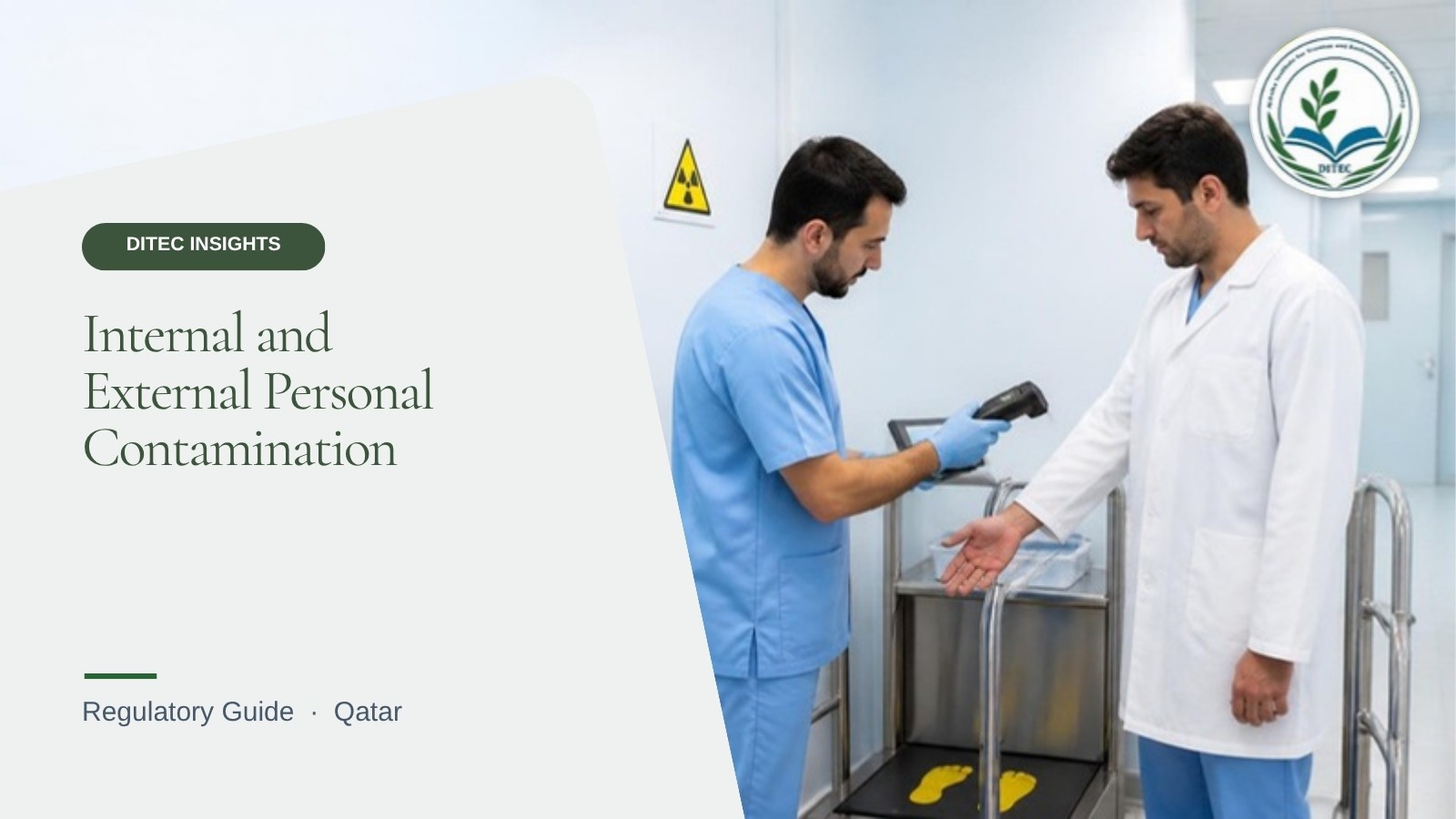
Who this page is for, and what it answers
The first thing article 5 of the instructions in decision 3 of 2007 requires when personal radioactive contamination occurs is a single question: is it internal or external? If it is internal, the duty is to notify the competent bodies immediately, which the instructions name as the medical committee for the treatment of radiation injuries. This page carries the regulatory duty and gives no first aid.
Four words are needed on this page. Personal contamination is contamination on a person rather than on a place. Internal contamination is what has entered the body. External contamination is what remains on its surface. And the medical committee for the treatment of radiation injuries is a body the instructions name in those words.
The page is for the radiation protection officer. It is for whoever writes the referral route in a facility plan. And it is for whoever reviews a plan and wants to know whether it names the body the instructions name.
Where this sits in the text: article 5 of the instructions attached to the decision, not of its two enacting articles. It has three clauses: identifying the state, then internal contamination, then external contamination.
The most important caution: this page is not first aid instruction. The article names measures applied to the body, and we explain no step of them and turn none into an act for the reader to carry out. What we render of them we render with the constraint the text attaches to it: under the supervision of specialists. We report the regulatory duty, who is notified, and when.
The number of sub-items is counted from the letters that order them in the text. Internal contamination has four sub-items, and external contamination has eight. We state the number and its place, and we do not reproduce the content of those that are action on the body.
The institute takes on no part of first aid, treatment or medical assessment, and that limit does not change with the question asked. All three belong to the medical bodies the instructions name.
The regulatory duties article 5 imposes
The first clause is a question rather than an action on the body: it provides that where personal radioactive contamination occurs, an effort must be made to find out whether the contamination is internal or external. So seeking to tell internal from external is the first duty. What follows is built on it.
If it is internal, notification is immediate: the opening of the clause provides that where internal radioactive contamination has occurred, the competent bodies, which the text identifies in brackets as the medical committee for the treatment of radiation injuries, must be notified immediately, and that first aid must be given to the injured by following the measures listed. The naming is the text's own, and the timing is immediate.
Internal contamination has four sub-items in the text, and most of them are measures applied to the body; we neither reproduce nor explain their content, and that is a guard of ours and not a gap in the text. The fourth sub-item, however, is a restriction on chemicals and medicines rather than a step on the body: it provides that chemicals or medicines are not to be used except on the advice of specialist physicians.
If it is external, there are eight sub-items, and the opening of the clause provides that where external radioactive contamination exists, the measures listed must be followed. Among them is an express prohibition rather than an action on the body: it provides that organic, acidic or alkaline solvents are not to be used. We carry that prohibition because it forbids rather than instructs.
In two of them what we rely on is the supervision qualifier and not the step itself. We neither explain them nor make them a step to follow. One provides that where necessary a full body wash is to be carried out under the supervision of a specialist, and the other that where the contamination does not come off with soap and water, suitable complex chemical agents are resorted to under the supervision of specialists. The qualifier in both is specialist supervision. So neither is read as an instruction to someone who is not a specialist.
The last external sub-item is a reporting duty rather than an action on the body: it provides that a report on the contamination incident must be submitted to the medical committee for radiation injuries, which the text identifies in brackets as the emergency department at Hamad Medical Corporation. We carry the name and what is bracketed with it as they appear, and add nothing to them. We publish no telephone number and no personal name.
What the article does not say here
The article states no numerical limit by which internal is told from external. It names no particular laboratory test. It states no period in hours. It states no report form and no notification channel. And it states no sanction for delay.
Why this page carries no first aid steps
First aid is a medical act on the body, and whoever reads a page is not necessarily a specialist. The text itself ties what touches the body to specialist supervision and to notifying a named medical body. Carrying the regulatory duty is faithful to the text, while explaining the step would go beyond our role.
What falls outside this article
Article 5 gives no numerical limit. It names no unit of radioactive activity and no area of surface over which a rate is worked out. The limits and their areas sit in other articles of the instructions, which have their own pages. Numbers from one place are not imported into another.
It does not deal with contamination in a place. An incident in the laboratory is another article, with its own page in this batch. A person is not judged by a rule written for a surface.
It does not deal with contaminated tools, surfaces, or clothing once removed. Those are other articles, belonging to a later batch in this series. We name them and do not quote them here.
The article does not mention the institute at all. The institute does not provide first aid, treatment or medical assessment, and that limit is constant across all our pages.
The places we have read in these instructions contain no penalty and no transition period. So it is not said that failing to notify carries a particular sanction. What we have not read, we do not judge.
The two states of personal contamination and what each requires
The table below sets the two states of contamination against what the text requires in each. These are regulatory duties, not first aid steps.
The table carries the regulatory duty and the named body alone. It carries no step applied to the body, and that is a deliberate guard. The number of sub-items is given by its place and not by its content.
The two states of personal contamination in article 5
| State | The regulatory duty | Named body and number of sub-items |
|---|---|---|
| Before classification | An effort must be made to find out whether the contamination is internal or external | The text names no body in this clause, which is a single clause |
| Internal contamination | The competent bodies must be notified immediately, and first aid must be given to the injured | The medical committee for the treatment of radiation injuries; the clause has four sub-items, and we do not reproduce what in them is action on the body |
| External contamination | The listed measures must be followed, among them a prohibition on organic, acidic or alkaline solvents, a qualifier of specialist supervision, and the submission of a report on the incident | The medical committee for radiation injuries, with the emergency department at Hamad Medical Corporation given in brackets in the text; the clause has eight sub-items |
A case of contamination on a worker's hand, and four steps
Suppose a laboratory worker whose hand shows contamination on a measurement taken after an experiment. The first clause requires an effort to tell internal from external before anything else. If what appears is external, the route followed is the eight external sub-items. Among those sub-items is the prohibition on organic, acidic or alkaline solvents. And among them is the submission of a report to the named body. The trigger for immediate notification in the wording of the text is the occurrence of internal radioactive contamination. And this is our reading: where it is a possibility, the safer course is to notify the body the instructions name at once. We do not write what is done to the body, since that is under the supervision of specialists and on the advice of specialist physicians. That is our reading of the order of the duty, and not a provision about any particular period.
Step one: make the first line in your route the question of internal or external. The first clause is that very question.
Step two: write into the route the name of the body as the instructions name it, and what they put in brackets with it. Do not put a telephone number or a personal name on a published page.
Step three: put the supervision qualifier on every line that involves action on the body. The text ties it to the words under the supervision of specialists, and to taking advice where chemicals or medicines are concerned.
Step four: make submitting the report a written item rather than a custom. The last external sub-item requires it in terms. The protection officer notifies, submits the report and writes it up: this is what we train on, not what we do for you.
Questions people ask
Can I tell internal from external by a reading on the skin?
The text states no method of distinguishing and no numerical limit. It requires instead that an effort be made to find out. We render that requirement in English and do not reproduce its wording. How it is found out is a point the text leaves open, and we have not put it to any authority. And this is our reading: a measurement on the skin shows what is on its surface and does not rule out that something has entered the body. The absence of contamination on the skin is therefore not a basis for ruling out internal contamination. Notification does not rest on a reading of the skin but on the occurrence of internal contamination, as the wording of the text has it.
Whom do I notify if the contamination is internal?
The text speaks of the competent bodies and names among them the medical committee for the treatment of radiation injuries. The timing is immediate. This is a duty to notify, not a first aid measure.
Do you set out the first aid steps on this page?
No. The text ties the measure applied to the body to specialist supervision, and we do not carry it onto a page read by a non-specialist. What we state here is who is notified and when. The institute does not provide first aid, treatment or medical assessment.
Do I submit a report in every case?
The last of the external sub-items requires a report on the contamination incident to be submitted to the named body. For internal contamination, the opening of its clause requires immediate notification. Each duty is stated in its own place.
Will the institute assess an injury to one of our workers?
No. Our work is training and consulting. The institute does not provide first aid, treatment or medical assessment, and does not run laboratory analysis. Assessment belongs to the named medical bodies, through specialist partners where needed.
Notes on transcription and reading
Article 5 is sound in transcription, containing no symbol and no figure whose reading is in doubt. What is withheld on this page is withheld in publication rather than in reading: the text is clear to us, and we decline to reproduce those parts of it that are action on the body. That is a decision of ours and we declare it. A note on the committee's name: the second clause calls it the medical committee for the treatment of radiation injuries, and the end of the third clause calls it the medical committee for radiation injuries. We give both namings as the instructions give them. Whether the two namings are one body is a point the text leaves open, and we have not raised it with the competent authority.
What we carry from the sub-items falls into three kinds: an express prohibition, a supervision qualifier, and a reporting duty. All three forbid or refer, and none teaches a step. Whatever is a step applied to an airway or to a wound is left where it sits in the decision.
A point the text leaves open: the first clause does not say who decides whether the contamination is internal or external. Whether the protection officer decides or the medical body does, it does not say. We have not raised it with the competent authority, so no view of theirs is reported here.
What the institute offers, its limits, and the reference
This page is about internal and external personal contamination and the notification and reporting the instructions require. The institute trains people to write the referral route and to document it.
ALDuha Institute for Training and Environmental Consulting works in training and consulting. Its training is licensed. It does not run a laboratory analysis service for smears. It does not calibrate radiation survey instruments. It does not test equipment or certify it as safe. It does not carry out decontamination in a laboratory or on a site.
The institute does not provide first aid, treatment or medical assessment. First aid and treatment belong to the medical bodies the instructions name. We train people to know who is notified and when, and to write down what happened.
Surveying and decontamination are the work of the licence holder and his radiation protection officer. Where outside expertise is needed, it is arranged through specialist partners. We train people to read, measure and document. We do not do the work in place of the licence holder.
Neither our training nor our consulting gives any undertaking that a licence will be issued. There is no undertaking about how long an approval will take. That decision belongs to the competent authority alone.
Reference: decision 3 of 2007 of the chairman of the Supreme Council for the Environment and Natural Reserves, on radioactive decontamination instructions. Location: article 5 of the attached instructions, with its three clauses. The decision rests on decree law 31 of 2002, and on the executive regulation issued by decision 4 of 2003. The decision's own preamble points in particular to article 17 of the first and article 97 of the second. We name the two enabling instruments and carry the preamble's reference to them, and we do not quote their text.
A note on the names of authorities: the decision was issued by the Supreme Council for the Environment and Natural Reserves. The authority addressed today is the Ministry of Environment and Climate Change, which houses the Radiation Protection Department. The name changed and the duty stands.
This page is an introductory explanation of a published text, and is not a legal opinion. It does not replace reading the decision itself. It does not replace checking with the competent authority.
In this article
Related Blog
Explore more articles in Medical Radiation Safety
October 11, 2026
Diagnostic Radiation Protection Officer in Qatar: Four Conditions, Two Lines
Part (a) of medical entry 10 in Decision 4 of 2007 licenses the diagnostic radiation protection officer in Qatar on four conditions, and ties the course and the experience to the field.
Read more
October 11, 2026
Nuclear Medicine Radiation Protection Officer in Qatar: An Unsealed Source
Part (c) of medical entry 10 in Decision 4 of 2007 licenses the nuclear medicine radiation protection officer in Qatar on four conditions, and its source is unsealed.
Read more
October 11, 2026
Small Institutions in Qatar: Two Routes to the Radiation Officer Licence
Medical entry 11 of Decision 4 of 2007 licenses the radiation protection officer at small institutions in Qatar by two routes, and says nothing about being full time.
Read more