
Occupational Dose Limits and Worker Monitoring in Qatar
 September 15, 2026
 7 min read
 DITEC Experts, Radiation Protection Team, ALDuha Institute for Training and Environmental Consulting
Who is a radiation worker?
A radiation worker is any person who, because of their job, may receive a dose above the limit set for members of the public. That definition is deliberately about the job, not about the job title: a radiographer, a maintenance technician who opens a gauge housing, a driver who transports sealed sources and a nurse who holds patients during fluoroscopy can all fall inside it.
Classifying staff correctly is the first thing an inspector checks, because everything else — monitoring, training, medical surveillance and records — follows from it. Under-classifying a worker to avoid the paperwork is the single most common finding in facilities that have never been inspected before.
The dose limits
Qatar's radiation protection framework — Law No. 31 of 2002 and its executive regulation — is built on the international system of dose limitation published by the International Commission on Radiological Protection and given effect in the IAEA Basic Safety Standards (GSR Part 3). The values below are that international basis, and they are the values facilities are normally assessed against.
A limit is not a target
The limit is the line that must not be crossed. The number a facility actually manages against is the dose constraint it sets for itself, which is lower, and the principle of optimisation requires doses to be kept as low as reasonably achievable below it. A department whose staff sit consistently just under the limit does not have a compliant programme; it has a warning.
The binding values are the national ones
The values above are the international basis. The values that bind a licensee in Qatar are those stated in the executive regulation and in the conditions written on the facility's own licence, and those are what should be quoted in the facility's radiation protection programme.
Dose limits (international basis)
| Exposed person | Quantity | Limit |
|---|---|---|
| Worker | Effective dose | 20 mSv per year averaged over five consecutive years, and no more than 50 mSv in any single year |
| Worker | Lens of the eye | 20 mSv per year averaged over five consecutive years, and no more than 50 mSv in any single year |
| Worker | Skin, hands and feet | 500 mSv per year |
| Trainee aged 16 to 18 | Effective dose | 6 mSv per year |
| Member of the public | Effective dose | 1 mSv per year |
Personal monitoring in practice
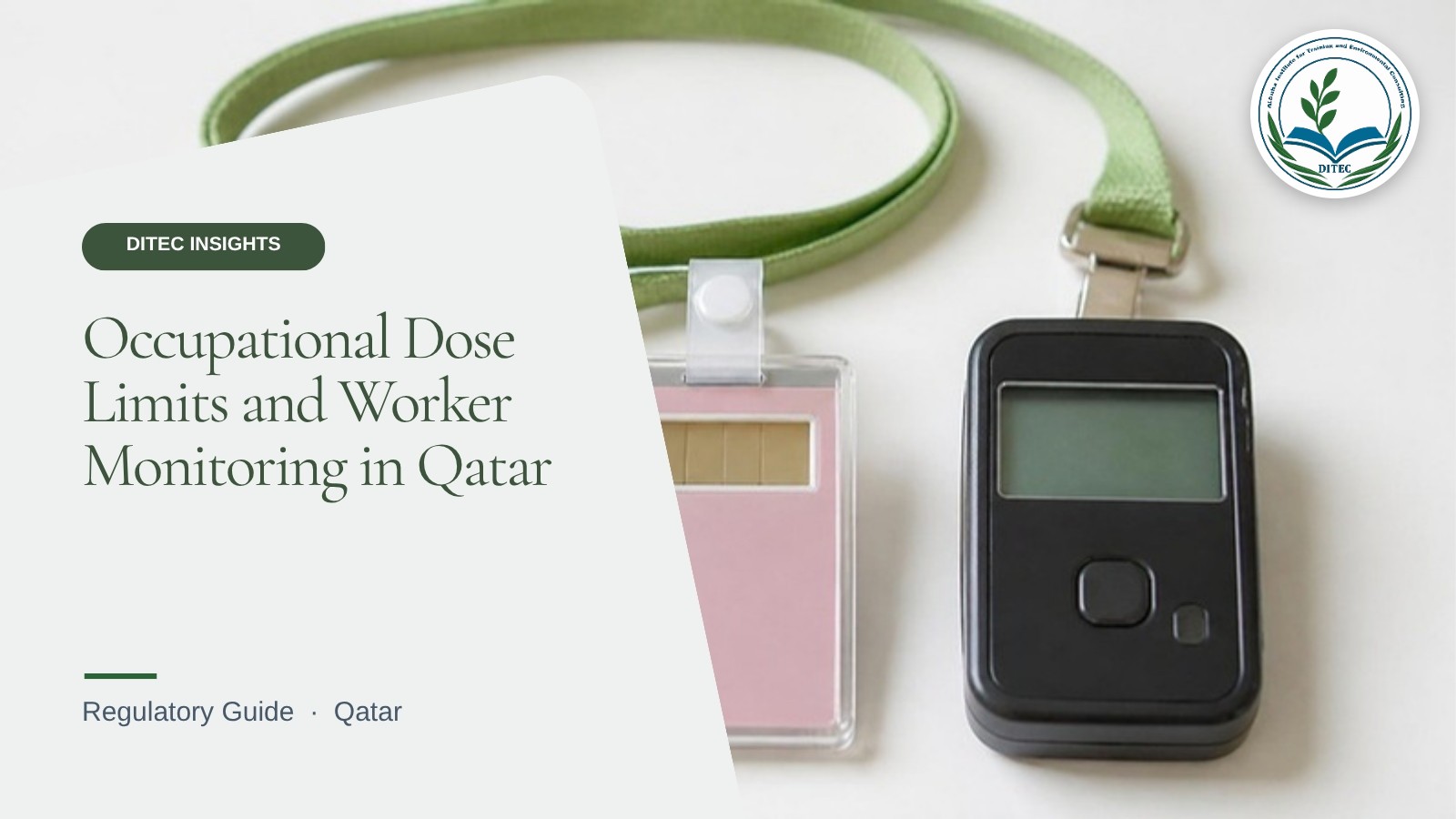
Personal monitoring in the region is done almost entirely with passive dosimeters: thermoluminescent (TLD) or optically stimulated luminescence (OSL) badges issued by an approved dosimetry service, exchanged on a fixed cycle — usually monthly or quarterly — and read by that service, which issues the dose record.
The badge only tells the truth if it is worn correctly, and this is where most facilities lose data. The whole-body badge is worn on the trunk, at chest or waist level, under the apron when a lead apron is used. In interventional work a second dosimeter is worn outside the apron at collar level, so that the dose to the head, neck and eye lens is actually measured rather than guessed.
Rules that keep the record usable
- One badge per named person — badges are never shared, swapped or left in a drawer.
- The badge stays at work: it is not taken home and never left in a car in the sun.
- A badge is never deliberately exposed to test it — that ruins the worker's record for the whole period.
- Badges are returned on time; a late badge means an unreported period, and an unreported period is a finding.
- A lost or damaged badge is reported immediately so the dose for that period can be assessed rather than left blank.
What the facility must do
Dosimetry is a service a facility buys; a radiation protection programme is something it runs. The programme is what an inspection actually examines, and five elements carry most of the weight.

Frequently asked questions
Does a lead apron remove the need for a dosimeter?
No. The apron reduces the dose; the dosimeter measures what is left, and it is the measurement that goes into the worker's record. An apron also leaves the head, neck and eye lens unprotected, which is exactly why a collar dosimeter is used in interventional work.
What happens if a reading comes back high?
A high reading is investigated, not filed. The facility establishes whether it reflects a real exposure or a handling error such as a badge left near a source, documents the finding and corrects the cause. Reportable levels are notified to the regulator within the timeframe set in the licence conditions.
How long must dose records be kept?
Occupational dose records are long-term records, kept for decades beyond the end of employment so that a worker's lifetime exposure can be reconstructed. They are not disposed of when a contract ends, and a copy is provided to the worker on request.
Do we need dosimeters for a nuclear gauge crew?
Yes. Field crews using portable density or moisture gauges are occupationally exposed workers: they handle the source rod, work close to the gauge and transport it. They need personal monitoring, training and a survey meter with them, not only the gauge's own indicator.
Training the people the programme depends on
Every element above depends on a person who knows what to do with it. ALDuha Institute for Training and Environmental Consulting delivers licensed radiation protection training in Qatar for radiation protection officers, medical and industrial users, nuclear gauge operators and drivers transporting radioactive material, and advises facilities on building the programme those people will run.