
Industrial Radiography: Site Requirements and Barrier Control
 September 16, 2026
 9 min read
 DITEC Experts, Radiation Protection Team, ALDuha Institute for Training and Environmental Consulting
Two very different jobs
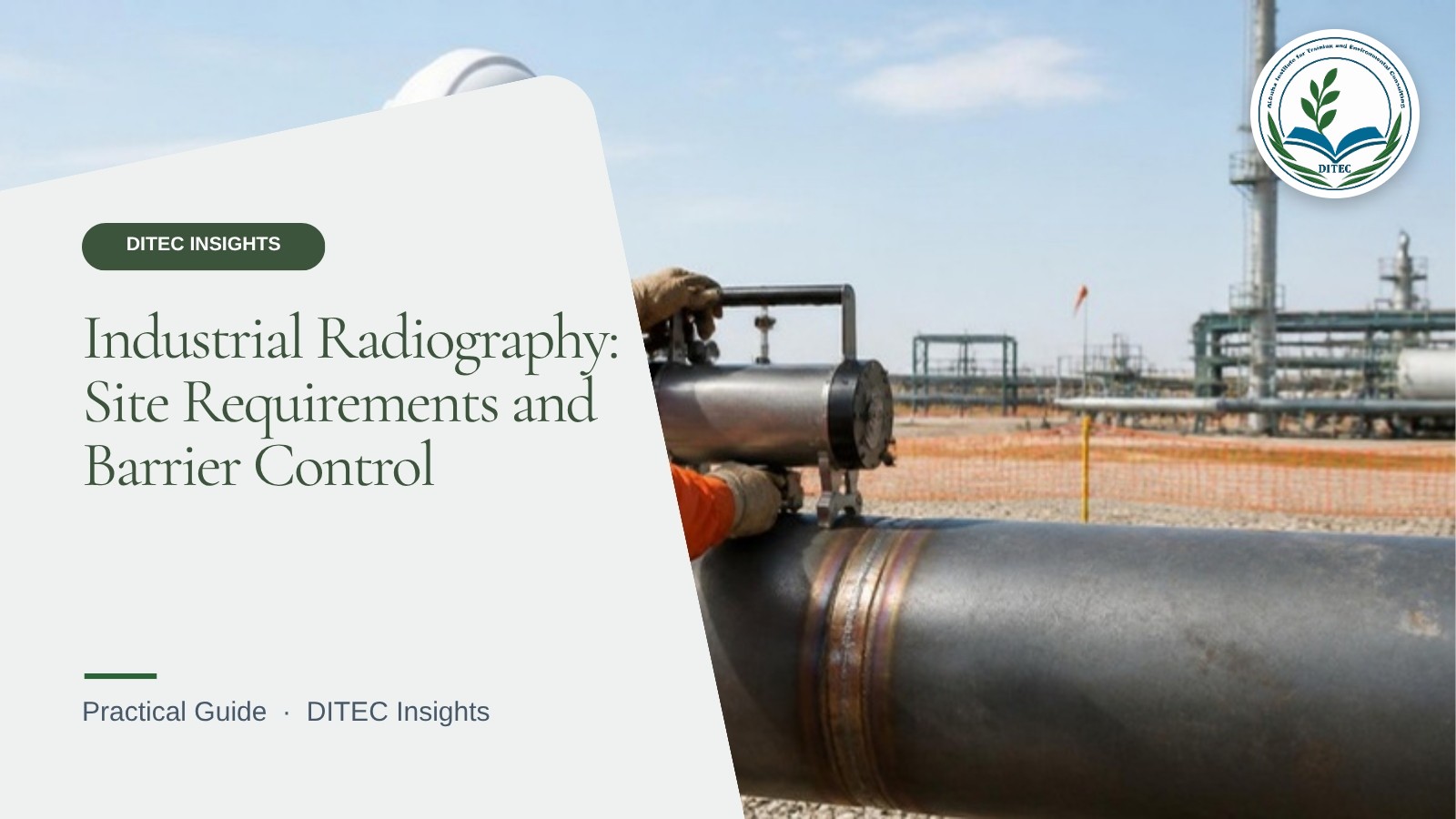
Industrial radiography is carried out in one of two ways, and the difference between them decides almost everything about how it is controlled. In enclosure radiography the work happens inside a purpose-built shielded room with interlocks, warning lights and a designed barrier. In site radiography the source is taken to the pipe, the vessel or the weld, and the protection has to be created on the spot, by distance and by control of people.
Site radiography carries the higher risk, and not because the sources are stronger. It carries it because the barrier is a line drawn on the ground by a crew working at night, under pressure, in a plant full of other people who did not come to work thinking about radiation.
The barrier is a calculation, not a habit
The most common failure in site radiography is a cordon distance carried over from the last job. The distance depends on the source and its activity today, on whether a collimator is used and in which direction the beam is pointed, on the structure that happens to be in the way, and on the dose rate the regulator sets for the boundary in the licence conditions.
Activity falls with time, so a barrier calculated for a fresh source is conservative months later — but the reverse mistake, reusing a distance set for a weaker source or a different geometry, puts people inside the controlled area without knowing it. The calculation is quick; skipping it is what takes time to explain afterwards.
What the boundary needs, every single time
- A distance derived from the actual source activity and geometry for that exposure, not from memory.
- A physical barrier — tape, barriers, cones — that a person walking normally cannot cross without noticing.
- Warning signs in Arabic and English, and warning lights when the exposure is live.
- A person watching each approach route that cannot be seen from the control position.
- A survey of the boundary with a calibrated meter after the first exposure, confirming the calculation on the ground.
Equipment that must be present — not back at base

Who is responsible: the plant or the NDT contractor?
Both, in different ways, and the confusion between them is where accidents live. The NDT contractor holds the source licence, employs the radiographers, and is responsible for the safe conduct of the exposure. The host facility controls the site: access, permits, the presence of other trades, and the decision to allow radiography at a time when the area can genuinely be cleared.
A host facility that issues a permit to work at a time when three other crews are working in the same area has not transferred its responsibility by hiring a licensed contractor. The safest arrangement in operating plants is radiography during a window when the area is closed, written into the permit rather than agreed verbally.
The source that does not come back
A source that fails to return to its shielded position inside the exposure device is the defining emergency of this trade. It is also the scenario in which the instinct to fix the problem by hand has caused the most serious injuries in radiography worldwide.
The correct response is the opposite of the instinct: stop, withdraw, extend the barrier outward rather than approach, confirm the situation with the survey meter from a distance, and call the emergency arrangements into effect. Recovery is done by trained people with a plan and shielding, and never by the crew improvising with the tools in the truck.
Frequently asked questions
Can radiography be done during normal plant operations?
It can, but only if the controlled area can genuinely be held clear for the duration of each exposure. In practice this is why most plants schedule radiography at night or during shutdowns: it is far easier to clear an area than to guard one.
Does a lower-activity source remove the need for a barrier?
No. A weaker source moves the boundary closer; it does not remove it. The barrier is set wherever the calculated dose rate reaches the value specified for the boundary, and that point exists for every source.
Who may enter the controlled area during an exposure?
Nobody. Not a supervisor, not the client's inspector, not a photographer. The area is cleared before the exposure begins and stays clear until a survey confirms the source is back in its shielded position.
What should a host facility ask an NDT contractor for?
The source licence and its validity, the radiographers' training and dosimetry records, the survey meter's calibration certificate, the emergency procedure, and the barrier calculation for the specific job. A contractor who cannot produce these on request is a risk the facility carries, not one it has transferred.
Training and consulting
ALDuha Institute for Training and Environmental Consulting trains radiation protection officers and radiography personnel in Qatar, prepares shielding assessments and licensing files for radiography enclosures and source stores, and reviews the radiation protection arrangements a host facility should require from its NDT contractors.