
Individual Monitoring in Qatar: Who Must Wear a Dosimeter
 September 21, 2026
 8 min read
 DITEC Experts, Radiation Protection Team, ALDuha Institute for Training and Environmental Consulting
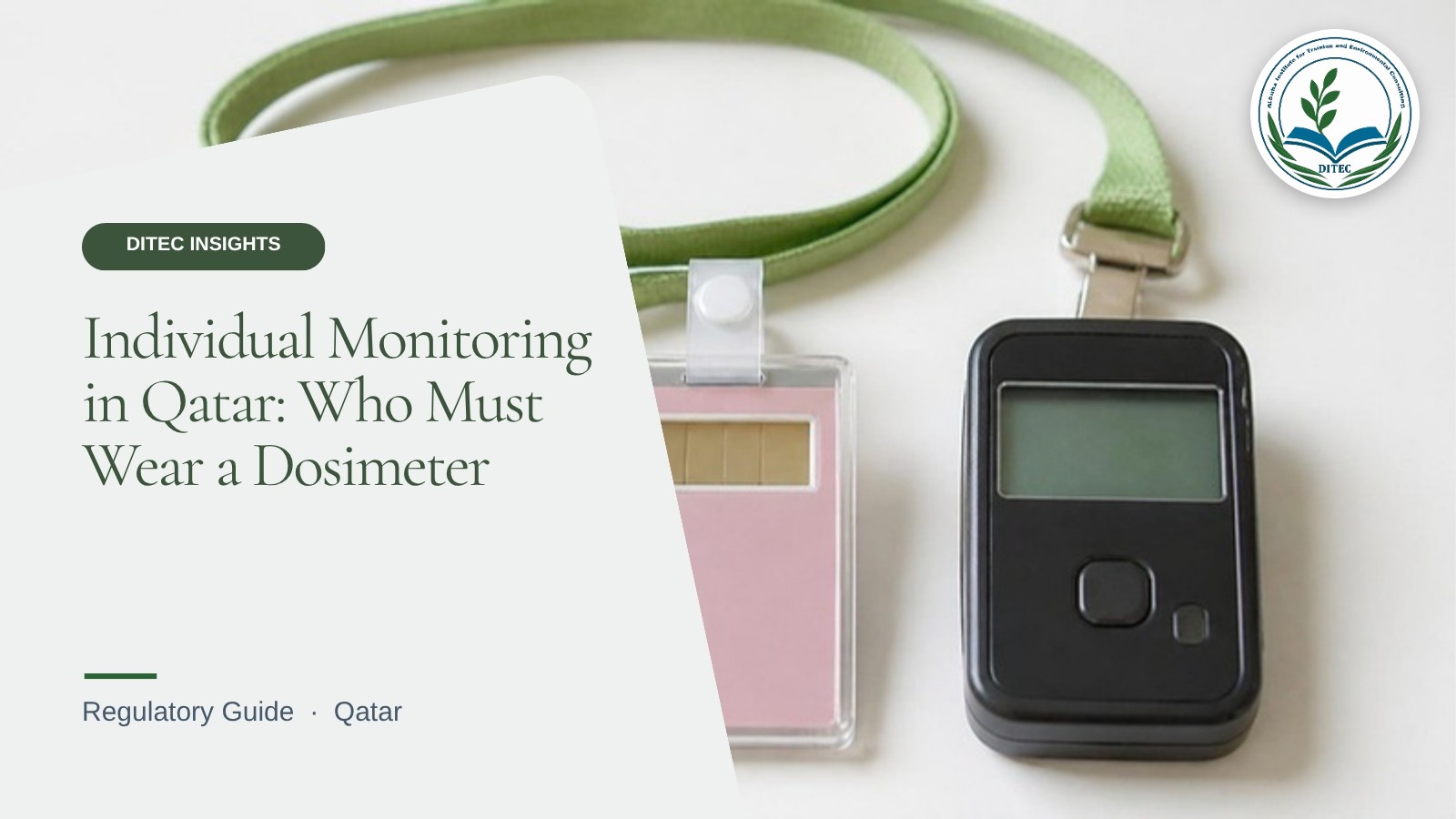
Who must be individually monitored
Article 37 answers it in one sentence: individual monitoring is carried out for every worker who normally works in a controlled area. The test is where the person normally works - not their job title, and not what their dosimeter read last month.
For supervised areas the Regulation gives a choice rather than a rule: the assessment in a supervised area may rely on the results of workplace monitoring or on individual monitoring. Personal dosimeters there are one permitted method. The assessment itself is not optional - only the way it is done.
Four things the licensee and the officer must make sure of
Article 33 is addressed jointly to the licensees and the radiation protection officers, and it is written as four checks rather than one. Issuing dosimeters meets the first.
Article 33 - the four checks
| The check | Where it usually fails |
|---|---|
| Every worker in a controlled area carries a dosimeter, such as a badge, a film or another type | Contractors and short-term staff who enter the area without being on the dosimetry list |
| Every worker keeps it in serviceable condition | Dosimeters left in vehicles or near sources between shifts, which records dose the worker never received |
| Every worker is trained to use it, and to place it in the right position and in the right way | Worn wherever each worker prefers - sometimes under a lead apron, sometimes over it, sometimes on a belt - because the site never wrote down where |
| Readings taken at fixed intervals and on a periodic basis, and recorded | Reports received from the dosimetry service but never entered against each worker |
The Regulation does not choose the technology
Article 33 names examples and then leaves the list open - badges, films or others. Film, thermoluminescent (TLD), optically stimulated (OSL) and electronic dosimeters are all inside that wording.
What the Regulation does fix is the quality of the service behind the device. Article 37 requires the licensee to make arrangements with the qualified and competent dosimetry bodies under a suitable quality control programme, and requires quality assurance of the radiation monitoring measurements and periodic calibration of the equipment used. The question to ask a dosimetry provider is therefore not which technology it uses, but what its quality programme and calibration record look like.
How the technologies differ in practice is covered in the Institute's separate article on TLD, OSL and electronic dosimeters.
How often - the text ties it to the exposure, not the calendar
Neither article fixes a reading interval. Article 33 requires readings at fixed intervals and on a periodic basis, and Article 37 says what the interval must answer to: the nature and frequency of the radiation monitoring must match the assessment of the exposure levels and the changes those values may undergo.
Two words carry the rule. Fixed - the interval is set and written down, not whenever the badges happen to be collected. And the changes those values may undergo - a site whose exposure can change quickly, such as industrial radiography in the field, needs a shorter interval than a fixed gauge whose readings barely move.
What a badge cannot measure
A dosimeter worn on the chest measures radiation arriving from outside the body. It records nothing that has been inhaled or swallowed. Article 37 closes that gap explicitly: the licensee must identify the workers who may be subject to internal contamination, and provide them with the appropriate monitoring, so as to achieve effective protection and a correct assessment of the internal exposure doses.
The duty has two steps, and the first is the one usually skipped: identifying who could be exposed internally at all. In Qatar that list typically includes work with unsealed sources in nuclear medicine and laboratories, and NORM work in oil and gas where scale and sludge are handled. A facility of that kind with a badge programme and nothing else has met Article 33 and not Article 37.
Frequently asked questions
Does every radiation worker need a personal dosimeter?
Every worker who normally works in a controlled area, under Article 37, and every worker in a controlled area under Article 33. In a supervised area, Article 37 allows the assessment to rest on workplace monitoring or on individual monitoring - a personal dosimeter is permitted there, not required.
Does the Regulation require TLD, OSL or electronic dosimeters?
None of them by name. Article 33 speaks of badges, films or others, which covers all of them. What Article 37 does require is that dosimetry is arranged with qualified services under a suitable quality control programme, with periodic calibration.
How often must dosimeters be read?
The Regulation does not fix a number. Article 33 requires readings at fixed intervals and on a periodic basis, and Article 37 requires the frequency to match the exposure levels and how quickly they can change. The interval is the licensee's to set, to justify and to write down.
Our dosimeters read zero every month. Can we stop issuing them?
Not while the workers normally work in a controlled area: Article 37 ties the obligation to where they work, not to what they record. A run of zero readings is evidence that the controls work. If the readings say the area no longer meets the controlled-area threshold, the route is to review the classification under Article 26 - and the monitoring follows the new classification.
How the Institute can help
Most dosimetry programmes are sound at the point of issue and weak at the point of record: badges go out, reports come back, and the reading never reaches the worker's file.
ALDuha Institute advises on setting up individual monitoring that meets Articles 33 and 37 - who goes on the list, the reading interval and its justification, what to ask a dosimetry provider, and where internal monitoring is needed - and trains workers and radiation protection officers to run it.
Scope of what the Institute does: training and consulting. Field radiation surveys are carried out through specialist partners working in the field. The Institute does not carry out laboratory analysis, instrument calibration or equipment testing.
This explanation is published for awareness by the radiation protection team at ALDuha Institute for Training and Environmental Consulting. The English text is an explanation, not a certified translation: the Arabic text published in the Official Gazette governs in case of any difference, and this article does not replace the official text or advice from the competent authority. Last updated 21 September 2026.