
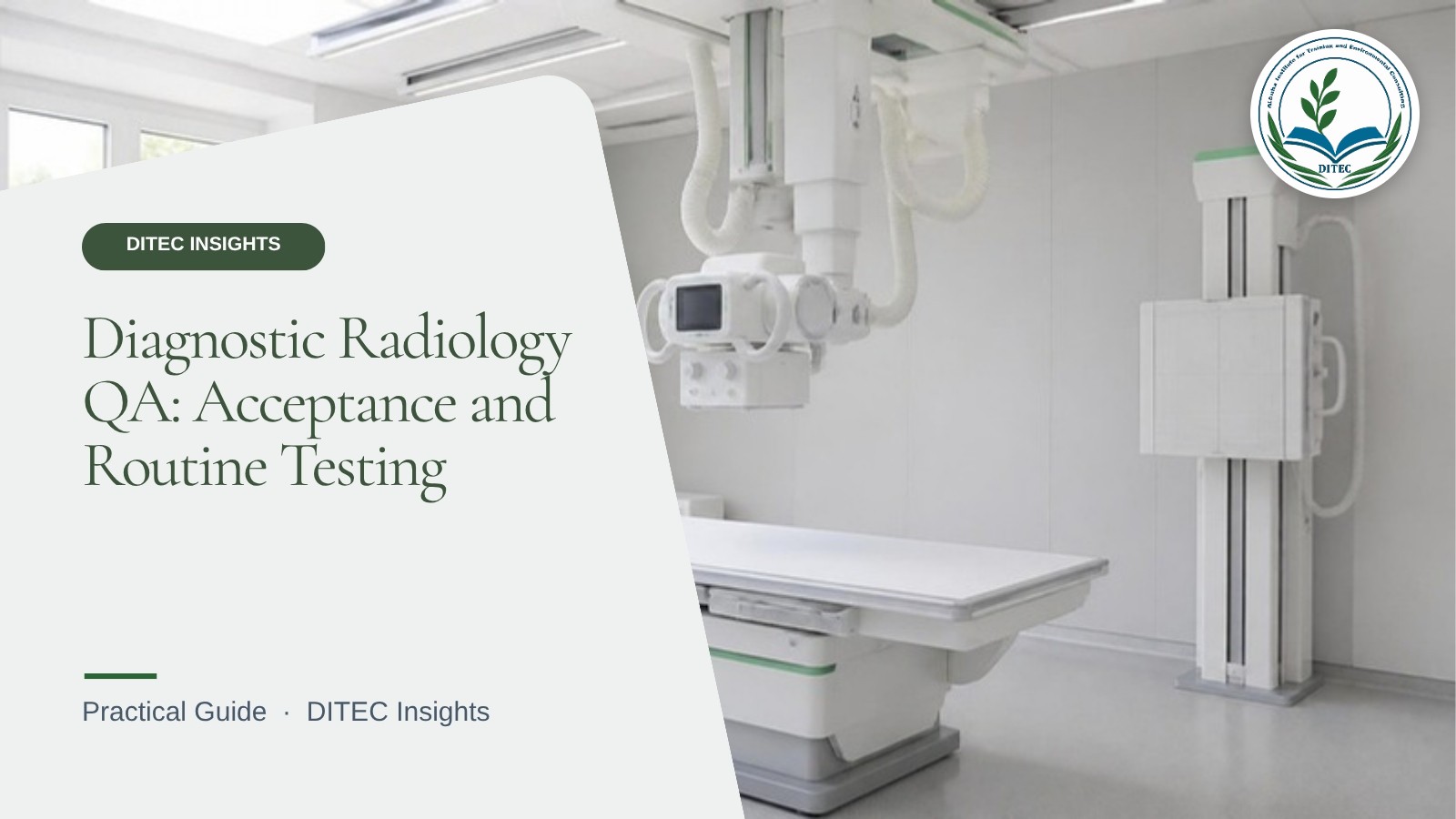
Diagnostic Radiology QA: Acceptance and Routine Testing
 September 17, 2026
 8 min read
 DITEC Experts, Radiation Protection Team, ALDuha Institute for Training and Environmental Consulting
Why QA exists at all
An X-ray unit that is out of calibration does not stop working. It keeps producing images, and the department keeps reading them — while delivering more dose than necessary, or producing images poor enough that examinations get repeated. Both failures are invisible from the console.
Quality assurance is the programme that makes them visible: a defined set of measurements, at defined intervals, against defined tolerances, documented so that a drift is caught as a trend rather than discovered as a complaint.
Three tests that people confuse
Skipping acceptance testing is the most expensive shortcut of the three. Without a baseline, a periodic test years later can only say the unit is within a generic tolerance — it cannot say whether the unit has drifted, and the moment to reject a newly installed machine has passed.
| Test | When | What it answers |
|---|---|---|
| Acceptance | Before the unit is used clinically, after installation | Does the equipment meet the manufacturer's specification and the regulatory requirements? It also sets the baseline values everything later is compared against. |
| Performance / periodic | At set intervals and after major repairs | Is the unit still performing within tolerance of that baseline? |
| Constancy / status | Frequently — often by the department's own staff | Has anything changed since the last check? Quick, simple, and the early-warning layer. |
What is actually measured
Typical measurements on a radiographic unit
- Tube potential accuracy and reproducibility — is the kV that is set the kV that is delivered, every time.
- Output, its linearity with tube current and its reproducibility between identical exposures.
- Beam quality expressed as half-value layer, which governs how much of the beam reaches the patient's skin as dose without contributing to the image.
- Beam alignment and collimation — whether the radiation field matches the light field and the receptor.
- Automatic exposure control performance across thicknesses.
- Image receptor performance, and for CT the dose indices alongside image quality.
- Reporting display performance — a correct image reported on an uncalibrated monitor is still a diagnostic risk.
Who signs it, and what the report must say
QA measurements are made and interpreted under the responsibility of a qualified medical physicist, and the signature is not a formality: it is the statement that the measurements were made correctly, with traceable instruments, and interpreted against the right tolerances.
A usable report identifies the unit and the room, lists the instruments used and their calibration status, states each measured value beside its tolerance and a clear pass or fail, records the baseline for comparison, and ends with corrective actions that name who does what by when. A report that stops at a table of numbers leaves the department exactly where it started.
Frequently asked questions
The supplier tested the unit at installation. Is that acceptance testing?
A supplier's commissioning check confirms the machine works as sold. Acceptance testing is an independent verification against specification and regulatory requirements, done for the facility rather than for the vendor, and it is the version that establishes the baseline.
How often should periodic testing be done?
At the interval set in the licence conditions and national requirements, and additionally after any major repair or tube replacement. Constancy checks are far more frequent and are carried out by the department itself between the formal tests.
Does QA reduce patient dose?
It is one of the few things that reliably does, in two ways: by keeping output and beam quality correct so each exposure delivers what it should, and by keeping image quality good enough that examinations are not repeated. A repeated examination is a doubled dose for no diagnostic gain.
Is QA the same as the radiation licence?
No, but they meet. The licence is permission to operate; QA is evidence that what is being operated performs as it should. Test reports are among the documents a regulator expects to see when the licence is inspected or renewed.
Training and consulting
ALDuha Institute for Training and Environmental Consulting advises medical facilities in Qatar on establishing a quality assurance programme — what to test, how often, what the reports should contain and how to act on them — and trains the staff who run the constancy checks between formal tests.